

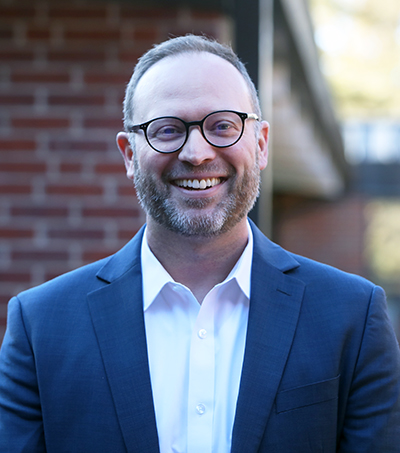
Guest column by Jeremy Ekeler
Chief administrative officer, Pius X High School in Lincoln
In July 2025, I officially began serving as chief administrative officer at Pius X High School in Lincoln. After 25 years in Catholic education—as a teacher, coach, volunteer, sponsor, principal, lobbyist, and consultant—I arrived with a wide range of experiences. Anyone who has worked in the Church knows that wearing many hats is not the exception but the norm, and nowhere is that more true than in Catholic education.
 I have loved the study of the history of Catholic education in America. It is a story marked by immigration and sacrifice, discrimination and perseverance, assimilation—both its blessings and its costs—and a persistent desire to build lives centered on Christ. Sadly, it is also about hurt and self-inflicted wounds that the faithful both carry and rise above.
Many of us need only look a generation or two back to find relatives who helped found parishes and schools. In my own family, that legacy includes a great-aunt, Sister Clothaire, who served in the rough neighborhoods of south Chicago, and a great-uncle, Monsignor John Ekeler, who played a role in early efforts to establish this diocese south of the Platte.
As I prepared to begin at Pius X, I asked Father Mark Cyza a simple question: How do I bring all of this together—my love for Catholic education, my study of its history, and my professional life in service to its mission?
His answer was just as simple: “Listen.”
So for my first 100 days, I did exactly that. I listened—intentionally and attentively—through hundreds of conversations, meetings, phone calls, and emails. Clear patterns emerged. Because of my work with Catholic schools across the Midwest, I was able to view those patterns both locally—how they affect Pius X—and more broadly, as reflections of the current state of Catholic education.
What follows is a synthesis of those observations. While many readers may approach this through the lens of Pius X and the Thunderbolts, my hope is that others will recognize themes that resonate far beyond one school—and perhaps even beyond one diocese.
A deeply rooted mission—and the call to integration
One of the most encouraging realities I encountered at Pius X is a deep pride in Catholic identity. Families choose Catholic education not simply for academic outcomes or extracurricular success, but because they desire formation—formation of mind, heart, and soul. Participation in retreats, liturgies, and campus ministry is at an all-time high, reflecting a genuine hunger for faith.
Yet Catholic educators across the country recognize a familiar challenge: participation does not always translate into integration. Students may pray together in the chapel but struggle to live charity, discipline, and reverence in hallways, classrooms, or athletic events. The task before Catholic schools is not merely to offer spiritual experiences, but to form habits of virtue—habits that shape how students treat one another, respect authority, care for shared spaces, and engage the wider world.
This challenge is intensified by a culture that is increasingly polarized and politicized. As Pope Benedict XVI reminded us, the Church is not a political party, but a moral witness. Catholic schools must help young people navigate complex social questions through the lens of Catholic social teaching, forming consciences rather than slogans. This is demanding work, but it is essential if our graduates are to become authentic Catholic leaders rather than well-intentioned but fragmented adults.
Community as a gift—and a responsibility
Ask almost any Catholic school graduate why they loved their school, and you will likely hear the same answer: “the community.” At Pius X, this is undeniably true. High levels of student participation in athletics, arts, and activities foster belonging, accountability, and pride. Summer camps and middle-school outreach programs are often the first places families experience that sense of welcome.
At the same time, community does not happen automatically for everyone. Students who are lightly engaged—or not engaged at all—are often the ones who struggle most with attendance, discipline, and connection. Catholic education, at its best, refuses to accept anonymity. Every student must be known, invited, and challenged to belong.
This principle extends to families as well. Newcomers, non-Catholics, and young families sometimes struggle to understand how to “plug in” to an established Catholic school culture. Intentional welcome, clear communication, and personal accompaniment are not optional extras; they are evangelical acts. If Catholic schools are truly for all who seek them, we must be transparent about who we are, while generous in how we receive others.
Excellence requires structure, not just goodwill
Catholic schools are blessed with extraordinary faculty and staff—men and women who serve not for prestige, but for mission. At Pius X, I encountered dedicated educators who care deeply about students and take pride in academic rigor and co-curricular excellence. This mirrors what I have seen across Catholic education: commitment is rarely the problem.
What often is lacking is structure. Clear and consistent systems for tuition management, discipline, communication, professional formation, and financial oversight are not signs of bureaucracy; they are expressions of justice. When processes are inconsistent or unclear, trust erodes and mission suffers. Conversely, when expectations are transparent and fairly applied, communities flourish.
This is particularly true in matters of discipline and attendance. Data-driven approaches that emphasize support and accountability—rather than punishment alone—help schools address root causes while maintaining high standards. Excellence, after all, is not opposed to mercy; it depends on it.
The question of sustainability
Perhaps the most pressing challenge facing Catholic secondary education today is sustainability. Aging facilities, rising operational costs, flat parish contributions, and increasing competition place real strain on schools. Many Catholic high schools operate with admirable efficiency but little margin for error.
This reality calls for courage and collaboration. Long-term sustainability requires honest conversations about funding models, enrollment strategies, school choice as a matter of justice, and stewardship. It also requires strong partnerships among schools, parishes, foundations, and diocesan leadership. Silos—whether financial, organizational, or relational—undermine the very unity we proclaim.
At the same time, generosity remains a hallmark of the Catholic community. When mission is clear and leadership is transparent, people respond. Campaigns that invest in both excellence and accessibility remind us that Catholic education is not a private good, but a ministry of the Church.
Hope rooted in Christ
After 100 days, my overwhelming conviction is one of hope. Catholic education is not in decline because it has lost its purpose; it is being purified to rediscover it. Families are still seeking formation, students are still longing for belonging, and educators are still willing to give generously of themselves.
The task before us is integration—integrating faith into daily life, community into every corner of the school, and excellence into systems that endure. If we remain rooted in Christ and united with one another, Catholic schools will continue to form not only successful graduates, but saints in the making.
In the One, we are one. And in that unity, Catholic education finds both its challenge and its promise.
