

By Cathy Blankenau Bender
Editor-in-chief
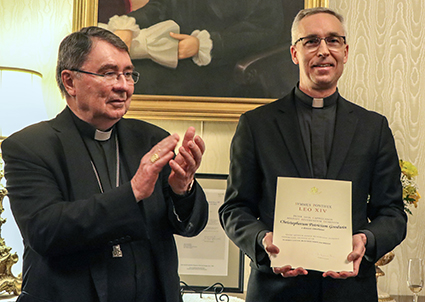
Pope Leo XIV named Father Christopher Goodwin, a priest of the Diocese of Lincoln, a “Chaplain of His Holiness” and conferred upon him the title of “Monsignor,” in recognition of his service to the Holy See.
The announcement was made Jan. 30 after the 80th birthday celebration for Cardinal Christophe Pierre, apostolic nuncio to the United States since 2016, for whom Msgr. Goodwin has served since 2023. The apostolic nuncio—nuncio means “messenger”—is the personal representative of the pope in the United States.
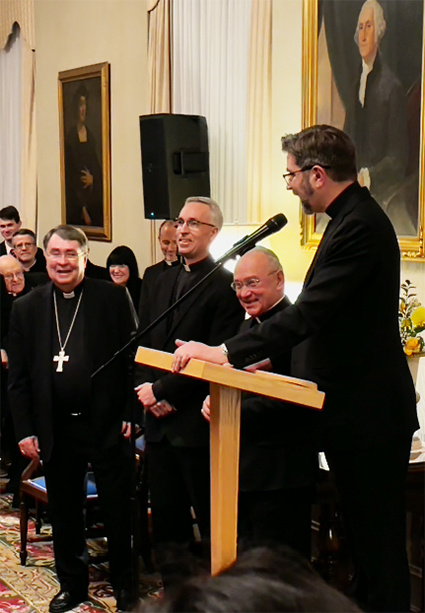
More than 200 people attended the reception, which gave bishops, clergy, religious, lay faithful, diplomats, and friends of the nunciature an opportunity to thank Cardinal Pierre and wish him well as he prepares to conclude his service as nuncio. Among the attendees was Archbishop Edgar Peña Parra, who serves as the Sostituto (substitute) of the Secretariat of State—essentially, the pope’s chief of staff, responsible for overseeing the day-to-day administration of the Vatican.
Bishop James Conley, who was present for the announcement in Washington, D.C., said the honor bestowed upon Msgr. Christopher Goodwin by the Holy Father is a tribute to Msgr. Goodwin’s dedication and fidelity to the Universal Church, and his loyal service to the Vatican Embassy in the United States.
“It is also a great honor for the Diocese of Lincoln to have ‘one of our own’ serving the Holy Father at such a high level, and a recognition by the Holy See of our solidarity with the See of Peter,” Bishop Conley said.
Msgr. Goodwin was ordained in 2004 and has served in diocesan parishes, schools and administration. He was assigned to the apostolic nuncio in Washington, D.C. in 2014-2018 and in 2023.
Before 1968, there were as many as 14 different types of monsignors. Pope Paul VI 1968 reduced the number of types of monsignors to three: Chaplain of His Holiness, Honorary Prelate and Protonotary Apostolic. In 2014, Pope Francis announced he was limiting the pool of possible candidates for the title of monsignor to priests in the Holy See’s diplomatic corps and those who serve at least five years in the Vatican, in addition to diocesan priests who are at least 65 years old.
Msgr. Većeslav Tumir made the announcement Jan. 30. He is one of several priests on staff at the apostolic nunciature in Washington who, along with the nuncio, are members of the Holy See’s diplomatic service – as is Msgr. Richard Gyhra of the Diocese of Lincoln. Msgr. Tumir’s title is “First Counselor,” the nuncio’s deputy. When the nuncio is out of the country, Msgr. Tumir oversees the daily work of the nunciature.
Msgr. Tumir said Msgr. Goodwin “has carried out his responsibilities with exceptional diligence, discretion and pastoral commitment to the service of the Holy See.”
“As a little sign of appreciation,” he continued, “Msgr. Goodwin has been appointed ‘Chaplain of His Holiness.’”
As the crowd applauded, the nuncio said: “So now you can call him Msgr. Goodwin!”
The announcement was the last of four papal honors bestowed that evening for members of the nunciature staff. The other honorees were Brother Joseph Britt, CFX, who for many years has served as the nunciature’s archivist, while also managing the weekly diplomatic correspondence sent between Washington and Rome; Father Michael McCormack, OP, who has served at the nunciature for about 16 years; and Mr. Giorgio Meli, who for many years has been responsible for managing the nunciature household. The three individuals each received the Pro Ecclesia et Pontifice Cross, an honor given in recognition of faithful service “for the Church and the Pope.”
There are currently just under two dozen people who work at the apostolic nunciature in Washington, D.C. That number includes those who care for and maintain the building; receptionists; religious sisters who live at the nunciature and provide meals, laundry and daily support for the nuncio and resident priests, while also sustaining the mission through prayer; priests of the Holy See’s diplomatic service who are typically assigned to a new country every three to five years; and American priests and religious who assist the mission as what are called “local collaborators.”
The nunciature is also home to the Holy See’s Permanent Observer to the Organization of American States, who is likewise a priest of the diplomatic service. Msgr. Goodwin is one of the local collaborators.
“While I am not a member of the Holy See’s diplomatic corps,” he explained, “I serve at the nunciature under an agreement between my bishop and the nuncio to assist with the Church’s work here. Because the U.S. nunciature serves as the liaison between nearly 200 dioceses in this country and the Holy See—and because of the sheer size and complexity of the Church in the United States—there is a great deal of correspondence, research and coordination involved. Local collaborators help receive and process communications from bishops, prepare materials that must be sent to Rome, conduct research, and assist in drafting correspondence for the nuncio.”
He said one especially important part of the nuncio’s work is overseeing the confidential process by which potential candidates for the office of bishop are proposed.
“A number of us assist with these inquiries and help prepare the nuncio’s report,” Msgr. Goodwin said, “which is sent to Rome for review by the Dicastery for Bishops before final recommendations are presented to the pope. In all of this, the presence of priests and religious who know the life of the Church in the United States and are fluent in both its language and culture is an important support to the diplomatic staff.”
This process perhaps aided the members of the relatively small staff who planned the announcement, in being able to keep the plans for the Jan. 30 honors completely under wraps from their co-workers.
“The fact that members of the nunciature staff were able to carry out the entire process of requesting these honors for the four of us—writing to our superiors, receiving responses, preparing documentation, often in places normally accessible to us; and receiving confirmation from Rome—all without our knowing, is genuinely impressive,” Msgr. Goodwin said. “It speaks to the discretion and confidentiality that are essential to the work of the nunciature, since we regularly deal with sensitive matters.
“In fact, when we begin our service here,” he continued, “one of the first things we do is take an oath to observe what is called the Pontifical Secret, which binds us to protect reserved information. So if I am sometimes a bit vague when people ask about the details of my work, it’s simply because I try to be faithful to that commitment.”
Although Msgr. Goodwin had no idea of the announcement ahead of time, as the evening went on, he said there were “a few small hints” that something might be coming.
“As the other papal honors were announced,” he said, “I had a growing sense of what was likely in store for me as well—so by the time I was called forward, the surprise had begun to give way to gratitude.”
As Cardinal Pierre’s 80th birthday approached—the age at which cardinals typically reach retirement—Msgr. Goodwin said he had been reflecting on “what a beautiful privilege it has been to know Cardinal Pierre over the past 10 years.”
“He is a man of prayerful discernment who understands, with real wisdom, the mission of Christ and His Church,” Msgr. Goodwin said. “For nearly 50 years, he has given himself generously to the Church’s service in communion with the Holy See and in faithful support of the popes.”
While the role of a nuncio necessarily involves a great deal of administration and responsibility, he said, “what I have most admired in Cardinal Pierre is the deeply pastoral way he has lived this mission.”
Over the years, Msgr. Goodwin said, he watched the nuncio travel constantly to dioceses, parishes, schools, and institutions; engage bishops and clergy; welcome people to the nunciature; and respond with great attentiveness to invitations and requests.
“All of this flowed from his desire to be present to people where they are and to accompany them in their lived experience of faith and ministry,” Msgr. Goodwin said. “And everywhere he went, he sought to communicate the heart of the pope’s message to the local Church.”
Serving under Cardinal Pierre during the pontificate of Pope Francis was a particular grace for Msgr. Goodwin personally.
“Cardinal Pierre has a rare ability to listen deeply, to understand differing ecclesial contexts, and to help bridge perspectives within the Church,” Msgr. Goodwin explained. “His long experience of service in Latin America, and his familiarity with the Aparecida document and the pastoral vision that shaped Pope Francis’s ministry, gave him an instinctive grasp of the Holy Father’s priorities—especially the call to renewed missionary discipleship in a changed world.”
He said what he came to appreciate most was Cardinal Pierre’s capacity to hold together genuine closeness to the bishops of the United States with a faithful transmission of the pope’s vision for the universal Church.
“That role is not always an easy one, but he fulfilled it with patience, respect, and deep love for the Church,” he said. “Those who spent time with him—whether in conversation, prayer, or shared pastoral work—could see clearly that he was a man committed to accompaniment: walking with, listening attentively, and encouraging the Church to remain open to the promptings of the Holy Spirit for our time.”
Msgr. Goodwin said to have had a kind of “front-row seat” and to learn from someone who has lived the Church’s life across so many decades—before, during, and after the Second Vatican Council—has been an extraordinary gift.
“That experience has formed me deeply, and it is something for which I will always remain profoundly grateful to Cardinal Pierre and to God.”
He added that he was grateful to know Cardinal Pierre personally at the time of the conclave that elected Pope Leo XIV, and to have heard him reflect afterward on that experience.
“His reflections were a real gift,” Msgr. Goodwin said. “He spoke with characteristic good humor, acknowledging the very human reality of the cardinals involved, while also expressing deep confidence in the work of the Holy Spirit guiding the Church.
“Since the election,” he continued, “I have been struck by how seamlessly he has continued his service to the Church as a faithful messenger of the new Holy Father. Much as Pope Leo himself has begun to do, Cardinal Pierre has helped articulate and solidify the lasting gifts that God gave the Church through Pope Francis’s teaching, while expressing them in a way fully consonant with Pope Leo’s own pastoral style and spiritual sensibility. It has been a beautiful example of continuity in the Church—one marked not by repetition, but by faithful reception and renewed expression.”
While Msgr. Goodwin has experienced many blessings in his work at the nunciature, he admitted it’s not always easy to be so far from the Diocese of Lincoln.
“It can be a challenge to stay connected while living so far away and working in a setting quite different from parish or diocesan life,” he said. “One of my priorities has been to remain in contact with my brother priests, whose fraternity has been so foundational to my happiness and security in my vocation. I’ve been grateful for opportunities to return to Lincoln occasionally to assist with retreats, especially for our religious women, and to spend time with friends when I’m able.”
He continues to meet regularly—virtually—with a handful of people in the diocese who seek spiritual direction. He’s also been able to make an occasional contribution to the Register, which he called a nice “connecting point.” (Editor’s note: See Msgr. Goodwin’s column on his own journey of spiritual growth and healing in anticipation of the healing conference this spring.)
“And the last several years, I have come to love Nebraska volleyball,” he said, “which, of course, is a passion that I share with a lot of Lincoln Diocese Catholics.”
Msgr. Goodwin expressed gratitude to Bishop Conley, “who not only made the sacrifice to travel to Washington to attend Cardinal Pierre’s reception—and to be present for my receiving this honor, which of course he knew about and I did not—but who has also given me the opportunity to serve at the nunciature, an experience that has been a blessing in so many ways.”
Photos courtesy Apostolic Nunciature
