

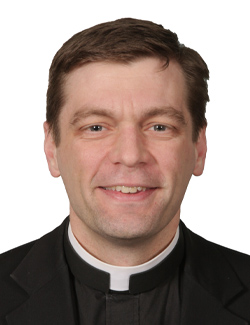
Guest column by Fr. Mark Cyza
Education Specialist, Diocesan Education Office
I serve as the diocesan coordinator for standardized testing, a role that sits at an interesting intersection of my own education and my priestly ministry. Before entering the seminary, I studied engineering, so I have always had a certain affection for data—how numbers, when read carefully, can tell a story.
 Recently, in a conversation with a colleague involved in public-policy work for Catholic education, a simple question came up: how are our Catholic school students doing academically, compared to students across the country? I decided to dig into the numbers to see what they might tell us.
At the same time, another question began to surface—one that felt more important. Do standardized tests, and the results they produce, actually serve the mission of our Catholic schools? Or do they risk distracting us from it?
That question stayed with me as I returned to Bishop James Conley’s pastoral letter, The Joy and Wonder of Catholic Education. In it, the bishop reminds us that Catholic schools do not exist primarily to chase outcomes or rankings, but to form the whole person—mind, heart, will, and imagination—so that young people may become fully alive in Christ. “The glory of God,” St. Irenaeus famously wrote, “is man fully alive.” Catholic education participates in that vision. Its purpose is not merely competence, but flourishing.
Education, Bishop Conley writes, should awaken wonder, because wonder is the beginning of knowledge, and knowledge ordered toward truth leads to freedom. A child who learns to marvel at creation, to delight in language, to wrestle honestly with mathematics, and to ask serious questions about history is not merely accumulating information. That child is being formed in habits that dispose the soul toward truth.
This vision stands in contrast to much of the contemporary conversation about schools, which often reduces education to test scores alone. And yet, from time to time, even a spreadsheet of numbers can quietly testify to something deeper—if we know how to read it.
In response, we reviewed results from nationally normed assessments given to our students in third and eighth grade. These tests do not measure faith, prayer, virtue or charity. They cannot tell us whether a child loves God or recognizes Christ in the poor. They do not measure whether a student has learned to forgive, to serve or to pray. But they do measure habits of mind: attention, perseverance, reasoning, and the ability to engage truth. In other words, they offer a limited but real glimpse into whether students are being formed intellectually in ways that support their full human flourishing.
One helpful way to read these results is through national stanines (“standard nine”), a nationally normed nine-point scale that compares student performance to peers across the country. Stanines divide students into three broad bands: below average, average, and above average. Because they are normed nationally, they allow us to see how our students are performing relative to students in other schools and states—not as competitors, but as fellow learners.
What emerges is striking.
In Grade 3, roughly nine out of 10 students in our diocesan schools score in the national average or above-average range in reading and mathematics. About one-third of third graders score in the highest stanine band in reading, indicating strong grade-level mastery compared to students nationwide. By Grade 8, that strength is sustained—and in some subjects, even more pronounced. More than nine out of 10 eighth graders score in the national average or above-average range across reading, math, and language, with particularly strong results in math and language, where well over one-third demonstrate above-average national mastery.
These numbers are important—but not because Catholic schools are in competition with anyone. They are important because they reveal something about the kind of formation our schools provide.
Bishop Conley insists that Catholic education is ordered toward truth—not merely useful information, but truth that liberates. Students who are taught that truth matters, that effort is meaningful, and that learning is an act of reverence toward reality itself tend to develop the intellectual virtues that allow them to grow. Attention, discipline, patience, and humility before the truth are not accidental byproducts; they are cultivated intentionally in classrooms where faith and reason belong together.
Seen through this lens, academic results are not the goal of Catholic education, but they can be a fruit of it. When students are formed in an environment where truth is pursued as something objective and meaningful, competence follows. When teachers accompany students patiently, encouraging perseverance rather than mere performance, growth becomes visible over time.
Another quiet testimony within the data is continuity. Strong performance in Grade 3 does not fade by Grade 8. Instead, it is sustained—and in some areas strengthened—over time. This reflects something deeply ecclesial about Catholic schools: children are not formed for a moment and then left to drift. They are accompanied. Teachers, parents, pastors, and school communities walk with students year after year, helping them mature intellectually and personally. Formation unfolds across time, much like discipleship itself. The Church does not abandon the soul after initial conversion; she accompanies it toward maturity. Catholic schools mirror that same patient accompaniment.
The data also invites humility. Not every subject shows the same strength at every level. In particular, early language skills in Grade 3 reveal an area where we can continue to grow. But here again, the Catholic response is not defensiveness. Bishop Conley reminds us that authentic education requires honesty, conversion, and hope. To acknowledge where we must do better is not a failure of mission; it is fidelity to it. Hope allows us to look clearly, act deliberately, and trust that grace works through sustained effort.
Perhaps most importantly, these numbers help us resist a false choice. Catholic schools do not have to choose between being deeply faithful and academically serious. The two belong together. Faith does not compete with reason; it perfects it. When schools foster wonder, order learning toward truth, and form students within communities of faith, intellectual competence follows. Not perfectly. Not uniformly. But consistently enough to be visible.
Standardized tests will never capture the fullness of what happens in a Catholic school. They cannot measure wonder, reverence, charity, or faith. They cannot quantify prayer or grace. But when read carefully, they can point beyond themselves. They can signal that something is working—not because numbers are the mission, but because formation bears fruit.
As Bishop Conley reminds us, education is about drawing out what God has placed within each child, helping them become fully alive. When that happens, even our most limited measurements can quietly echo a deeper truth: that when minds are formed in the light of Christ, learning follows—and freedom is not far behind.
Father Cyza coordinates standardized testing for Catholic schools in the Diocese of Lincoln
