By Reagan Scott
for the Register
In his apostolic exhortation “Familiaris Consorio,” published in 1981, Pope Saint John Paul II wrote, “More than ever necessary in our times is preparation of young people for marriage and family life.”
St. John Paul II said because Christian marriage influences the holiness of a large number of men and women, “The Church must therefore promote better and more intensive programs of marriage preparation….”
Pope Francis would later take up this call, expressing the need for a “new catechumenate” for marriage preparation, the result of which was a document entitled “Catechumenal Pathways for Married Life,” published in 2022 by the Vatican’s Dicastery for Laity, Family and Life.
“Catechumenal Pathways for Married Life” serves as a guideline for the process of marriage preparation (the Marriage Catechumenate), with an emphasis on mentorship and accompaniment.
In the introduction to the document, Pope Francis wrote, “…we have a primary duty to responsibly accompany those who manifest their intention to be united in marriage, so that they may be preserved from the trauma of separation and never lose faith in love.”
Pope Francis noted that the Church devotes several years to preparing men and women for vocations to the priesthood and religious life, but only a few weeks for couples preparing for marriage, despite the fact that “married couples constitute the vast majority of the faithful.”
In keeping with Pope Francis’ request, the Lincoln Diocese has revised its marriage preparation policy guidelines for the Marriage Catechumenate, a period of formation meant to serve as a spiritual and practical roadmap for a couple’s future together with stages similar to the Order of Christian Initiation of Adults (OCIA).
Rachael Tvrdy, the director for family life and discipleship for the diocese, said that after she took on her role in November 2022, she was asked to revise the diocese’s marriage preparation policy, which was more than 25 years old. This coincided perfectly with the release of the dicastery’s guidelines.
The new diocesan policy for the Marriage Catechumenate went into effect Jan. 1 this year, with parishes expected to walk through the model with all newly engaged couples as they begin their marriage preparation.
Diocesan guidelines and other resources are available at www.lincolndiocese.org/marriage-catechumenate.
While the diocese still requires couples to complete a pre-marriage inventory, take a fertility awareness intro course and attend a retreat as part of their marriage preparation, a new addition to their formation requires couples to choose a mentor couple with whom they can meet monthly to receive a witness of married life in the home and ongoing support before and after the wedding.
This mentor couple should be married in the Catholic Church for five or more years, actively practicing their faith as members of the church or parish that the engaged couple belongs to or plans to get married in and someone the engaged couples admires.
This process is facilitated through a program called Witness to Love, a virtues-based model of marriage renewal and preparation that the diocese has partnered with. Founded by Mary-Rose and Ryan Verret in 2012, Witness to Love is being used in 106 dioceses across the globe.
Rachael Tvrdy said she met the Verrets, who are the only lay consultants to the Vatican’s Dicastery for Laity, Family, and Life from North America, at a conference in 2019, and was instantly convicted that Witness to Love is a movement of the Holy Spirit.
“I learned about their program and recognized that they were the preferred program for most dioceses across the world… and what impressed me most was that it was relational, helping couples form friendships with married couples in their parish. That was the missing piece the Verrets added: mentor couple accompaniment.” she said.
To help parishes transition to the new guidelines and onboard them to Witness to Love, which recently updated and streamlined its training videos, the Office of Family Life and Discipleship co-hosted a Marriage Catechumenate webinar with the Verrets in January.
There were 90 people in attendance, including parish and chancery priests. Lay attendees included married couples, parish wedding and marriage formation coordinators and Engaged Encounter team members.
Bishop James Conley opened the webinar, and emphasized that marriage preparation is key to building a culture of life and a civilization of love, not something the diocese does to have couples check a box or jump through hoops.
He said, “It’s really bringing couples to experience, as much as we can – because the Holy Spirit is the one who can do this – a true encounter with Jesus through us, through our words and through this program.”
Tvrdy then walked attendees through the five stages of the Marriage Catechumenate.
The first is remote preparation, which encompasses childhood through engagement and includes all of the lessons one learns about the vocation of marriage, dignity of the body, virtues and more.
The second stage, reception, encompasses the first few weeks of engagement and is used to establish a couple’s freedom to marry, welcome them to the parish and introduce the Marriage Catechumenate.
The catechumenal stage involves six to 12 months of preparation and is meant to help couples discern and prepare for the sacrament. The diocese prescribes eight to 12 months as an ideal timeline for this stage, and anything shorter than six months requires a dispensation.
It is during the catechumenal stage that couples will attend an Engaged Encounter retreat, or an approved alternative option, and meet with their mentor couple.
Tvrdy noted that the inclusion of the mentorship model in this stage will relieve the priest of some of the previously necessary meetings that he might hold with an engaged couple.
“I tell the priests it’s focused on role allocation. The priest is the welcoming face of the Father to the parish, and he’s overseeing and supervising the pastoral formation, but the married couples themselves are doing more of the relational accompaniment,” Tvrdy said.
Several parishes in the diocese opted to pilot the Marriage Catecumenate during the past couple years, including St. Patrick Parish in Lincoln.
The pastor for St. Patrick, Father Troy Schweiger, talked about his experience with the new policy during the webinar, and said transitioning to the new guidelines will require humility as the diocese shifts from a priest-centric model of marriage preparation.
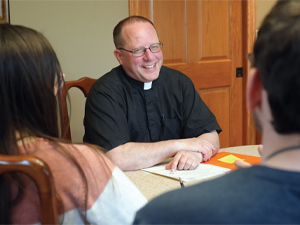
“I think the humility part of it is that [we priests] have to be humble and say there’s things that our couples need that we can’t give them. They need to be connected, they need to be connected with another couple, they need to be connected more strongly to the parish,” he said.
In his time piloting the Marriage Catechumenate, Father Schweiger found that about half the couples who came to him for marriage preparation didn’t know anybody in the parish, or have a mentor couple they could ask to accompany them through their engagement.
Just as he had to be open to the Holy Spirit’s guidance as he learned to navigate the new guidelines, Father Schweiger encouraged these couples to turn to Him as well.
“[The Holy Spirit] will guide these engaged couples to ask the right mentor couple that’s going to help them grow,” he said.
Father Schweiger counsels couples to sit in the back of the church for four or five Sundays, and before the start of each Mass, ask the Holy Spirit to help them see who He is raising up to be their mentor couple. Once they’ve identified someone, all they need to do is ask.
“And it works,” Father Schweiger said. “I’ve seen amazing things. I’ve seen mentor couples really grow. I’ve seen the engaged couples really get to know these mentor couples and not only are they inviting them to their wedding, there’s just that ongoing connection, and it’s really beautiful.”
Father Schweiger said the Holy Spirit really wants to help engaged couples be connected in their parishes, and encouraged the priests to let their parishioners know about Witness to Love, and ask them to be open to helping engaged couples who may approach them asking to be mentored.
The fourth stage of the Marriage Catechumenate, called the final preparation, comprises the final 60 days before the wedding, and is meant to be a more intense time of spiritual formation and prayer.
The couple should learn how to pray together from their mentors or another lay couple, will plan their wedding liturgy with the parish priest and reconfirm their intent to marry.
The ceremony is not where the Marriage Catechumentate ends, though. The final stage – mystagogy, or ongoing formation – is meant to support couples through their first few years of marriage.
“It’s actually the first five years of marriage that you should continue on with formation,” Tvrdy said. “The divorce rate in year five of marriage is something like 23% for Catholics, so the statistics are telling us that couples need that ongoing formation and maintenance after the wedding.”
This could mean meeting in small groups or walking with other married couples, but the goal is continued fellowship, which is why a mentor couple can continue to play a pivotal role in the lives of their newly married mentee couple.
St. Michael Parish in Hastings was another one that opted to pilot the Marriage Catechumenate over the past couple years. Pastor Father Jeremy Hazuka has walked seven couples through the new program, and said the part he likes is the support couples have from their mentor couple after the wedding.
He said, “I like to think of what’s called Dunbar’s Number – the idea, just from a human standpoint, we can only know so many people. And so often you have a priest involved with the preparation, but then once the preparation is done, the wedding’s over, then who’s going to be there to help follow-up, to support, to be with the couple, to accompany them as they begin their marriage?”
Father Hazuka said just having mentors who the newly married couple can come to if they have questions or struggles is one of the biggest benefits he’s seen from the new model.
The webinar continued with an open Q&A session for Tvrdy and the Verrets, and attendees asked questions about the Catechumenate and logistics for utilizing Witness to Love.
Mary-Rose emphasized that marriage isn’t a problem to be solved, and engaged couples aren’t an issue to be addressed, but two people who, with the graces bestowed in the sacrament of marriage, have the power to change the Church.
“The prayers and love and friendship that you pour into one couple pours into another, and that’s what builds up the body of Christ in the Church. We’re not just trying to get the couple to the altar, we’re trying to prepare them to renew the Church and be those missionary disciples,” Mary-Rose said.
Tvrdy was asked to speak at the Marriage Catechumenate Summit in Lafayette, La. in March to share her experiences and takeaways from the launch in the Lincoln Diocese with other diocesan directors and bishops who are starting this in their own dioceses.
She said that in talking with leaders from other dioceses, she realized that despite experiencing challenges and growing pains, the diocese is fortunate to have such strong support from Bishop Conley and senior leadership.
Tvrdy has found that the process of standardizing the Marriage Catechumenate across the diocese will take time as priests become familiar with the guidelines and utilizing Witness to Love.
The parish priests aren’t meant to do it all, she said. The goal for the Catechumenate is to share the responsibility for walking with couples preparing for marriage, and they’ll need support at the parish level to do it.
“It’s going to be a big cultural change for our diocese, but hopefully it’s going to bear a lot of fruit,” Tvrdy said. “In the places where it’s been piloting for several years, I hear that it not only bears fruit for the engaged couples, but the married couples themselves.”