

By S.L. Hansen
for the Register
Nebraskans will have a new way to support Catholic education beginning Jan. 1: a tax credit for contributions to K-12 scholarship funds.
Signed into law by President Donald Trump this summer, the Education Freedom Tax Credit program is a boon to all taxpayers, while also supporting parents and guardians who need financial assistance to choose the right schools for their children.
Beginning in 2027, taxpayers can contribute up to $1,700 to help fund K-12 private school scholarships and receive a dollar-for-dollar tax credit on their 2027 federal income tax returns. The contributions can be made to a granting organization, such as Opportunity Scholarships of Nebraska (OSN). OSN plans to use these funds for private school tuition scholarships to help Nebraska kids.
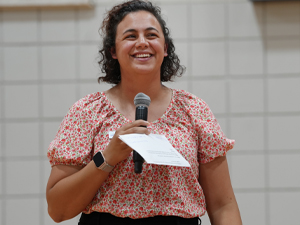
“This is a simple way to make sure that your federal income tax dollars are going to stay here in Nebraska to benefit students,” said Sam Kavan, OSN’s director of implementation. Kavan introduced the benefits of the new tax credit to parents during the back-to-school open house at Blessed Sacrament School in Lincoln this August.
All of the Diocese of Lincoln’s schools are partners with OSN, which is a 501(c)(3) nonprofit organization. OSN has been endorsed by all three Catholic Dioceses in the state of Nebraska.
Father Michael Morin is pastor of Blessed Sacrament parish and school. With roughly 30% of parish families already receiving scholarships, he knows how crucial it is for people to support organizations like OSN.
“The cost of education has gotten so high across the board,” he pointed out. “For the families who struggle financially, we make a great effort to accommodate them.”
The value of diocesan Catholic schools cannot be understated.
“Not only do we provide an excellent education,” Father Morin said, “students learn how to lead a good life. It has an impact on society.”
He anticipates that the tax credit will appeal to Catholic families.
“They already pay taxes. There is no reason they should not get some kind of benefit,” he said.
Chip Kaplan of Cathedral of the Risen Christ Parish in Lincoln previously contributed to OSN before the State of Nebraska’s tax credit act was repealed by voters in late October 2024.
“It provided a way for me to give more money toward Catholic education than I’d have otherwise been able to give, because I recouped everything in the next spring when my taxes were filed,” he explained.
Kaplan is encouraged by the opportunity to once again receive a tax credit for his support of Catholic school scholarships. He has a very good reason for hoping many more taxpayers take advantage of the federal tax credit: its $1,700 limit.
“It will be important for more people to contribute to their local scholarship funds,” he reasoned. “We can no longer rely on a small number of large donors, as we could with the state tax credit in the past.”
Father Morin agreed. “We need to get the word out to as many tax payers as we can.”
Before the state tax credit was repealed, OSN was able to distribute roughly $12.8 million to more than 4,800 Nebraska students. OSN is now working to raise funds so they can resume scholarship distribution. The Education Freedom Tax Credit can be the inspiration people need to start or resume contributions to the organization’s scholarship fund.
Making a contribution to OSN gives taxpayers the additional choice of either supporting all the Catholic schools in Nebraska or selecting a particular school or schools to support. For example, a tax payer may choose to support the school(s) their children attend, their own alma mater, or one that employs a beloved teacher, loved one or friend. OSN will provide the documentation contributors need so that their tax professionals can help them claim the dollar-for-dollar credit appropriately.
To qualify for a scholarship funded by the Education Freedom Tax Credit, students must be from a household with an income not greater than 300% of the area’s median gross income and must be eligible to enroll in an elementary or secondary school, whether public or private. (The U.S. Department of the Treasury may issue additional qualifications before the start of 2027.)
“Based on what we have seen,” Kavan said, “about 95% of the K-12 students in Nebraska would be eligible to apply for a scholarship through this program.”
The scholarship can be used for tuition at a private school, private tutoring, advanced placement exams, career training, materials for homeschooling and other educational expenses.
Kaplan and his wife have chosen Catholic school for their own children, so he knows very well the difference a scholarship can make.
“Anybody who pays taxes and supports Catholic education should make use of the new federal tax credit,” he said.
Kavan encouraged parents to rely on the OSN newsletter for forthcoming information about the federal tax credit and to be notified when scholarships become available. Visit the OSN website at nebraskaopportunity.org to sign up.
