
By Andrew Winter
1.
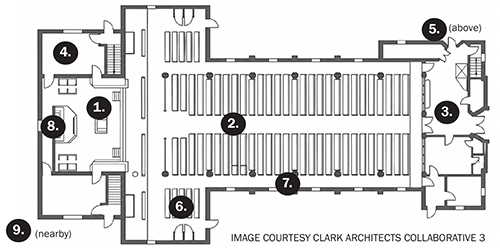
The most important part of any Catholic church is the sanctuary, where the ambo, altar, celebrant’s chair, and (usually) the tabernacle are located. The sanctuary is at the front of the church. The ambo, also called the pulpit or lectern, is the podium where the lector reads the readings and priest gives the homily. The altar, the most sacred part of the sanctuary, is consecrated by the local bishop and usually contains at least two relics from saints’ bodies, one of them usually a martyr.
2.
The large space where the congregation sits, taking up most of the church, is called the nave (from the Latin navis, meaning ship). Usually the confessionals and stations of the cross are found in the nave. Pews, which fill the naves of almost all Catholic churches today, are a relatively new invention. Through the Middle Ages, the faithful usually stood in an empty nave, and only a few chairs or benches were available for the aged and sick. Protestantism was responsible for the popularization of pews in church, as Protestants’ emphasis on preaching during worship called for sitting during long sermons.
3.
The narthex (or vestibule) is at the back of the church, usually separated from the nave by doors. It is a less sacred space of gathering, and in ancient times was the spot designated for catechumens and pagans who were not allowed to participate in the entirety of the Mass. Narthex is a Greek word meaning “giant funnel,” while vestibule comes from the Latin vestibulum, meaning “entrance” or “court.”
4.
The sacristy is the room where the priest puts on his vestments and where the sacred vessels are stored. Usually the sacristy stands to one side of the sanctuary. Some sacristies are divided into two parts, one on either side of the sanctuary, and they are often connected by an ambulatory, or hallway running behind the altar.
5.
Some churches have a choir loft, and all churches have a baptistry. This is of course where the baptismal font is, but it can be located in many different parts of the church. Some baptismal fonts allow for baptism by pouring only, while others have large pools that allow for baptism by immersion.
6.
Many churches are built in the shape of a cross, with the sanctuary at the “head” and the narthex at the “feet.” In this case, the “arms” of this architectural cross are called transepts, in which often stand side altars.
7.
Though not in any specific location within the church, holy pictures, statues, and stained-glass windows are a crucial part of every Catholic church. Especially in the Middle Ages, when few of the common faithful could read, religious pictures were essential in telling the stories of Christ and the saints through visual representation. Also located somewhere in the church is the ambry, a kind of wall safe where the Oil of the Sick, the Oil of the Catechumens, and the Sacred Chrism are kept.
8.
Tabernacles today are usually placed behind the main altar, sometimes within the structure of the high altar, but they can be located elsewhere within the church. With permission from the local bishop, churches can house tabernacles in completely separate adoration chapels.
9.
Though not technically part of the church building, the rectory is usually adjacent to the church. It is the house where the pastor and his assistants live.