

By Bishop James Conley
“I praise you, for I am fearfully and wonderfully made. Wonderful are your works; my soul knows it very well. My frame was not hidden from you, when I was being made in secret, intricately woven in the depths of the earth.” Psalm 139:14-15
 God has instilled his creation with wonder, and he made us as beings who can recognize it and respond. As we embark on the second half of our yearlong pilgrimage through the humanities, we can reflect on the reason for engaging the humanities. It’s so typical in our consumerist culture simply to look or listen and then move on. The great works of the humanities, however, beckon us to stop, reflect more deeply, and appreciate God’s wonderful creation, including our place within it. The humanities intend to humanize us, enlarging our thoughts and desires by drawing them toward what is true, good, and beautiful.
“Nascantur in admiratione. Let them be born in wonder.” This was the motto of the Pearson Integrated Humanities Program (IHP) at the University of Kansas, which offered me my first Humanities Syllabus, and which led me into the Catholic Church. It’s also the goal of this yearlong series: that we all may be born anew in wonder. The founders of this program—John Senior, Dennis Quinn, and Frank Nelick—understood that it was not enough to read the Great Books. To appreciate them, we need to grow in wonder, a kind of awe that overwhelms us and opens our minds and hearts to become receptive. Quinn described this experience as “a birth of the human spirit, an entry into a new world that excites interest because it is seen in the light of wonder.” Senior described it in a more fundamental way: “wonder is the beginning of knowledge; that reverent fear that beauty strikes with in us.”
When we experience something that moves us to wonder, whether it is the beauty of creation, great art and literature, or a deep conversation, we are drawn beyond ourselves into something greater, the immense and awe-inspiring reality of God’s works. In addition to our natural birth and our spiritual rebirth in baptism, we need another kind of birth that awakens our minds and imaginations, enabling us to see more deeply and appreciate the glory of creation and human culture; what one might call an experience of the “sacramental imagination.”
Book
If we are born anew in wonder, it will change how we live, making us more receptive and attuned to the good things that surround us. As we experience the treasures of the great tradition, we might even be inspired to embrace lost ideals. But what would happen if we really embraced the ethos of the great and noble works of the past? Wouldn’t we look like fools in our culture? Even the desire to live a devoutly Christian life can seem quixotic today.
Miguel de Cervantes’s great novel “Don Quixote” inspired us in the IHP to be willing to set out on the great adventure of life, armed with the wisdom of the past to do what others thought foolish. Although Cervantes pans overwrought chivalric literature through Don Quixote’s overactive imagination, the purpose of the story is not solely to laugh at his delusion. For one, Quixote manifests the power of reading and the imagination, as “he gave himself up so wholly to the reading of romances, that at night he would pore on until it was day, and would read on all day until it was night; and thus a world of extraordinary notions, picked out of his books, crowded into his imagination; now his head was full of nothing but enchantments, quarrels, battles, challenges, wounds, complaints, love-passages, torments, and abundance of absurd impossibilities; insomuch that all the fables and fantastical tales which he read seemed to him now as true as the most authentic histories.” And though the tales of chivalry may not have warranted such devotion, as they play out in his disastrous exploits, there are times when he sees the world more truly than those around him, looking into the heart of those in need and giving greater esteem to the lowly.
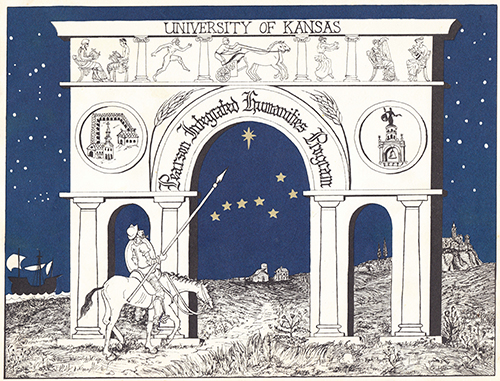
In fact, the very first time I ever saw any formal publication on the Integrated Humanities Program at KU was at a college fair at my high school at the end of my senior year. There, on the cover of a brochure, was a pen and ink illustration of Don Quixote in full shining armour on horseback, jousting with the windmills. Above his head, handwritten in elegant calligraphy were the words in Latin: Nascantur in Admiratione (Let them be born in wonder). Later I found out that one of the IHP students had designed the brochure, which contained several pages of description and illustrations, explaining the nature, purpose and scope of the IHP. But the image of Don Quixote on horseback became the unofficial icon of the program.
If only we could see things as they truly are, suffused with God’s glory and wonder, we might respond like Quixote to a judge arriving at an inn with his daughter, “Enter, sir, into this paradise; for here you will find suns and stars worthy of that lovely heaven you bring with you. Here you will find arms in their zenith, and beauty in perfection!” Too often, we lack the ability to imagine how the hidden truths of our faith can play out in plain sight.
When we look at St. Ignatius of Loyola, for example, we see a man who had devoted his early life to the ideals of chivalry and the achievement of great exploits. After an unsuccessful surgery on his leg, shattered in battle, he was confined to bed with only the “Life of Christ” and “The Golden Legend” of the saints to read. He placed himself within those works and thought—why can’t I live like this? And so he did. Was he out of his mind? To his previous acquaintances and those who witnessed his intense prayer and asceticism in a cave, he certainly seemed to be!
If we allow ourselves to be taken up into a vision of what is true, good, and beautiful, might not we, too, set off on an adventure that would turn heads? Quixote tilted against windmills, and we might find many worthy opponents today. My mentor, John Senior, thought mortal combat was needed against the TV. For us, it’s high time to fight back against the oversaturation of screens and social media that crowd out genuine wonder in the reality of creation and our faith.
Poetry
In the IHP, we didn’t just read books. We sang, danced, and spent time outside looking at the stars. You could describe its teaching method or pedagogical approach as “poetic.” This certainly included memorizing poetry, but more broadly, it meant engaging the imagination and the emotions as the foundation for learning through the direct experience of things. The Greeks understood that stargazing induced wonder, and the contemplation of the mystery of the cosmos served as the beginning of philosophy.
Gerard Manley Hopkins’s poem “The Starlight Night” invites us to do our own looking. This requires getting out of the city at night to a place where the light of the stars still shines. We turn our heads up, away from the incandescent glow that keeps our eyes turned downward. Hopkins recognizes how the tapestry of the heavens manifests the communion that unites us through the even greater fire of God’s holiness. Looking up, he reminds us, invites us to consider the highest things:
Look at the stars! look, look up at the skies!
O look at all the fire-folk sitting in the air!
The bright boroughs, the circle-citadels there!
Down in dim woods the diamond delves! the elves’-eyes!
The grey lawns cold where gold, where quickgold lies!
Wind-beat whitebeam! airy abeles set on a flare!
Flake-doves sent floating forth at a farmyard scare!
Ah well! it is all a purchase, all is a prize.
Buy then! bid then! — What? — Prayer, patience, alms, vows.
Look, look: a May-mess, like on orchard boughs!
Look! March-bloom, like on mealed-with-yellow sallows!
These are indeed the barn; withindoors house
The shocks. This piece-bright paling shuts the spouse
Christ home, Christ and his mother and all his hallows.
Music
In addition to the stars, the sea often inspires wonder, as its vastness, surging waves, reflective hues, and dangerous beauty overwhelm us. In the spring of 1976, the IHP spent the semester in Inishbofin, a small island off the west coast of County Galway, Ireland. Professor Quinn explained the purpose of seeking this remote setting that still preserved a traditional culture had a simple purpose: “So dominant is modernization in America that college-age students have almost no direct experience of traditional culture, with its slower pace, its love of a living past, its handcrafts, its unspoiled countryside.” This island, with its starkness and rocky shorelines, opened us as students even further to the great mystery and adventure of life.
The island had a kind of terrible and wild beauty that captured our youthful hearts. The time also bore a heavy grief as, within two weeks of our arrival, we lost two of our friends and fellow students in a tragic accident in the dangerous ocean tides.
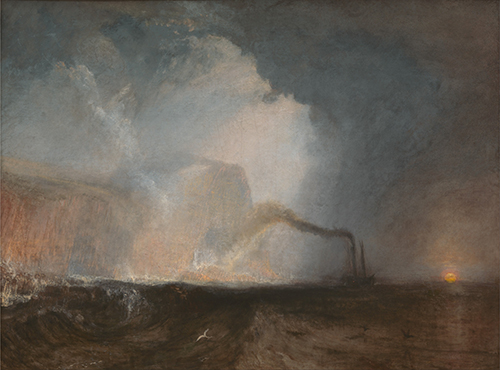
The German Romantic composer, Felix Mendelssohn, made his own journey to the rocky coast of the British Isles. In 1829, he sailed to Fingall’s Cave, a sea cave on the island of Staffa, part of the Inner Hebrides off the west coast of Scotland. The main melody for what became his concert overture, “The Hebrides,” came to Mendelssohn as soon as he approached the island, with its basalt walls rising from the sea with a section hollowed out to funnel the echoing sound of the wind. This enjoyable piece captures the vivacity of the water and wind that surges through the music as it bounces seamlessly from the playful to the profound, from exhilaration to an aching desire for more. Mendelssohn expresses the beauty of nature while also channeling the yearning of the spirit which reaches farther, striving for even greater heights.
Art
The content and experiences of my education had such a profound impact because of the bonds of friendship they created. Together, we entered into a great adventure that led us somewhere and to someone. There is a light that burns brighter than the stars that attracted us, which the Gospels describe as the oil of a lamp. The humanities can awaken us to the greatest truths of life, fostering docility to the promptings of grace. The IHP produced more than 300 converts to the Catholic faith, simply by fostering attention to the meaning and purpose of life in all that we studied and experienced together. It led to additional questions and conversations that carried us ultimately to the fullness of truth in God himself.
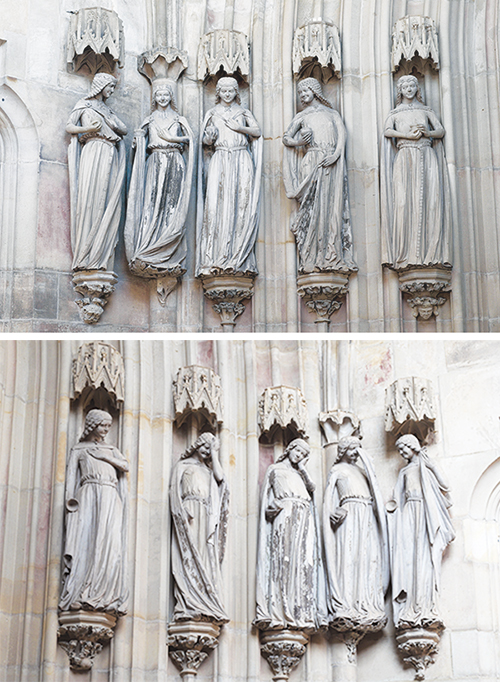
Why do so many people miss the message God sends us through the testimony of his works in both creation and redemption? A set of medieval sculptures that adorn the northern portal of the Magdeburg cathedral express two different dispositions to the truth that point us to the answer. Sculpted from stone in the mid-13th century, the wise and foolish virgins, two sets of five jamb statues, boldly express through bodily movements and expressive emotional features the joy of finding the truth or the sorrow of missing it.
As Jacqueline E. Jung explains in her delightful book, “Eloquent Bodies: Movement, Expression, and the Human Figure in Gothic Sculpture,” they were sculpted when Gothic artists sought greater expression of the emotions, which might seem overdone at first. The figures, who share the same face but with distinct expressions of delight or despair, invite those entering the church to share their responses—to repent or rejoice, based on their own dispositions. “If, as I contend, the Magdeburg Foolish Virgins did not overplay their roles, they did, like their cousins in the drama, demonstrate their sorrow with maximum force, and summoned viewers not just to look but to feel along with them. By vicariously experiencing the Foolish Virgins’ self-recrimination and despair, living men and women might be prompted to reform their own inner lives, so as to avoid such a state in the future” (Jung, 166).
The 10 figures, each sculpted from a single block, are between 48-51 inches in size and were originally painted. They continue to witness two fundamental dispositions in life, which relate to our theme of wonder. The wise virgins were attentive and vigilant, enabling them to see the bridegroom and experience his joy. The foolish virgins fell into distraction and could not be present when the object of their hope appeared before them.
If we look at the foolish virgins first, we see them in succession beating of the breast, smacking the forehead, resting the head in lethargy, wiping the eyes, and hiding in shame. Their empty bowls face the viewer as an expression of vacuity, an interior emptiness that can be filled no longer. They stand lost in their own isolated misery, unaware of what happens around them, expressing the lack of attentiveness that placed them in this damning position.
The second set of figures look toward one another and the viewer, expressing a communion absent in the other set. Instead of beating the breast, there is a gesture pointing toward it in two of the figures, as if inviting one into the intimacy of the heart. Their smiles predominate, yet the central figure also expresses determination that translates into holding their lamps confidently upright. If we learn to look at reality in its fullness and open our hearts to its truth, goodness, and beauty, we can share their eternal joy.
Movie
It’s become increasingly hard to be born in wonder with eyes dulled by a continuous stream of digital images. Flannery O’Connor took an unusual path to reawaken the imagination of modern Americans through her stories set in the South with a misfit cast of characters, who rediscover the deep and forgotten elements of human life in shocking ways. If you write for a disenchanted audience who no longer knows how to see reality with wonder, “then you have to make your vision apparent by shock—to the hard of hearing you shout, and for the almost-blind you draw large and startling figures” (“Mystery and Manners,” 34). O’Connor uses sudden and unexpected acts of violence, for instance, to break through the barriers of modern readers, trying to bring them face to face with human brokenness and the power of God’s grace to enter where we generally refuse him entrance. A rebirth in wonder stands at the heart of her stories, summoning us to look beneath the surface.
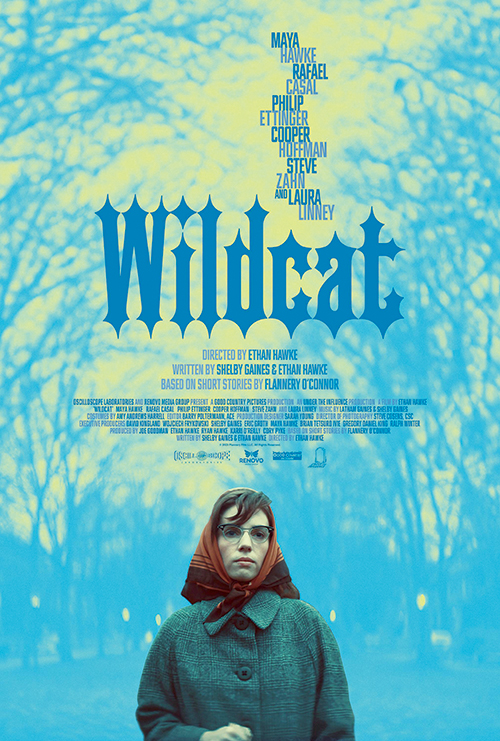
Director Ethan Hawke masterfully captures O’Connor’s unique imaginative vision in his 2023 biopic “Wildcat,” starring his own daughter Maya. It focuses on O’Connor’s early writing career, when her health forced her to retreat to her family farm in Milledgeville, Ga. Coming to grips with her diagnosis of lupus, O’Connor experiences the power of grace breaking through her limits. The film, which draws not only on her short stories, but also on quotes from her spiritual diary, relates the experience: “The reality of death has come upon me. And the consciousness of the power of God has broken my complacency like a bullet in the side. A sense of the dramatic, of the tragic, of the infinite has descended, filling me with grief. But even more than grief, wonder.”
O’Connor’s writing often feels like a bullet in the side to the reader, and she clearly wanted to wake her audience up, enabling us to perceive the ways grace tries to break through our complacency, using startling means to share her wonder. The film portrays how a reawakening to wonder and God’s grace can find its way into our lives, even if drastic means are required.
Conclusion
A summer night spent watching dusk turn to darkness across an orange-tinted sky makes us inherently understand the psalmist’s words, “Wonderful are your works; my soul knows it very well.” The beautiful, God’s handiwork, is something we recognize and know from the depth of our soul like we know our very self. We see and hear God’s creation in the words of “The Starlight Night” or in the music that swells forth from Mendelssohn’s “The Hebrides.” We can look to the contrast between the Magdeburg sculptures of the Wise and Foolish Virgins to understand the misery we experience without God and the joy we find in God. There’s also beauty – and truth – we can uncover in the world around us by being awake to it like Cervantes’s “Don Quixote,” or being confronted by it as Flannery O’Connor often did in her writings. God’s wonder awaits us – our soul knows it well!
Summer offers us many opportunities to grow in wonder. In addition to taking time for vacation, in the summer of this jubilee year, I encourage you to make a pilgrimage, enjoying holy sites and their surrounding natural beauty. For adventurous types who enjoy hiking or walking, I strongly recommend the Camino to Santiago de Compostela in Spain, to the tomb of St. James the Apostle. There you will see what Cervantes saw, the hills and countryside, the skies and the planes, that inspired his main character, Don Quixote.
Another suggestion would be the Shrine of Our Lady of Guadalupe in La Crosse or the Our Lady of Champion shrine in Green Bay, both in Wisconsin. Monasteries such as Our Lady Queen of the Apostles in Missouri. Or, closer to home in our diocese, we have our designated nine pilgrimage sites for the Jubilee Year. You can find that list and more about our diocesan Jubilee Year celebration at lincolndiocese.org/jubilee.
This summer, let us all be intentional in seeking the splendor of God’s beauty, whether it be in a sunset or a storm — or a great work of art!
Nascantur in admiratione. Let them be born in wonder.
—
Bishop Conley’s Humanities Syllabus
July: “Born in Wonder”
Book:
“Don Quixote” by Cervantes
Film:
“Wildcat” (2023)
Music:
“The Hebrides” by Felix Mendelssohn
Poem:
“The Starlight Night” by Gerard Manley Hopkins, SJ
Art:
“The Wise and Foolish Virgins” of Magdeburg Cathedral
ADDITIONAL SUGGESTIONS
Book:
“Laurus” by Eugene Vodolazkin
Movie:
“Into Great Silence” (2005)
Music:
Songs of Turlough O’Carolan
Poems:
“Choose Something Like a Star” by Robert Frost
Art:
“The Monk by the Sea” by Casper David Friedrich
FOR CHILDREN
Book:
“The Lion, the Witch, and the Wardrobe” by C.S. Lewis
Movie:
“The Secret Garden” (1993)
Music:
“Flight of the Bumblebee” by Nikolai Rimsky-Korsakov
Poem:
“Pied Beauty” by Gerard Manley Hopkins
Art:
“Starry Night” by Vincent van Gogh
