

By Bishop James Conley
“Thomas said to him, ‘Lord, we do not know where you are going; how can we know the way?’ Jesus said to him, ‘I am the way, and the truth, and the life; no one comes to the Father, but by me.’” - John 14:5-6
 By the middle of August, children are heading back to school. The word “school” comes from the Greek word for leisure, skole, which points to the purpose of taking so much time to prepare for adulthood. Even though children might think of school as drudgery, it is meant to be a gift of leisure, enabling them to expand their minds and hearts by engaging what is true, good, and beautiful. Rather than offering ready-made information, it is meant to unfold a great search for truth, initiating an adventure to carry them through life with eyes fixed on our ultimate end.
Truth has become a bad word for many, as if it represented setting up one person’s opinions antagonistically over everyone else. Thomas Aquinas, however, defined truth as the “conformity of the mind to reality,” the grasping of things as they are.
Understood in this way, the truth unites us to a good we share in common. It’s not that any one of us could possess it fully—only God who is Truth itself could do that—but, as we grasp it more, we can share what we have discovered with others. The lifelong, shared pursuit of truth should bring us together in conversation, reading, teaching, and contemplation.
Our culture has become oversaturated with knowledge and information but lacks wisdom, struggling to come to understanding, meaning, and purpose. Taking time for leisure, therefore, enables us to pursue the highest things, those we need most to feed our souls. May our schools, as well as our parishes and families, be marked by this kind of leisure. This is why we are taking time to enjoy the arts and humanities through these monthly syllabi as a catalyst for continuing to learn and grow.
Movie
Why does truth seem so elusive today? Technology, if it becomes all pervasive, can give us the sense that reality must conform to our own thoughts and feelings. If everyone has their own truth, cold, hard facts become the only thing that unites us. But even those break down as we make mistakes or disagree on how to interpret them, leaving us lost within an often-harsh world. Polish filmmaker, Krzysztof Kieślowski, explored how our desire to measure and control creates a void of meaning. He began his masterful 10-part television series on the Ten Commandments, “Dekalog,” addressing how science has become a modern idol.
The series arrived at a pivotal moment, with the release of its first episode coming one month after the fall of the Berlin Wall in December of 1989. The materialist culture of Communism was losing its grip, but what would replace it? Kieślowski presciently presented a choice between technology and faith, one that has not yet played itself out.
In the hour-long episode, “Dekalog: One,” the main character, Krzysztof, a Warsaw professor focusing on the emerging power of computers, cannot answer the basic questions posed by his son, Paweł, about life’s meaning and the existence of the soul. With his wife abroad, Krzysztof’s sister steps in to witness these deeper truths, which can be found in love, she assures him, as she tries to arrange Paweł’s religious education.
The young boy stands in awe of the power of his father’s computer, yet he senses that there is also something more that cannot be seen. Father and son put faith in the computer’s power to calculate, relying on its prediction of the thickness of nearby ice, with tragic results: Paweł dies when he falls through the ice. Instead of humbling himself, Krzysztof, radiating with his computer’s green glow, lashes out against God, overturning an altar inside an under-construction church. In the final scene, he reaches into the holy water font only to find solid ice.
Book
While Kieślowski rightly points out the limits of reason for those who idolize its technological power, a great Christian statesman and philosopher of late antiquity, Boethius (480-524), helps us contemplate reason’s ability to soar toward heaven. He stands as a much-needed counter to the modern reduction of reason to calculation and utility.
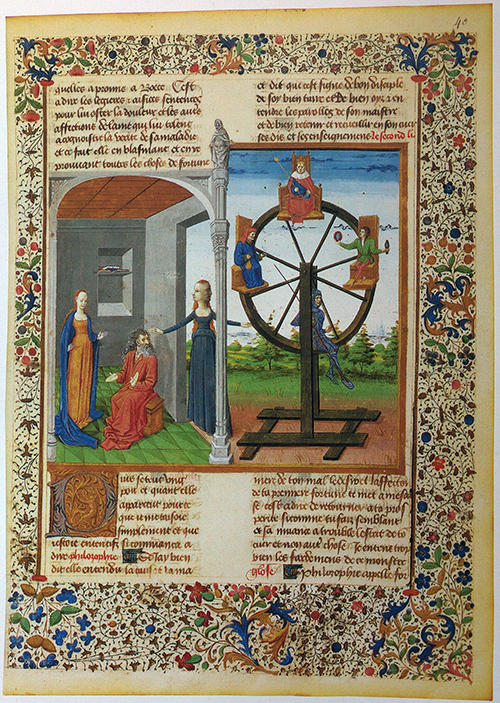
For a 1,500-year-old book, it’s built on a relatable premise. Why do we suffer? Loss motivated Boethius’s “The Consolation of Philosophy,” having fallen from the height of influence as a senator and consul, trying to preserve order and learning in the barbarian dominated remnants of Rome.
Sitting in a prison cell, expecting death, he thought painfully back on his family life, studies in his library, and interventions to save his people from oppression. Where had it led him? In a moment of despair, he is visited by Lady Philosophy, who enters into a dialogue that draws forth Boethius’s own reason and philosophical studies as a remedy for his sadness. He records this conversation, interlaced with beautiful poetry, in one of the great works of early Christian thought. Of all the books we read in the Integrated Humanities Program, this thin volume had perhaps the widest appeal among all the students.
In his last great labor before death, Boethius sought to complete the task of transmitting the wisdom of ancient times to a new world that was growing up from the ashes of the Roman Empire. The work employs reason to search out and fix upon the true source of happiness, which itself is not subject to loss or the passing whims of fortune. Lady Philosophy guides him to the source of true happiness, which can be found only in God himself and participation in the divine nature. Nothing else will satisfy us, for “the good is that which, when a man possesses it can lack nothing further.” But, to attain it, we must turn away from counterfeits, including the pleasure and success that abandoned Boethius in his captivity. As his Lady poetically expresses it:
Who truth pursues, who from false ways
His heedful steps would keep,
By inward light must search within
In meditation deep;
All outward bent he must repress
His soul’s true treasure to possess.
Then all that error’s mists obscured
Shall shine more clear than light.
Boethius responds to his suffering as an opportunity to let go of his own ambitions and to order his thoughts to what is highest. He encourages us to listen to the voice of reason alongside him. “Wherefore let us soar, if we can, to the heights of that Supreme Intelligence,” Lady Philosophy urges us on, so that we might participate in his divine nature. Made in the image and likeness of God, we should embrace our ability to know and contemplate the truth, so that, enlivened by grace, we can enter into the Truth itself to find a happiness that nothing can take away, including death.
Art
How do we make sense of all the competing truth claims we so often face? There’s a common, but false refrain today that faith contradicts science. Truth, however, is one, because reality is one and whole. We know it when our minds grasp and conform to it.
But there are two ways of knowing it, one by rational apprehension of the created world and the other through God’s revelation that enables us to see beyond the confines of the cosmos. Boethius spoke of soaring on the wing of reason, and John Paul II added the wing of faith, which together bring about a harmonious flight. From the beginning, the Church has accepted the importance of philosophy and education in forming the person and proclaiming the truth of the Gospel.
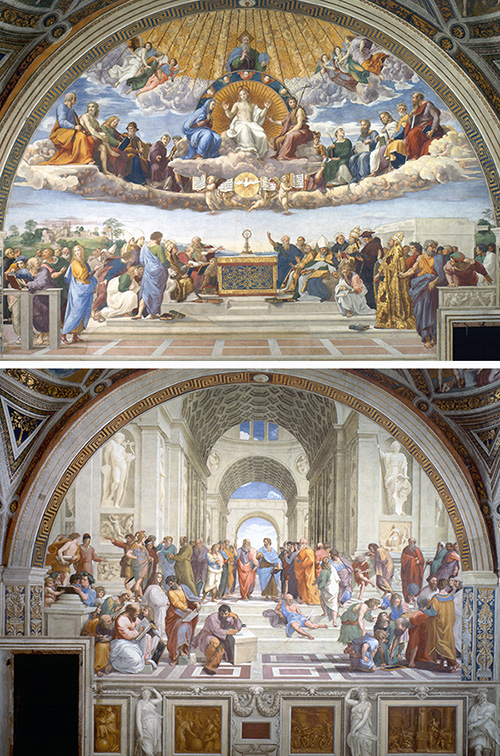
Raphael expressed this beautifully through two paintings in the Apostolic Palace in the Vatican. They face one another in the Stanza della Segnatura, and he, together with his workshop, completed them from 1509-11 to fulfill a commission from Pope Julius II. The “School of Athens” depicts the great quest for wisdom that guided the ancient philosophers, while the “Disputation of the Sacrament” focuses on the development of theology, contemplating and unfolding the Church’s teaching on the Eucharist. The way he positioned Plato, with his finger raised, and Aristotle, with his hand pointed downward, in the center of the painting, they walk directly toward the scene on the opposing wall, filled with saints contemplating the Holy Trinity.
While the ancients sought the truth in ideas, books, and conversation, symbolized in the architecture built up through human effort that frames the scene, the faithful encounter the Word made flesh present before them under the appearance of bread coming down directly from heaven. Truth, as Boethius made clear, has a goal, and will only be satisfied when it reaches its end in the very fullness of the one who is Truth itself
Music
When you received the gift of faith, you may have experienced its ability to break through even the most difficult obstacles. Some of us have powerful conversion stories, as the truth broke through all the objections, wounds, and difficult circumstances that stood in the way. Or, if you were baptized as an infant, you could certainly share some of the challenges you’ve had to face to hold on to the gift of faith you were given at such a young age.
The Church, too, has faced many obstacles to her mission to proclaim the truth of Jesus Christ to the nations. This year we celebrate the 1,700th anniversary of the Nicene Creed that proclaims Jesus’s oneness with the Father in response to Arian crisis that denied Jesus’s divinity. The First Council of Nicaea concluded Aug. 25, 325, a fitting date to celebrate during this Jubilee Year of Hope. This Creed has served as a bedrock of faith and an inexhaustible wellspring of creative power that has raised up soaring cathedrals and filled them with melodious voices.
Our composer this month, Arvo Pärt, was born in Estonia shortly before the outbreak of the Second World War, and his nation fell under Communist oppression at its conclusion. His musical version of the Creed, which he called “Summa,” and premiered in 1977, could be seen as an act of defiance against a regime that sought to destroy faith. With its name harkening to Aquinas’s great articulation of the faith, Pärt’s “Summa” comes in much shorter in length, a choral setting of the Nicene Creed about six and a half minutes in length.
A convert from Lutheranism to Orthodoxy, Pärt also had a musical conversion from the “twelve-tone technique” to more traditional influences, such as Gregorian chant. And as our own continued proclamation of the Creed echoes across the centuries, you can hear the ancient influences in this piece, though they ring with a distinctly modern voice.
Pärt describes his own distinct compositional approach, which he based on the sound of a bell (tintinnabulum):
“Tintinnabulation is like this. Here, I am alone with silence. I have discovered that it is enough when a single note is beautifully played. This one note, or a silent beat, or a moment of silence, comforts me. The three notes of a triad are like bells. And that is why I call it tintinnabulation.”
“Summa” was composed in this style, giving it a contemplative feel, seemingly simple, yet with voices complexly woven together in a circular structure. Like the ringing of a bell from the steeple of a church, “Summa” gives voice to the enduring spiritual power of truth over all who would seek to destroy her.
Poetry
The truth’s enduring power should not be taken for granted. Like Boethius in his cell, we should feel the urgency of pilgrims hastening to our final destination. Will we listen to truth’s power and greatness? Our poem, Coventry Patmore’s “Magna Est Veritas,” boldly asserts truth’s supremacy over its rivals, while also urging us not to wait until it is too late to care.
Its title quotes a passage from the Septuagint version of the Bible that did not make its way into the canonical version. The title, which translates, “great is the truth,” comes from the fourth chapter of 1 Esdras (which corresponds to the book of Ezra with significant additions). Three bodyguards of the Persian King Darius contend to convince him of what “one thing is strongest.”
The first praises the strength of wine, which so easily seduces us, the next of the power of the king himself, who commands others. The third, who happens to be Zerubbabel, descendent of King David, praises women, who have given us life, but then says truth is even greater than all. Everything else is unrighteous and will not endure, “‘But truth endures and is strong forever and lives and prevails forever and ever.’ ... When he stopped speaking, all the people shouted and said, ‘Great is truth and strongest of all!’” (1 Esdras 4:38, 41). To reward Zerubbabel, Darius commissions him to rebuild the Temple in Jerusalem.
Unlike the crowds, Patmore, whose poetry is known for its expression both of marital love and grief, realized that the world is largely preoccupied with other things. In his “Magna Est Veritas,” he indicates that this greatness endures, though largely veiled, as all else fails.
Here, in this little Bay,
Full of tumultuous life and great repose,
Where, twice a day,
The purposeless, gay ocean comes and goes,
Under high cliffs, and far from the huge town,
I sit me down.
For want of me the world’s course will not fail:
When all its work is done, the lie shall rot;
The truth is great, and shall prevail,
When none cares whether it prevail or not.
As we sit with him by the bay, we can feel our littleness, and insignificance as the course of the world progresses. Yet, by laying hold of the truth, we latch onto something greater than ourselves that anchors us as all else passes away. Now is the time for our search; we can’t wait until it’s too late.
Conclusion
Jesus told us that “the truth will set you free” (John 8:32). When so many despair of finding it, we go to Jesus himself, who is “the way, the truth, and the life.” There’s no need to be intimidated by truth in our relativistic time. The truth remains what it always is, the knowledge of God and the works of his creation. Truth is not about winning an argument, but it does call us to share what we have received, standing together in humility before the reality of the goodness and beauty of what God has given to us. Even though we live in a busy and distracted world, the humanities call us to stop, look, receive, and share the things that are most necessary for the life of the mind and soul.
The life and work of St. John Henry Newman, the newest Doctor of the Church, were driven by a passionate and unwavering search for the “kindly light” of truth, wherever it led him. Even though his pathway forward was oftentimes dim and unclear, he never turned away from the light. He requested that this simple line be inscribed upon his gravestone: Ex umbris et imaginibus ad veritatem (out of shadows and images into the truth).
Bishop Conley’s Humanities Syllabus
August: “The Greatness of Truth”
Book:
“The Consolation of Philosophy” by Boethius
Film:
“Dekalog: One” by Krzysztof Kieślowski
Music:
“Summa” by Arvo Pärt
Poem:
“Magna Est Veritas” by Coventry Patmore
Art:
“The School of Athens,” “The Disputation on the Sacrament” by Raphael
ADDITIONAL SUGGESTIONS
Book:
“The Apology” by Plato
Movie:
“The Island” by Pavel Lungin
Music:
“Creed,” Mass for 4 Choirs by Marc-Antoine Charpentier
Poems:
“Truth: The Ballad of Good Counsel” by Geoffrey Chaucer
“The world is too much with us” by William Wordsworth
Art:
“The Geographer” by Johannes Vermeer
FOR CHILDREN
Book:
“The Adventures of Pinocchio” by Carlo Collodi
Movie:
“Cheaper by the Dozen” by Frank Bunker Gilbreth Jr. and Ernestine Gilbreth Carey (the 1948 version)
Music:
“Faith of Our Fathers” by Frederick William Faber
“Philosopher Symphony (no. 22)” by Joseph Haydn
Poem:
“Now We Are Six” by A.A. Milne
“The Rainbow” by Christina Rossetti
Art:
“Guardian Angel” by Pietro da Cortona
