

By Bishop James Conley
“For God will save Sion and rebuild the cities of Judah; and his servants shall dwell there and possess it; the children of his servants shall inherit it, and those who love his name shall dwell in it.”
Psalm 69:35-36
 Throughout the year, we have explored the great cultural legacy we have inherited; great works that embody truth, goodness, and beauty that continue to inspire us and shape the world. When we look around at today’s cultural landscape, however, it might be tempting to give in to discouragement. The Psalmist asked, in a line that resonates, “Foundations once destroyed, what can the just do?” (Psalm 11:3). We can’t save the world, and we shouldn’t really expect too much from it. It’s not our home.
This is why our biblical quote this month is so important. It is the Lord who saves Sion to establish a better and everlasting dwelling place for his children. We do our best to receive and spread the blessings of the heavenly Jerusalem as we pass through this world as pilgrims.
J.R.R. Tolkien reflected this perspective in one of his letters: “I am a Christian, and indeed a Roman Catholic, so that I do not expect ‘history’ to be anything but a ‘long defeat’—though it contains (and in a legend may contain more clearly and movingly) some samples or glimpses of final victory.” His masterpiece, “The Lord of the Rings,” reflects the humble task of rebuilding amid defeat and victory. Though some view the story’s ending as anti-climactic, the chapter “The Scouring of the Shire” portrays its true crescendo, when, after the overarching victory has been achieved, its fruits must be applied in ordinary life. Samwise in particular initiates the healing of the Shire one small seed at a time, setting in motion a lifetime of new growth.
Nebraska can be somewhat of a shire, our beautiful place on earth to cherish, nurture, and protect. We’ve been given extraordinary graces by the great victory of Christ over evil and death, and now, even when facing overwhelming difficulties, we must continue the work of planting seeds for the growth of Christian culture into the coming generations. This is why education is such an important expression of our mission in the Diocese of Lincoln. The bronze statue on top of our state capitol, named “The Sower,” was created by the artist Lee Laurie. It depicts the farmer casting his bag of seeds on the fertile ground. This iconic statue symbolizes the importance of agriculture to Nebraska, representing the sowing of not just grain, but of a way of life and a foundation for a civilization.
Book
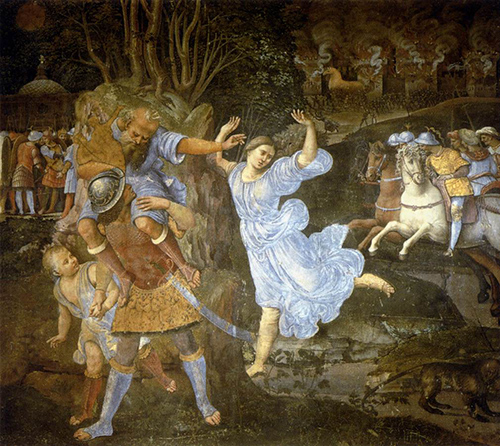
My teacher, John Senior, had a great love for the one of the foundational texts of Western Civilization, Virgil’s “Aeneid,” which he viewed as a figure for education itself. Virgil, Rome’s greatest poet, has been called the father of the West for casting the vision of its noble ideals. He accomplished for the Latin West what Homer had done for the Greeks in creating a founding myth that could carry the great treasures of civilization forward, even into new lands. Out of the flame and ashes of ancient Troy, Aeneas escaped to become the father of the greatest empire the world has ever seen. He fled the burning city with his father, Anchises, on his back, and his son, Ascanius Julius, at his hand, reflecting both the need to receive the remnants of our heritage and pass them on to the next generation. This image embodies the whole spirit of this humanities pilgrimage, as, in this image from Genga, Aeneas looks back into his father’s face as he continues forward.
Senior provocatively claimed in a talk at the University of Wyoming that “If Virgil had not written the Aeneid, we would be savages by now” (“The Importance of Virgil”). Historically speaking, it is true that The Aeneid served as the great textbook for the barbarians who overran the Roman Empire, passing on to them a great love of classical language and the ideals of civilization.
Senior continues: “It is scarcely an exaggeration to say that Virgil and the Bible have been the only common documents of Western education. It follows, as a very strong probability, that the fortunes of our civilization are connected with the values Virgil fixed in the forms of his poetry. The essential liveliness of Virgil, his revivifying power, is, it seems to me, more important today in what a communist critic of the 1930s called this ‘dying culture,’ than at any time since the poems were written. There are those, of course, who think they do not want civilization, who opt for the destruction of the West. I believe that most who hold this view are ignorant. The crisis in the West today, the serious illness, the paralysis of will we suffer, is in very large part the consequence of the fact that a determinate number no longer knows Virgil.”
Aeneas not only fled his destroyed homeland. He had to face shipwreck, a tragic stay in Carthage, and fight his way into his destined homeland. Aeneas encourages his companions to keep up their courage after making it through so many hardships, knowing that they are working to initiate a new beginning: “Recall your courage, put sorrow and fear away. This too some time we shall haply remember with delight. Through checkered fortunes, through many perilous ways, we steer for Latium, where destiny points us a quiet home. There the realm of Troy may rise again. Keep heart, endure till prosperous fortune come” (lines 203-06). In part, this beginning in hardship with the spirit of endurance drew Senior to recognize the centrality of this epic. He remarks, “That war is our war, it is the only one we have the right to fight–and it seems to me to be more than accident that Virgil ties us to the losing side. Our history begins in shipwreck too.” As we saw in Tolkien, we may seem to be on the losing side of history even as we maintain confidence in the ultimate victory of Christ that gives us courage to continue the work of rebuilding.
Music
Western civilization has faced destruction many times. The Fall of Rome, Viking incursions, the Black Death, sectarian wars of the Reformation, and modern political revolutions all pushed its survival to the brink. Napoleon, for instance, bragged that he could destroy the Church, capturing two popes and scoffing at his own excommunication. Some saw Napoleon as a savior, finally throwing off the shackles of the cultural legacy that so many had carried on their back for centuries, which had led children to embrace Greco-Roman culture and the vision of the Bible.
Ludwig von Beethoven, for instance, initially dedicated his third symphony, the Eroica, to Napoleon, though he withdrew it shortly after, literally scratching it off the score. The promise of the heroic figure descended into a tyranny that would lead to the deaths of millions as Napoleon gobbled up the continent. While resident in Vienna, Beethoven witnessed the ups and downs of the French armies, initially triumphing over Austria only to fall after its disastrous invasion of Russia. Beethoven’s Seventh Symphony, which premiered at a benefit concert for Austrian veterans in 1813, speaks of resilience after conflict and upended hopes, offering a note of triumph in strife. Looking back at Europe’s crisis, it’s Beethoven’s exhortation not to give up hope in the creative energy of our civilization, even as he faced the loss of his own hearing.
Though great music exceeds simple summary, we can hear this message in Beetoven’s masterpiece. The initial sustained note suffers attack, rising up through a series of punches. Its soothing response gradually spirals upward until it becomes a galloping burst of vitality, flowing over us in a delightful wave. The prominent role of the flute and oboe expresses a hope that is capable of incorporating the blows of the drum, breaking through a ceiling that cannot contain it. The second movement begins in a more somber and thoughtful manner, expressing an aching for more, remaining hopeful amid tension. It’s not as triumphal as the opening, feeling heavier but also restorative, laying a new foundation, layer upon layer.
The third movement draws another opposing beat that initially seemed like an attack into its own triumphal expression, at moments calming to a soothing consolation. The fourth and final movement ends with another rushing torrent that speaks to life’s enduring power to grow and build despite the difficulties that inevitably arise, and which slow the creative torrent at times. The final bursts of the horns, rather than sounding like destruction, offer an invitation to continue.
Poem and Art
The world witnessed the fragility of our civilization as Notre Dame de Paris burst into flames April 15, 2019. Many feared the damage too great to repair, but by Dec. 7, 2024, one of the greatest acts of rebuilding in our lifetime came to completion. The devastation enabled the world to rediscover the secrets of medieval cathedrals and witness the reemergence of lost artisanship.
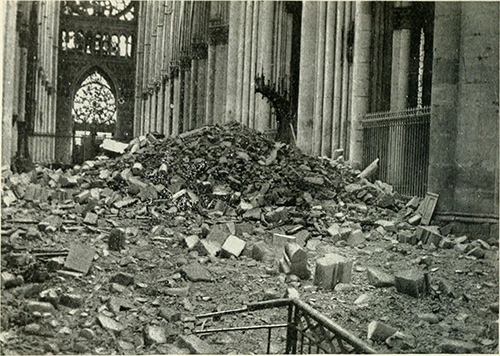
A similar catastrophe occurred Sept. 18, 1914, during the First World War, when Reims Cathedral similarly caught fire after being bombarded by the German army. France has been known as the eldest daughter of the Church because on this site the first barbarian ruler after the fall of Rome accepted the faith here, King Clovis I in the year 496, making this church the site of subsequent French coronations.
Pope Benedict XV called World War I “the suicide of civilized Europe,” and the destruction of this beautiful church stands as symbol of the senseless destruction of life and culture.
The American poet and Catholic convert, Joyce Kilmer, died not far from Reims Cathedral during the fighting in 1918. Before his death, he translated a poem by Emile Verhaeren, “The Cathedral of Rheims” that stands as a last testament to his own sacrifice. The poem speaks of the cathedral as a mountain that rises up in witness to God and the glory of Christian France:
Sacred thou art, from pinnacle to base;
And in thy panes of gold and scarlet glass
The setting sun sees thousandfold his face;
Sorrow and joy, in stately silence pass
Across thy walls, the shadow and the light;
Around thy lofty pillars, tapers white
Illuminate, with delicate sharp flames,
The brows of saints with venerable names,
And in the night erect a fiery wall.
But then a different fire emerged over its walls, as the refuge the cathedral offered even to wounded German troops could not protect this sacred place.
And now, as to so many weary men,
The glorious temple gives them welcome, when
It meets them at the bottom of the plain.
At once, they set their cannon in its way.
There is no gable now, nor wall
That does not suffer, night and day,
As shot and shell in crushing torrents fall.
This war of men who should be brothers in faith turns even against the sacred.
The Virgin’s gentle hands, the Saints’ pure faces,
All, even the pardoning hands of Christ the Lord
Were struck and broken by the wanton sword
Of sacrilegious lust.
O beauty slain, O glory in the dust!
Strong walls of faith, most basely overthrown!
The ruined cathedral “with wounded arms,” shows her attackers “their own disgrace.”
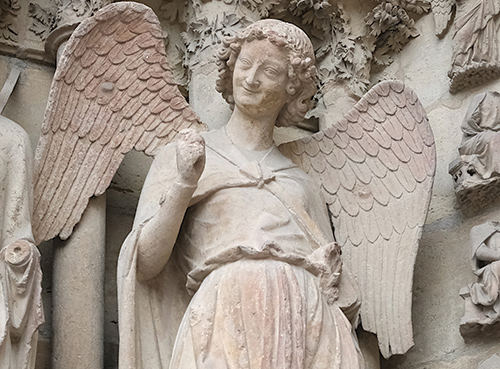
God cannot be overcome, of course, even if his sanctuaries suffer sacrilege. The north portal of the cathedral’s façade testifies to this truth with its “struck and broken” figures who, nonetheless, endure in benediction to all who come before them as pilgrims. One especially, the “Smiling Angel,” Gabriel at the Annunciation, carved in the early 13th century, continues to gaze with joyful serenity. He comes to Mary to bring the greatest news: the Savior has come to begin the great work of restoration. Though restored after being hit in the head during the bombardment, it continues, in its partially broken state, to proclaim this message and the power to endure.
Movie
God has not asked us to build a perfect civilization on earth. We have received many cultural treasures that can help us to order our minds, imaginations, and lives to what is true, good, and beautiful. These things, however, should not become distractions, incline us to concentrate on earthly achievements, or obsess about recovering lost treasures. The Kingdom of God does not grow through our own efforts. We rely on the grace of God that often grows more through defeat than victory. Our film this month, “Of Gods and Men,” a French film directed by Xavier Beauvois (2010) points us to our ultimate goal, depicting the 1996 martyrdom of seven Trappist monks who willingly chose to remain in Algeria during its civil war.
Benedictines stand as the great rebuilders within Christian history, beginning with St. Benedict of Nursia himself. As a young man he fled decadent Rome around the year 500 to leave civilization behind, seeking solitude to become, unwittingly, the father of a new Europe. His monks built centers of prayer and culture that weathered the many storms of war, fire, and persecution. Benedict’s own monastery, Monte Cassino, was destroyed and rebuilt five times, suffering most recently from American and British bombers in 1944. By seeking the Kingdom first, the monks maintain earthly stability, finding the strength to endure hardships for the sake of Christ.
“Of Gods and Men” depicts the close relationship the monks maintained with their Muslim neighbors in their life of prayer and agriculture. They strove to maintain peace and neutrality during the war, receiving many warnings of their impending danger.
As a community, they faced a crisis of faith and purpose as they discerned the will of God. Recognizing their call to remain in the place where they had been sent to serve, they unanimously agreed to stay in willingness to lay down their lives. Beauvois portrays the peace and joy they found in a powerful last supper scene, as the monks listen to a hauntingly beautiful suite from Tsaichovsky’s Swan Lake that expresses the resolution of their tension, portrayed through intense close ups of their faces.
Their willing sacrifice expresses the Church’s deepest rebuilding effort, not simply with stones or even ideas. Following the footsteps of Christ, we must embrace a love stronger than death and any material destruction.
Conclusion
“Behold, I make all things new.” The world constantly falls to pieces while we unceasingly seek to put things back together again through the newness Christ brought into the world. Our selections this month offer hope that God will draw us into the great rebuilding of Sion, making us a place to dwell. As Catholics, we are like Virgil, who though our culture seems to burn before us continue a great legacy. God’s grace enlivens us for this work, which runs through us like the enduring strength we can hear in Beethoven’s symphony. The rebuilding of the cathedrals of Reims and Paris gives concrete expression to our ability to restore what has been damaged so that it may glorify God. The Algerian martyrs show us that we must embrace the task of rebuilding as a spiritual work that transcends our earthly life. Though our culture has fallen into spiritual decline, we have received the gifts we need both to endure and sow seeds for a new springtime.
Bishop Conley’s Humanities Syllabus
October: “The Task of Rebuilding”
Book:
“The Aeneid” by Virgil
Film:
“Of Gods and Men” (2010), Xavier Beauvois
Music:
“Seventh Symphony” by Beethoven
Poem:
“The Cathedral of Rheims” by Emile Verhaeren
Art:
The Smiling Angel of Rheims Cathedral
ADDITIONAL SUGGESTIONS
Book:
“Pan Tadeusz” by Adam Mickiewicz, on the survival of Polish Catholic culture during the build up to Napoleon’s invasion of Russia.
Film:
“Tree of Wooden Clogs”
Music:
“The Overture of 1812” by Tchaikovsky
Poem:
“The Second Coming” by William Butler Yeats
“The Angel with the Broken Wing” by Dana Gioia
Art:
“The Fire in the Borgo” by Raphael
“Introduction of Christianity to the German Primeval Forests” by Joseph von Führich
FOR CHILDREN
Book:
“The Wind in the Willows” by Kenneth Grahame
Film:
“WALL-E” (2008), Andrew Stanton
Music:
“The Lord of the Rings: The Fellowship of the Ring” Soundtrack by Howard Shore
Poem:
“Canadian Boat Song” by Thomas Moore
Art:
Reims Cathedral, additional images of the church and its statuary
