

A guest column from the
Diocesan Liturgical Commission
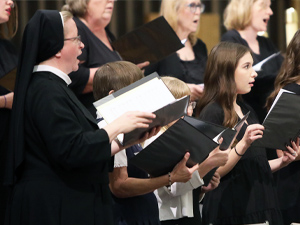
On Saturday, Oct. 3, musicians from around the Catholic Diocese of Lincoln, and friends from neighboring dioceses came together for a morning of reflection on prayer and music at the Cathedral of the Risen Christ. Dr. Richard Carrillo, choir director at St. Cecilia’s Cathedral in Omaha and at the University of Nebraska at Omaha was the speaker. He began by quoting the Catechism: “The musical tradition of the universal Church is a treasure of inestimable value, greater even than that of any other art” (CCC par. 1156).
It is never enough to merely make a beautiful noise: music without prayer is just noise. How does this relate to our music at Mass? We can begin by truly being conscious of the prayers we are singing. It is easy to become accustomed and even nonchalant about the Psalm or the parts of the Mass that we sing week in and week out. Rather than running through them as an afterthought or rushing through them in the Mass itself, we should recall why they are sung so frequently to begin with. For the Psalms, not only are they millennia-old prayers that we can pray from the heart, but further, they are God’s Word itself, and the Church instructs that they be proclaimed from a prominent place. With singing part of the Liturgy of the Word, we play a part in making God present for those at Mass.
The “Glory to God,” “Holy,” “Lamb of God,” etc. are also sung each week and, perhaps, easy to do by rote without reflecting on the meaning. The first question to ask ourselves is: why are they sung every week? The answer, of course, is that they are part of the Mass itself, truly the most important things that we sing, above the hymns and songs.
Carrillo encouraged the cantors, singers, and choir members in attendance to take time to reflect on what the words of the Mass parts mean and what we are praying. In these prayers, we offer praise, ask for God’s mercy, and confess our faith.
“AMEN!” We sing this word after the Doxology, as the priest elevates the Eucharist and declares “Through Him, With Him, In Him…” Even in this seemingly simple word, we have the call to pray because it means “I believe! So be it!” Do we sing it as merely a reflex, or as a prayer that expresses our faith?
Music ministry is both work and prayer. We practice and do our best, but should always be mindful of being in God’s presence. Carrillo reminded participants at the music retreat that what we’re doing is an act of love—showing God’s love to the congregation, to the wedding couple, to the mourners at a funeral, but we are primarily singing to God. We should work hard to prepare our body to sing with proper technique, diction, and accuracy, but ultimately, we should prepare with prayer so that our music, even when we make mistakes, is oriented to the Lord and bringing His love to those worshipping with us at Mass.
Our generosity is a tiny example of God’s love. In fact, the One who is most invested in our choir, in our efforts to sing or cantor for Mass, and the most invested in each of us individually is God Himself. We should never lose sight of the reason we sing in our worship: we sing for Him and to Him.
We might not always feel particularly like we are actually praying in the midst of life’s busyness or the moments of flipping through our music books to make sure we know what is next. Dryness and distractions are frequently a part of life even when we are participating in the Mass so closely with our music, but in this too, we should be intentional with our prayer. Finding joy and praise even in the darkness, dryness, or mistakes in life or music and bringing who we are and what we have to the Lord.
In Acts chapter 16, we learn the story of a miraculous release from prison for Paul and Silas, but it is remarkable to note when they began singing songs of praise. “About midnight, while Paul and Silas were praying and singing hymns to God…” it was before the miraculous earthquake, while they were imprisoned and chained, that they sang to God.
What a gift that the Church calls us to sing as we worship God at Mass, and at every rehearsal and Mass, we are given the opportunity to offer our song united with our prayers and an offering of love and praise to our Creator.
Read more about the Liturgical Commission helping parishes 'give their greater gift'
