

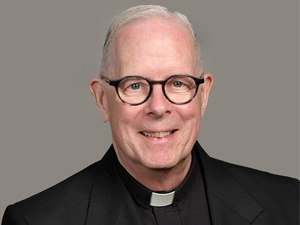
Guest column by Msgr. Timothy Thorburn
Pastor of Sacred Heart Parish in Lincoln
Diocesan Director of Cemeteries and Calvary Cemetery
“Requiem aeternam dona eis, Domine, et lux perpetua luceat eis.” Eternal rest grant unto them, O Lord, and let perpetual light shine upon them.
When I was a boy of about 10 years old, after a very pointed religion class on vocations to the priesthood and religious life, my fifth grade teacher, Sister M. Macarina, asked us what we wanted to be when we grew up. Many got the point and said that they wanted to be priests or sisters. But there were also some lawyers, nurses and other careers mentioned. I announced I was going to be a mortician.
 I said that, in part, because I was being a smart-aleck and wanted to say something different than everyone else.
But it was not entirely false. Knowing very little about it, I was attracted at some level to that vocation. In retrospect, I think it may have had something to do with the untimely death of my father the previous year. Children’s minds can deal with death in very strange ways sometimes.
As it turned out, I did not become a mortician, but I did end up being the only boy in that class who became a priest.
And perhaps, as an expression of God’s sense of humor, I did end up working in the funeral industry, as I have served in various capacities at Calvary Cemetery now for nearly 15 years!
I also served for many years as chaplain for our Discalced Carmelite nuns in Valparaiso, and it was there that I came to love and appreciate the ancient form of our Roman Rite. In that setting I discovered the power of the beautiful chants of the Solemn Requiem Mass to pray for the dead and console hearts that have been wounded by the death of ones they loved.
Masses in the Roman Rite are often given names or labels by the first words of the introit or entrance antiphon.
The “headline” of this article comes from the first words of the introit for the Mass of the Dead, both in the ordinary and extraordinary forms of the Mass.
Because of All Souls Day, November is traditionally a time when Catholics remember, in a special way, those who died. To that end, a solemn, or sung Requiem Mass in the extraordinary form of the Roman Rite will take place at Sacred Heart Church in Lincoln on Saturday, Nov. 21, at 10:30 a.m. All are invited to participate in that Mass and pray for their beloved dead.
A solemn, or sung Requiem Mass in the extraordinary form of the Roman Rite will take place at Sacred Heart Church in Lincoln on Saturday, Nov. 21, at 10:30 a.m. All are invited to participate in that Mass and pray for their beloved dead.
Why do Catholics pray and have Masses offered for those who have died? Have they not been judged and their eternal destiny to be with God in heaven, or apart from him in hell for all eternity been decided? That is true. But that does not account for the fact that those who are destined for heaven may not be ready to be there at the time they die, because they have not yet fulfilled the requirement Jesus set to be “perfect as my heavenly father is perfect.” (Mt 5:48)
But did Jesus not atone for our sins on Calvary? Yes, he did. And for one who dies in his grace, that means they are certainly destined for heaven. God is so merciful to us!
Yet we must also remember that God is also just, and that our sins cause real damage, not only to our own souls, but to others, indeed the whole Church. A thief may be forgiven, yet still be required to repay what he had taken, and so our purification in purgatory is a restoration of the damage our sins had caused.
But our prayers, and particularly the most powerful prayer, the Mass, truly help those who have died to fulfill the requirement of justice, even after mercy has been bestowed by God’s forgiveness.
The Solemn Requiem Mass that will be celebrated at Sacred Heart in the extraordinary form will be entirely in Latin, except for the homily. Claudio Casciolini’s Missa pro defunctis, as well as the Gregorian chants of the Requiem Mass, will be featured as sung by the Sacred Heart Schola Cantorum under the direction of Mr. Nikolas Barger.
One of the features of a Solemn Requiem Mass is the presence of a “catafalque.” A catafalque is an empty casket in place in the church as if it were actually a funeral, which may sound strange, but there is a twofold reason for this.
The catafalque represents all of the dead we are praying for, but it also represents “everyman” that is, each one of us, for one day, we will die, and our bodies will be brought to the church in a similar way for our Requiem Mass. This Mass is particularly intended to be an opportunity to pray for the dead and to pray for ourselves, that we will be ready whenever death may come for us.
It is important to remember that the Church teaches us not to fear death. Saint Paul mocks death in 1 Corinthians (15:55) when he states, “O death, where is your victory? O death, where is your sting?” And the Preface of the Mass of Christian Burial encourages us by its words,
“In him the hope of a blessed resurrection has dawned, that those saddened by the certainty of dying might be consoled by the promise of immortality to come. Indeed, for your faithful, Lord, life is changed, not ended, and when this earthly dwelling turns to dust, an eternal dwelling is made ready for them in heaven.”
A mistake that Christians can make is to try to deny death. Today many opt for some form of a “celebration of life” to deal with death casually rather than prayerfully. While it is good to remember the joyful and happy times of one who has died, survivors need to deal with their pain and grief when a loved one dies.
The funeral rites in a Catholic Church help us to deal directly and effectively with death, but they also inspire us to do something. At death, many feel helpless. They are not. They can, according to the Church’s tradition, help those who have died to be purified of the remnants of their sin, and the just punishment due for their sins. We also piously believe that those who have died can pray and offer their suffering for us. This exchange of prayerful love, therefore, can continue even after loved ones have died.
During the month of November and indeed, throughout the year, let us not forget to pray for those who have gone before us. Let us instill in our own hearts, and those of our children, the responsibility we have, in charity and justice, to include the faithful departed in our daily prayers and by means of the most powerful of prayers, the Holy Sacrifice of the Mass.
“Eternal rest grant unto them, O Lord, and let perpetual light shine upon them. May they rest in peace. Amen.”
