

by Bishop James Conley
Last week, the Church celebrated the Solemnity of Corpus Christi, translated literally as “the Body of Christ.” It’s a beautiful feast as it is a celebration of the gift of the Institution of the Holy Eucharist itself.
Corpus Christi is suitably celebrated with grandeur, splendor and magnificence as parishes throughout the world honor our Blessed Lord with outdoor Eucharistic processions, with canopies suspended over the priest carrying the Blessed Sacrament, flanked by altar servers with candles and the fragrance of incense rising to the heavens. There is a beautiful tradition of boys and girls who recently received their First Holy Communion joining in the procession donned in their First Communion attire.
We have these beautiful processions, accompanied with such splendor because the Eucharist is truly a gift to us. In the Eucharist, Jesus continues to give of himself to us and remains with us. In the Sacred Scriptures, we meditate on the complete outpouring of God’s love for us. God the Son humbles himself by taking on human flesh in the incarnation, suffers a brutal death on the cross, is resurrected from the dead by the Heavenly Father, and continues to be present to us under the appearance of simple bread and wine in the Holy Eucharist. Saint John Paul II would often speak of building a culture of “Eucharistic amazement.”
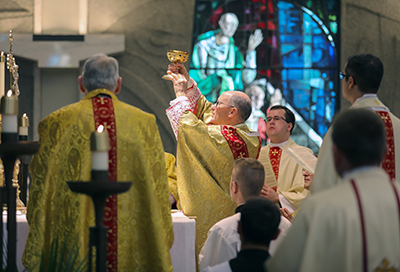
As Catholics, we believe in the Real Presence of Jesus Christ in the Eucharist. The Eucharist looks, tastes, and smells like bread and wine, but is changed substantially into the body, blood, soul and divinity of Jesus.
When I was studying at the University of Kansas but not yet a Catholic, the truth of the Real Presence of Jesus was instrumental to my eventual conversion to the Catholic faith. The words of Jesus in John’s Gospel, chapter 6, continued to intrigue me: “Amen, amen, I say to you, unless you eat the flesh of the Son of Man and drink his blood, you do not have life within you. Whoever eats my flesh and drinks my blood has eternal life, and I will raise him on the last day” (John 6: 53-54). If I really believed these words to be true, then I had to become Catholic.
One of the truly awesome blessings of being a priest and a bishop is the privilege to offer the Holy Sacrifice of the Mass every day. A priest offers the Holy Sacrifice of the Mass with and for the people of God. The priest offers up the body, blood, soul and divinity for the salvation of the world. The priest re-presents the self-same sacrifice of Christ on Calvary to the heavenly Father, who in turn accepts the sacrifice and returns it to us as food for our souls.
Neither the priest celebrating the Mass, nor the people of God fully realize the treasure that is the Eucharist. It’s enshrouded in mystery. St. John Vianney said of priests, who celebrate the Eucharist, “Were we to fully realize what a priest is on earth, we would die: not of fright, but of love.”
However, we need to face the reality that a true and authentic understanding of the real gift of the Eucharist, even among Catholics, is diminishing. If the polls are correct, some 70% of Catholics do not believe in the real presence of Christ in the Eucharist. This reality is extremely troubling.
There are many possible factors that might lead to such a high number of Catholics who do not believe in Christ’s presence in the Eucharist. Secularization is evermore encroaching in the institutions of our country and throughout the Western world. In a highly scientific culture, belief in miracles are hard to accept.
Many Catholics are baptized and perhaps confirmed and probably consider themselves Catholics, but never really practice the faith. In addition, the dispensation from the obligation to attend Mass on Sundays and Holy Days of obligation due to the global pandemic, while necessary, has likely led to confusion about the gift of the Eucharist.
Whatever the reasons, the statistic is distressing. The Eucharist is a central teaching of the Catholic faith. If the Eucharist is “the source and summit of the Christian life” as Vatican II states, and so few Catholics understand it, then we have real work to do in evangelization. All Catholics, including bishops, priests and the lay faithful, have a role to play in restoring a true understanding of the Eucharist by our words and the example of our lives.
Next week, the United States Conference of Catholic Bishops (USCCB), will address the issue of “Eucharistic coherence.” Archbishop Charles Chaput, archbishop emeritus of Philadelphia, described Eucharistic coherence as “conforming our private and public lives to what the Church teaches and what we claim to believe as Catholics.” The bishops will vote on developing a teaching document on how to bring about a greater understanding of the beauty, mystery, and wonder of the Holy Eucharist.
Throughout my time as bishop of Lincoln, I have stressed the blessings of Eucharistic Adoration. In 2017, I wrote a pastoral letter, “Love Made Visible,” on Eucharistic Adoration. Many parishes throughout the diocese have vibrant—and long-lasting—Eucharistic adoration programs. Eucharistic adoration brings life to a parish; it leads to vocations to the priesthood and religious life; and it leads to holy marriages.
It’s a very simple reason as to why adoration produces such beautiful fruit. Adoration unites us to Jesus Christ. When we gaze upon Jesus in the monstrance, it’s the same Jesus who walked the shores of Galilee; it’s the same Jesus who died on Calvary; it’s the same Jesus who rose from the dead. He’s there in the Eucharist and he will come near us if we invite him.
Adoration should draw our hearts and souls to Jesus like a magnet so we can be one with him. Every day, all of us should make an examination of conscience to see where we are falling short of being united with the Lord.
In his little book on the Eucharist, “God is near us,” Pope Emeritus Benedict XVI addresses the impact of Eucharistic Adoration on our individual consciences. He says, “The adoration of the Lord in the sacrament is also an education in sensitizing our conscience. ‘Christ comes into the hearts of our brothers and sisters and visits their consciences.’ When the conscience becomes dulled, this lets in the violence that lays waste the world.”
This is why public figures such as politicians and other prominent public leaders who claim to be devout Catholics but hold positions clearly contrary to the Church’s teaching, need to re-examine their lives and should not present themselves to receive Holy Communion until they be reconciled with the Church.
Their words and actions in public life need to be consistent and coherent with their faith. When public figures who claim to be devout Catholics hold positions that oppose the sanctity of human life and contradict God’s plan for human sexuality, they put their own eternal souls at risk, and they cause scandal and confusion for both Catholics and non-Catholics.
Ultimately, it is a question of unity and love in the Body of Christ. The Holy Eucharist is the sacrament of unity, and it calls all of us to live lives that are integrated; lives where our faith and our actions are consistent and coherent. The Eucharist is also a sign of love, the mission of love we share with Jesus Christ for the salvation of the world. As I wrote in “Love Made Visible”:
“In the Eucharist, we are made sharers in Christ’s mission of love... He has given us—the Church—a mission. And in the gift of the Holy Eucharist, he has given us himself, so that as we follow him, we can be unified to his life, and he can be present, with us, at all times, until the end of the world.”
