

By Cathy Blankenau Bender
Editor-in-chief
Five couples at Cristo Rey Parish in Lincoln celebrated a boda comunitaria, or community wedding Mass Saturday, July 11.
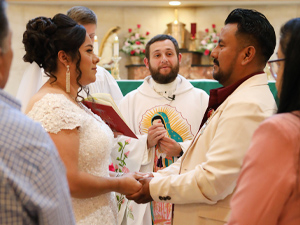 During the Mass, each couple came forward one at a time to profess vows, and each couple was assisted by padrinos – godparents or sponsors – as they participated in cultural traditions. They exchanged arras, or coins, to symbolize shared responsibility and mutual trust, and they were draped with a lazo (“lasso”), or cord, that represents unity during the nuptial blessing. Friends and family attending also brought forth gifts for the couples to be blessed. Each couple also presented a bouquet of flowers at an image of Our Lady of Guadalupe.
Father Rafael Rodriguez-Fuentes, pastor of Cristo Rey Parish, was the main celebrant of the Mass, and Father Dominic Winter received the vows. Father Winter was assistant pastor of Cristo Rey Parish until June 15, when he began his new appointment as pastor of St. Benedict Parish in Nebraska City.
(Story continues below)
SNR photos | Cathy Blankenau Bender and Sarah Schinstock. Click for more photos.
After preparing four of the five couples for the community wedding, he said he was “giddy with excitement” for the community wedding Mass.
Over the last few years, Father Winter said, Father Rodriguez had considered the idea of a community wedding. It’s a fairly common occurrence in Latin American countries, he explained, especially in areas where there are few priests.
“In Cristo Rey’s case, many immigrant families would like to have a big, momentous wedding,” he said, “but they are prevented by many factors including cost, distance from family, and lack of connection with the community.
“I could see that the community wedding helps with all those circumstances at once,” he continued. “All the couples could have the thrill and the grace of a beautiful wedding in a packed church, without inviting too many people or paying any large costs.”
Having the ceremonies together also led to a natural sense of community, as the couples celebrated together and the guests joined in prayer for all of them.
All the marriages July 11 were convalidations, meaning the couples were already civilly married and needed their marriages to be validated by the Church. The United States recognizes wedding ceremonies performed by clergy, but in many countries, particularly in Europe and Latin America, governments require that a marriage ceremony be performed by a state official. Catholics are expected to follow a civil wedding with a religious liturgy.
“Often, civil marriages actually delay the religious wedding, rather than speed it along,” Father Winter said. “Many couples, especially the husbands, already feel secure in their relationship and have little motivation to take the leap of faith” toward convalidation.
He said the parish wanted to remove this obstacle as well, so the community wedding assists by planning all the details of the wedding Mass: the date, time, flowers, music, photographer, ministers, readings, and other items.
“Much less initiative is required when so many of the decisions are already planned out,” he said.
In most of the couples, the bride was first to seek out the religious wedding, Father Winter noted.
“But I was gratified—and amazed—when all the grooms eventually embraced the preparation with a truly good will, and even seemed to become visibly more peaceful,” he said. “Naturally, the brides also mirrored their husbands’ good attitudes. Only time will tell, but I truly believe all of these five couples will continue to practice the faith as a family for many years to come.”
Father Rodriguez agreed.
“The Lord is so good to us that he strengthens our faith through the sacraments,” he said. “When a couple decides to marry in the Church, they invite God to be an integral part of their marriage. In the case of convalidations, the couple, once married in the Church, can receive absolution in the sacrament of penance and they can also receive the Real Presence of Jesus in the Holy Eucharist.”
It’s beautiful, he added, to see newly married couples who, for many years have not been able to receive Communion because they were not married in the Church, to now come together to receive the Lord as a family.
“This truly strengthens the faith as a family,” he said.
This is so true that Witness to Love, a popular Catholic marriage prep renewal ministry, has launched a Witness to Love track specifically for couples who are seeking to have their civil marriages blessed by, or convalidated in, the Catholic Church. The guidelines lean heavily on a sense of community, and the couples seeking marriage or convalidation are led by mentor couples.
“Couples that are to be married pick a mentor couple that walks with them through the program Witness to Love,” Father Rodriguez explained. “They usually develop a good friendship as they share their experience and, more important, their faith, with the couple that is in preparation for marriage.”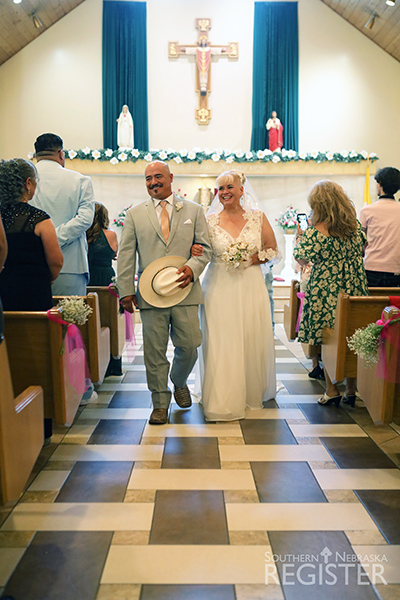
Two of the couples who had their marriages blessed July 11 began their preparation before Witness to Love was introduced in the Lincoln Diocese, but Father Winter said the other three couples enjoyed excellent mentor relationships in their preparation. He said when looking at the process, he thinks the community wedding lends itself to that peace he witnessed in the couples for two reasons.
“First, there are fewer distractions,” he said. “The couples can focus more on their real preparation when they are confident that the Mass is already set up.
“Second, the couples are humbler,” he said. “They were willing to sacrifice ‘their special day’ as individuals, in order to more readily receive the sacrament. Indeed, many people reading this article are probably taken aback by the very idea of a community wedding.”
He pointed out that Americans often lament the excessive pride, entitlement and sense of individuality witnessed throughout modern culture.
The community wedding, with its focus and humility, he said, “makes for much more fertile ground for the true practice of the faith after marriage,” he said.
“With God’s grace,” he added, “here and in the future, all these couples will achieve faith’s goal: their salvation!”
