

by Bishop James Conley
As we begin the new academic year with students of all ages returning to the classroom, it is also a time when our beloved seminarians return to the seminary for their ongoing formation, as they continue to discern the call to the priesthood.
In his post-conciliar document of the Second Vatican Council on priestly formation, Optatam Totius, St. Pope Paul VI described the seminary as “the heart of the diocese.” We are blessed within our own diocese to have St. Gregory the Great Seminary, a college seminary, where our seminarians begin their formation in preparation to become priests. As the heart continues to give life to the physical body, the seminary is a reminder of the life that continues in the Mystical Body of Christ, the Church, as a seminarian is formed to be alter christus, another Christ in the world. Without this seminary life in a diocese, there is little hope for the future.
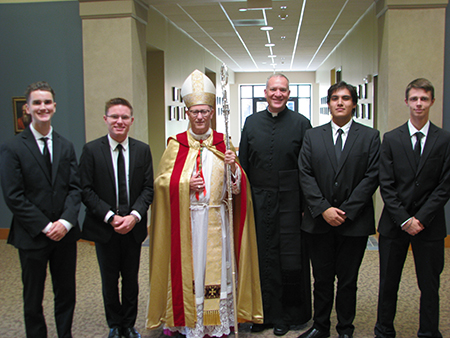 St. Gregory the Great may be referred to as a “college seminary” because those seminarians who have not yet received a college degree work towards receiving an accredited bachelor of arts degree in philosophy. Those who have already received a college degree enter a two-year, pre-theology program which prepares them for graduate studies in theology. After attending St. Gregory’s, seminarians attend a “theologate” for their final four years of seminary formation and engage in graduate level studies of theology. Currently we have seminarians studying theology at St. Charles Borromeo Seminary in Wynnewood, Pa., Mount Saint Mary’s Seminary in Emmitsburg, Md., and the North American College in Rome.
The six to eight years of seminary formation is aimed at forming the entire man into a future priest of Jesus Christ. A seminarian gains a well-rounded education in the study of logic, philosophy, literature, history, ancient and modern languages, in addition to the study of theology. This allows him to learn how to think and how to make a logical argument. He takes a step back from the world to see it in the context of the rhythms of history. He begins a regimen of prayer and work that can be modeled in his work as a priest.
This kind of formation is so essential for our times, as our nation and world grow ever more secular, away from the truths of Jesus Christ. In many ways, our own culture looks much like the culture the apostles faced as they went forth proclaiming the Gospel: secular, self-seeking and Godless.
But, our current cultural milieu should not cause us to despair. We look to the courageous witness of the great missionary St. Paul, who used his secular and religious studies to evangelize the world. St. Paul preached a famous sermon at the Areopagus in the ancient city of Athens. Paul was brought to the Areopagus—a court of public opinion—by the philosophers of the city of Athens. Quite literally, it was the public square, the hub of social and intellectual life in Athens. The Greeks heard what Paul was preaching, and they could not understand it. They asked him to explain the meaning of the Gospel.
At the Areopagus, Paul used the philosophy, the poetry, and the mythology of the Greek people themselves to proclaim Jesus Christ. He gave them the Gospel in a context that was meaningful to them. To be sure, he was mocked and ridiculed by many, and he won only a few converts that day, but he began a project to which the Church continues to be called—Paul proclaimed the Gospel to a new people, in a way that they could understand it, and in a way which might compel them to believe.
Paul could preach at the Areopagus because he knew the content of the Gospel. He knew, at a deep level, what the Incarnation, the crucifixion, and the resurrection actually meant. And, at the same time, Paul knew the culture of the Greeks. He knew their language and their philosophy and their art and their poetry. He knew their stories and their heroes.
Over the coming weeks, the Diocese of Lincoln launches our annual Bishop’s Appeal for Vocations (BAV). The BAV is the principal means by which the diocese pays for the educational costs of our seminarians.
The Lord gave us the priesthood to continue his redeeming work as priest, prophet, and king, as priests sanctify, teach and govern. That redeeming work of Christ is manifested everyday through the work of priests. Priests continue the sanctifying work of Jesus through the administration of the sacraments: they baptize our children, bring us the Bread of Life in Holy Communion, hear our confessions after we fall, be by a loved one’s bedside as they lay dying, giving them the anointing of the sick.
Our priests preach the Word of God in season and out of season, guiding us and giving us encouragement as we live our lives in Christ in a fallen world. Priests as tasked with a mission to lead and build parishes into a communities of discipleship, communities of love. Our future priests need integrated, well-rounded studies and formation to accomplish this mission.
We can’t even imagine a Church without priests, and we can’t have priests without men who are authentically discerning the call of serving the Lord in the radical way of being a priest forever.
Our goal for this year’s BAV is to raise $800,000 for our seminarians. I ask for your continued generous support in this endeavor. The theme for this year’s BAV is “We are servants of Christ and stewards of the mysteries of God.” All of us, as baptized Christians, are called to be faithful disciples of Jesus Christ. As disciples, we desire a closer relationship with Jesus for ourselves and for others. While not all are called to be priests, we live out our discipleship in our support of priests. We are all stewards of the mysteries of God because we are entrusted with the gift of faith. This gift of faith is our greatest gift in our lives and is manifested in gratitude and generosity.
I ask for your support of the BAV as your means allow. Your financial support is necessary in the continued formation of our future priests. But first and foremost, I ask you to pray for our diocesan seminarians. Pray for more vocations to the priesthood. We have been blessed in the diocese with many vocations to the priesthood. There is no doubt in my mind that much of this is attributed to the prayers of all the faithful: laity, priests, and religious. We have two cloistered, contemplative religious sisters in our diocese, the Pink Sisters and Carmelites, who pray fervently and frequently for vocations to the priesthood and religious life.
As “stewards of the mysteries of God,” vocations are the business of all of us.
In addition to your prayers, I ask you to offer your encouragement to our seminarians. Tell them you are praying for them; thank them for discerning the call. If you see a young man who is a faithful disciple of Jesus, devout and generous, encourage him to think about the seminary. As a former seminarian, I can tell you this goes a long way.
