by Bishop James Conley
The Diocese of Lincoln, with a population of nearly 100,000 Catholics, is largely rural. Our diocese includes 134 parishes and covers nearly 24,000 square miles, which is bigger than the country of Switzerland.
The agrarian life is the heartbeat of the entire State of Nebraska. All of its citizens and many of its industries are affected by the economy of agriculture, its surpluses and shortfalls. Many of the parishioners in the Diocese of Lincoln depend on agriculture for their very livelihood.
I have a personal love for the rural life because, although I grew up in the suburbs of Kansas City, I spent one and a half wonderful years “truck farming” in north central Kansas, after graduating from college.
A good friend of mine inherited his grandmother’s farm and he and his new wife invited me to try my hand at farming. We raised all our own food, organically, and sold produce to the local grocery stores in the area. Soon thereafter, another friend of ours from college and his wife, joined us. We were all recent converts to the Catholic Church, and we formed a little Catholic community in the midst of strong Missouri Synod Lutherans!
I have such fond memories of that year and a half, and I probably would have spent the rest of my life farming, surrounded by the beauty of God’s good creation, if it weren’t for the call to the priesthood. In fact, I am convinced that it was because of the silence and beauty of the rural life that I was able to discern and answer the call of God, to serve him as a priest. I shall always be grateful for those rural years in my early adult life.
During these early days of spring, I find myself in the thick of what could be termed “Confirmation season,” out on the “ol’ Chrism trail,” as I like to say! I have been traveling throughout the diocese this spring to parishes, both urban and rural, administering the sacrament of Confirmation to our young people.
When I preach to our youth receiving Confirmation, I tell them that they are made for greatness, and I try to instill in them the desire to become saints for this is our great, universal calling. No one is called to a life of mediocrity. God wants us to live lives of great purpose and meaning on this earth, and to be with him for all eternity in heaven. The Lord has called us to great things, and the greatest of these things is to imitate him perfectly in our Christian lives. The Lord is patient with us. He knows our weaknesses, but he also knows our gifts, and he will use those gifts to help us grow closer to himself.
St. Teresa of Avila said famously, “Bloom where you are planted.” God has given all of us the particular and unique circumstances of our lives for a reason. We are meant to blossom in those environments.
As I travel throughout the diocese, I can’t help but think about how God has called so many in our diocese to become saints as farmers and ranchers, with the rural life as a means to holiness. Our Lord himself honored the work of farmers by using parables from rural life. There are parables about a sower, vineyards, and the mustard seed. In Luke’s Gospel, Jesus says, “No one who sets a hand to the plow and looks to what was left behind is fit for the kingdom of God” (Lk. 9:62).
We all live within the context of Divine Providence. The Lord has a plan for each one of us, even if that plan is not always abundantly clear. The heart of being a disciple of Jesus is to trust him to lead us down the path that he takes us in our lives. We should see our lives as gifts from God, where we receive a share in God’s life and, thus, share in his generosity. To live this out, Christian disciples must make the daily choice to trust in the providence of God, Jesus, I trust in you as we just proclaimed on Divine Mercy Sunday.
Farmers and ranchers are particularly attuned to the providence of God. Farmers are successful when they put their heart into their work. They do this by knowing the land and following the best agricultural practices. But they are also dependent on things that are totally out of their control. Their crops need to receive the right and timely amount of moisture and sunshine. They need the blessing of good weather. They need to receive fair and just prices on their harvests.
This past week, farmers, ranchers, and inhabitants of several towns in rural Nebraska have been impacted by the recent wildfires. A combination of an unusually dry spring and high winds has produced wildfires throughout the state, including the central and western part of our diocese.
The towns of Cambridge, Indianola, parts of Benkelman, as well as others, were under mandatory evacuation orders due to the danger the fires posed. Several have been injured and as of the printing of this column, one man, a retired Cambridge fire chief, was killed.
I have spoken to all the pastors of areas affected by the wildfires, and I have promised them my prayers. I ask everyone to pray for the deceased, the injured, those who have lost property and equipment and all who are affected.
Father Kenneth Wehrs, pastor of St. John the Baptist Parish in Cambridge and St. Germanus Parish in Arapahoe, had to evacuate from Cambridge on two separate occasions. Father Wehrs expressed to me that their greatest needs right now are hay for livestock and fencing supplies because there are hundreds of miles of fencing that have been destroyed. Please be generous in your support of those in need.
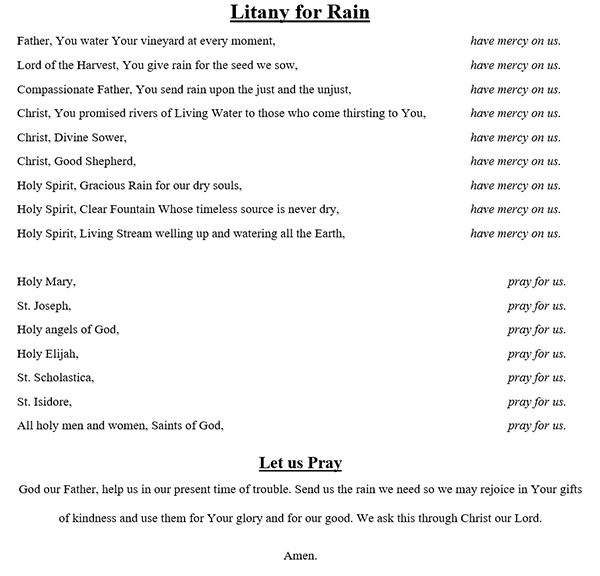
I have an urgent plea for all: please pray for rain, especially in areas affected by the wildfires and areas of severe drought. Meteorologists have forecasted that many parts of Nebraska will remain in a very substantial drought. This drought will cause serious problems for crops and livestock as we move into the summer if we do not receive increased moisture.
Due to this grave concern, I am allowing priests of the Diocese of Lincoln to celebrate votive Masses for rain, at the discretion of the celebrant. Normally during the Easter Season, votive Masses are not to be celebrated unless for serious pastoral reasons, but this certainly is one. I encourage any priest to celebrate this votive Mass, as they see fit, for the foreseeable future.
Farmers and ranchers put in much hard work to produce food for the whole world, and we are grateful for that. They take great risks, relying on the providence of God, to provide for our sustenance. Through the intercession of St. Isidore the Farmer, we pray for all farmers and ranchers. We pray in particular for those affected by the wildfires in central and western Nebraska. May the good Lord, the Lord of life, watch over them and keep them safe.
Editor’s note: Hay donations may be made to Daffer Feed Yard on Hwy 89, 2 miles west of Danbury; and ODea farms on Hwy 6 and 34, a mile west of Indianola. Fencing Supplies may be sent to Bartley Fire Hall two blocks north of Highway 6 and 34 next to the city park. Or venmo: https://account.venmo.com/u/farmer-firerelief.