

by Bishop James Conley
December 12 is the feast day of Our Lady of Guadalupe. History teaches us that the Blessed Virgin Mary appeared to St. Juan Diego at a place called Tepeyac Hill in Mexico, which later became Villa de Guadalupe, a modern suburb of the metropolitan city of Mexico City, with a population of just over 22 million souls.
In 1531, when Our Lady appeared to Juan Diego, an indigenous peasant who lived in the area, Tepeyac was a small hill in the desert. The first apparition took place on the morning of Saturday, December 9, 1531, which is now the feast day of St. Juan Diego. He was beatified by St. John Paul II May 6, 1990, and canonized a saint by the same St. John Paul II July 31, 2002, both ceremonies taking place in Mexico City.
According to the accounts of the day, the “woman,” speaking to Juan Diego in his native Nahuatl language (the language of the Aztec Empire), identified herself as the Virgin Mary, “mother of the very true deity.” She asked Juan that a church be built on that site in her honor. A basilica was built and the site is now the most visited Catholic shrine in the world, and the world’s third most-visited sacred site.
A unique aspect of the Marian apparition of Our Lady of Guadalupe is the fact that it continues to be an ongoing miracle. Not surprisingly, when Juan Diego went – as instructed by the Virgin – to the Bishop of Mexico City, the Most Reverend Juan de Zumárraga, to ask him to build a church in honor of the Blessed Virgin Mary, the bishop did not believe the peasant man. Juan Diego spoke to Bishop Zumárraga a second time the next day, Sunday, December 10, 1531, and the bishop asked Juan to return to Tepeyac Hill to ask the “woman” for a miraculous sign to prove her identity. Juan Diego related this to the woman, who promised to show him a sign the next day.
On Monday, December 11, Juan Diego’s uncle, Juan Bernardino, became gravely ill. Juan felt obligated to attend to his uncle, and so avoided going to Tepeyac Hill. In the early hours of the morning on Tuesday, December 12, his uncle took a turn for the worst, and Juan journeyed to Tlatelolco to fetch a Catholic priest to come hear Juan Bernardino’s confession and administer to him the Sacrament of the Sick, on his deathbed.
In order to avoid being delayed in his mission of mercy to his uncle by the “woman,” and also being ashamed at having failed to meet her on Monday, Juan Diego chose another route around Tepeyac Hill. The Virgin, however, intercepted him and asked where he was going. Juan Diego explained what had happened and the Virgin gently chided him for not having made recourse to her. In the words which have become the most famous phrase of the Guadalupe apparitions, and are now inscribed above the main entrance of the Basilica of Guadalupe, she asked: “¿No estoy, yo aqui que soy tu madre?” (Am I not here, I who am your mother?”).
The Virgin assured Juan that his uncle had now recovered and told him to gather flowers from the summit of Tepeyac Hill, which was normally totally barren, especially in the month of December. Juan Diego obeyed her instruction and found, to his surprise, an abundance of Castilian roses, not native to Mexico, in full bloom.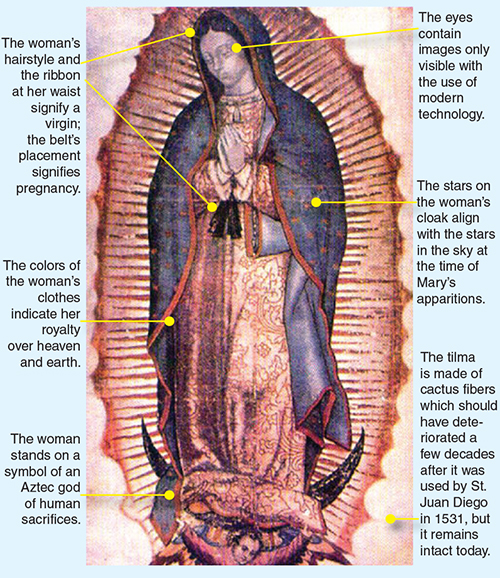
According to the story that has been handed down, the Virgin arranged the flowers in Juan Diego’s tilma, or cloak, and then instructed him to go to the bishop’s house and show him the roses. When Juan Diego presented himself before Bishop Zumárraga and opened his cloak, the flowers fell to the floor, revealing on the fabric of cloak, the miraculous image of the Virgin of Guadalupe.
There has been no adequate scientific explanation of how the image imprinted itself on the tilma and remains to this day, nearly 500 years later, as an ongoing miracle. The tilma is lit up and beautifully displayed behind protected glass in the sanctuary of the Basilica of Our Lady of Guadalupe in Mexico City.
Another unique aspect of the story of Our Lady of Guadalupe is the fact that Mary appeared to Juan Diego as an expectant mother, dressed in traditional maternal garb of the indigenous women of that region. She spoke the native dialect and she related to Juan Diego as a trusted family member.
This is why Our Lady of Guadalupe is considered the Star of the New Evangelization. She is absolutely relatable. She does not judge those around her. She is truly multicultural and is attractive to a diverse population. She embodies everything we think of today when we speak about diversity, equity and inclusion. She draws all cultures to herself and she carries within her womb all truth, goodness and beauty.
Our Lady of Guadalupe appears as a bright star in the night, shining through the darkness of the evil of child sacrifice – the religion of Juan’s day – and continues to cast a shadow over our own age, in the scourge of abortion. The Virgin appears as the patroness of the unborn and the maternal protector of all human life. She listens to and welcomes all life. She is receptive and attentive to the needs of those around her: the childlike, the ill, the marginalized, the migrant, and the oppressed. She nurtures all in her maternal and feminine genius. In her fecund beauty, she empowers, encourages and enlightens.
And in her very womb, she carries within her the Bread of Life. If it were not for the incarnation of the Word made flesh, which took place within her virginal womb, we would not have the Holy Eucharist. She gave the Son of God his genetic make-up, flesh and bone, human life and breath.
This is why, in the Diocese of Lincoln, we are encouraging all the faithful, during this time of Eucharistic Revival, to consider making a pilgrimage to the Shrine of Our Lady of Guadalupe. Three pilgrimage groups this fall went to live with the poor and homeless, literally in the city dump of Mexico City, and to pray before our Eucharistic Lord in quiet adoration. What better way to spend five days of your life than with the miraculous image of the Blessed Virgin Mary of Guadalupe on the tilma of St. Juan Diego, the Real Presence of Jesus Christ in the Holy Eucharistic, and with the “least of my brethren”? For as Mother Theresa of Calcutta would often say, “unless we believe and see Jesus in the appearance of bread on the altar, we will not be able to see him in the distressing disguise of the poor.”
To register for a pilgrimage, email This email address is being protected from spambots. You need JavaScript enabled to view it..
