By Bishop James Conley
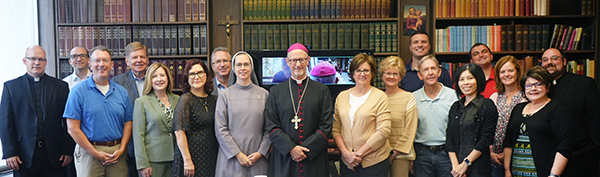
On Saturday, Sept. 14, the 12th anniversary of my episcopal appointment in Lincoln, I convoked the inaugural meeting of the Diocesan Pastoral Council (DPC) for the Diocese of Lincoln. While most everyone likely knows what a parish pastoral council is, you might not be familiar with a diocesan pastoral council. Like parish councils, diocesan pastoral councils were called for in the documents of the Second Vatican Council, as well as in the revised 1983 Code of Canon Law. While not mandatory (like finance councils at the parish and diocesan levels), diocesan pastoral councils are “highly recommended” in Church documents.
The Vatican II Decree on the on the Pastoral Office of Bishops in the Church, “Christus Dominus” (Oct. 25, 1965), says this:
It is highly desirable that in every diocese a special council be established, over which the diocesan bishop himself presides and in which clergy, religious and laity specially chosen for the purpose will have a part. It will belong to this council to investigate, to consider, and to formulate practical conclusions about those things which pertain to pastoral works.
While it is true that not every diocese has a diocesan pastoral council, over the years I’ve thought and prayed about how a council of this sort might be beneficial to me and to the diocese by way of pastoral planning for the future. In my letter to all the priests earlier this month, I wrote: “A diocesan pastoral council helps advise the bishop in his role as shepherd of the local church and allows a forum for the bishop to share his pastoral vision with selected and proven lay leadership in his diocese. The DPC is primarily lay in membership, advisory/consultative in nature, and deals broadly with all issues and opportunities impacting the pastoral life of the Diocese of Lincoln and the wider Church.”
One might rightly ask, how does the bishop select the members of the DPC? In June, I wrote to all the pastors in the diocese asking them to offer names of proven lay leaders who might be willing to serve. I wanted to have representation from all 15 deaneries, north and south, east and west. I also wanted to have a wide diversity of ethnic backgrounds, as well as men and women of all ages. I asked pastors to send me the names of up to three laypersons “of good character” who are “active and engaged in the Church… entirely faithful to her teachings, and sacramentally regular in their status.” My pastors were very responsive, and I received more than enough names from which to choose. Not everyone I invited to serve was able to make such a commitment due to family, work, or other obligations, but 16 people said yes. With the addition of the four “ex-officio” members from my senior staff, we have a council of 20 members, three clerics, one religious sister and 16 lay faithful.
In another Church document, Omnes Christifideles, we hear these words:
Members of the pastoral council should reflect the entire diocese, and the majority of members should be lay since the greatest part of the diocesan community is composed of laity. Certainly, the council is consultative; still, its recommendations are of great help to the bishop in coming to a decision. The actual obedience and reverence which the faithful should show their sacred pastors fosters an open and sincere manifestation of what is needed for the good of the Church. The bishop should greatly esteem the council’s propositions and seriously consider the judgments on which the councilors agree, preserving the freedom and authority which are his by divine law for is pastoral service to that portion of the People of God committed to his care (OC 7 and 8).
The Diocesan Pastoral Council will meet quarterly, and each member is asked to serve for a three-year term. The council always meets on a Saturday from 10 a.m. to 2 p.m. and includes a light lunch. For those who can make it, I offer Holy Mass at 9 a.m. in the Cathedral of the Risen Christ.
With the help of Jennifer Gutierrez who served as our facilitator, we spent the first session introducing ourselves and getting to know one another. Jennifer then led us through a “listening session” to hear from the members what they see as strengths and challenges in the diocese, and what their hopes are for the future. I am grateful to Jennifer for facilitating this first meeting and helping us get the DPC off the ground and running.
In the afternoon session, we invited Marion Minor from the Nebraska Catholic Conference to speak to us on the challenges Catholics face in the public arena, particularly with regard to the ballot initiatives that we will be voting on in November. Through the course of his presentation, we learned of the urgency of these issues, convincing us more than ever that we must do all we can to defeat the pro-abortion initiative 439. I urged all of our members to go back to their parishes and deaneries and talk to their neighbors and larger communities about how important it is to vote to protect women and children. After our discussions and listening to the DPC members, I just can’t see how any Catholic or Christian in good conscience could ever vote in favor of initiative 439.
I was very pleased with the first meeting of the Diocesan Pastoral Council, and I was extremely edified and humbled by the zeal and faith of the members. The call of the DPC members, and of all the lay faithful in our diocese, is to bring each other into the Church in a greater way through our pastoral works. The advice and counsel of the DPC will be a valuable instrument that will strengthen our connection with each other, diocesan-wide, as we accept this pastoral call and walk together to fulfill this mission. I look forward to working closely with the DPC as we plan and pray for the future of the diocese, which will include opportunities for all of you to take part in listening sessions to share your hopes for the future of our diocese. More information will be provided in the coming months. Please keep this initiative in your prayers.