Why Latin? Why chant?
In recent years, there has been a movement in the direction of bringing Latin and chant back into the Church. The natural question asked by many is “why?” When Pope Emeritus Benedict XVI opened the Year of Faith, he encouraged all to read the documents of the Second Vatican Council. With regards to music, the Second Vatican Council gave Gregorian chant “pride of place” among the many forms of liturgical music. By singing Gregorian chant at the Mass, we are falling more in line with the teachings of the Church, as set by the council. Some may fear that we are taking a leap backwards. This is not the case. We are simply taking the beauty of the old, (extraordinary form of the Mass) and using it to enrich the new (the Mass as we know it today). Imagine a pendulum, swinging from the Latin masses before Vatican II to the Novus Ordo (new order) which sprung out of the conclave. Pope Benedict appropriately gave us notice that the documents of Vatican II actually placed the pendulum in its proper place, balancing the beauty of both Forms of the Mass. This means that the church continues to live and grow musically, while also treasuring the music and language of our 2000 year history.
Why should the “non-musical” parishioner care?
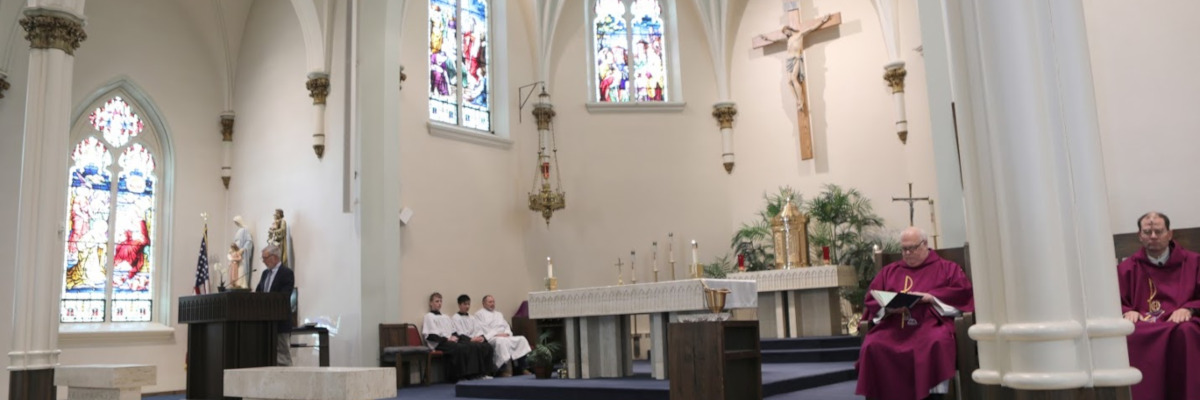
The architecture of places like the Newman center and other Gothic style churches is designed to lift us up to God, taking us heavenward the moment we enter into the sacred space. The same should be said about the music that is a part of the sacred liturgy. Everything from the “Amen” that we chant to the hymns we sing should have the same effect, lifting us heavenward.
Participation during Mass has several layers. A parishioner can outwardly participate by speaking the prayers, singing the hymns and responses, and kneeling or sitting at the appropriate times. The other layer of participation at Mass can often go unlooked. This is the idea of an inward, or silent prayerful participation. When a chant or a song you may not know is sung during the Mass, that opportunity can be used to prayerful observe the priest performing his sacred duties and meditating on the message of the day. This active and inward participation is exactly why the average parishioner should care about understanding the role of music in the sacred liturgy. Through this understanding, you are able to fully enter into the sacrifice at the altar throughout the entire Mass, giving yourself less opportunities to become distracted and step out of your daily cares and worries, entering into something greater than ourselves that transcends our earthly desires.
Why should we even care about the documents of Vatican II? Aren’t we going backwards?
Today, in 2016, when we think about the Second Vatican Council, our minds jump to the 1960’s. Our immediate response is that was over 50 years ago. That seems like a very long time ago, but in the vast 2000 year history of the Catholic Church, these documents are barely teenagers. Though created in the 60’s, this council is our guideline and the Universal Church is still trying to implement it in the way the council fathers intended. One document in particular, Sacrosanctum Concilium (Constitution of the Sacred Liturgy), reads that “steps should be taken so that the faithful may also be able to say or to sing together in Latin those parts of the Ordinary of the Mass which pertain to them.” If we are expected to follow the instructions of the council, then steps should be taken to insure that the faithful at the very least have a basic appreciation for all aspects of the Liturgy.
“I’m still not convinced about this whole Latin thing.”
The Mass is a re-presentation of the sacrifice of Calvary. We are truly present at His Passion. When Mass is celebrated with the use of some Latin in the prayers, our sense of hearing is taken back to Calvary in the time of Christ. When we use Latin, we then incorporate the three main languages of Christ’s time; Hebrew (Amen, Alleluia), Greek (Kyrie eleison – Lord have mercy), and Latin (Angus Dei – Lamb of God). These languages are the “Languages of the Cross.” The very languages that the words “Jesus of Nazareth, King of the Jews” was inscribed above Our Lord during his Crucifixion. During the Mass, we are taken back to that day, escaping the confines of time.
This Q&A originally appeared in the Southern Nebraska Register, May 6, 2016