

One of the most frequent topics of Ask the Register questions is baptism. Therefore, I present Ask the Register Lightning Round: Baptism Edition.
Q. Are we all baptized priests?
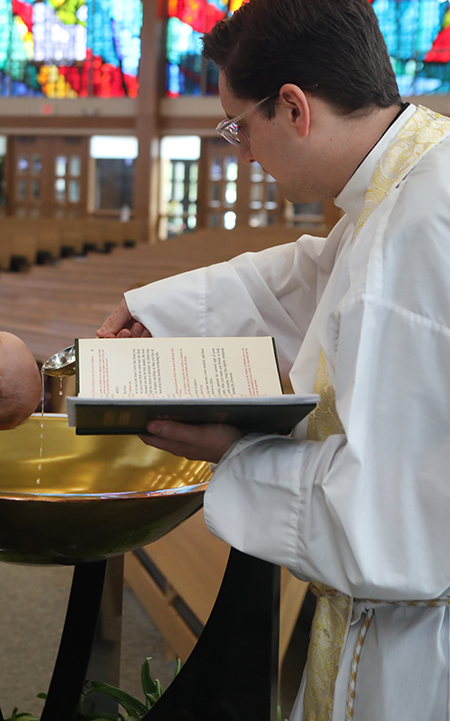
A. Yes, by virtue of our baptism, we share in the Priesthood of the Baptized, one of the three munera (meaning offices) of Christ. It is distinct from the ministerial priesthood as conferred by the Sacrament of Holy Orders. Essentially, it means that by virtue of our baptism, we are called to pray and sacrifice for others and to be a bridge between others and God.
Q. Is a person baptized Catholic a Catholic forever?
A. Yep. Apart from the supernatural effects of baptism, baptism also has a juridic effect. By being baptized in the Catholic Church, one becomes enrolled in a particular church sui iuris, meaning one is subject to the rights and obligations of that church. A person baptized in the Latin Catholic Church becomes subject to the law of the Latin Catholic Church. A person baptized in the Melkite Catholic Church becomes a subject of the law of the Melkite Catholic Church, and so on.
While it is possible to change ascription to a different church sui iuris within the Catholic Church, it is impossible to renounce one’s enrollment in the Catholic Church. People might say they aren’t Catholic anymore, but that doesn’t change the fact that the Church sees them as Catholic. There used to be a way to formally leave the Catholic Church, but that was removed from the law. So if you are baptized Catholic, the Catholic Church will always see you as Catholic.
Q. What are the rules about baptismal sponsors?
A. Contrary to popular understanding, a sponsor’s primary role is to serve as the official witness to the baptism. Second to that, the sponsor is to help “the baptized person to lead a Christian life in keeping with baptism and to fulfill faithfully the obligations inherent in it” (CIC c. 872). Notice that was all in the singular. That’s because you only need one sponsor. You can have two (one man, one woman, no doubling up) but that’s not required.
You don’t technically have to have a sponsor, but it is encouraged “in so far as possible” (.ibid). Sponsors need to be at least 16 (this can be dispensed from), confirmed, not under any juridic penalty, not be the parent of the one being baptized, and they need to lead “a life of faith in keeping with the function to be taken on” (CIC c. 874 §1/3). This is why they generally need some kind of letter from their pastor vouching for them. Non-Catholics cannot be sponsors but can be a “Christian witness” so long as there is a Catholic sponsor because, again, you really only need one sponsor.
Q. Are there rules about having a certain kind of name in order to be baptized?
A. The Code of Canon Law states that “Parents, sponsors, and the pastor are to take care that a name foreign to Christian sensibility is not given” (CIC c. 855).
The logic behind this is pretty obvious. By being baptized one is to be Christ in the world. It can be a challenge being Christ in the world if your name is, say, Satan. It’s not impossible, but it’s a challenge. This is why the first pope to change his name (Pope John II) changed his name, because Pope Mercurius (as in, the Roman god Mercury) is awkward.
So yes, parents are to name their children something that is not contrary (that’s what foreign means in this context) to the faith. If a parent really likes a name that is a bit more secular, it would be good to at least give the child a Christian middle name. There was a time that priests would give new names to kids whose names were not Christian, but those times are long gone (at least in our country).
These questions were answered by Father Caleb La Rue, chancellor of the Diocese of Lincoln. Write to Ask the Register using our online form, or write to 3700 Sheridan Blvd., Suite 10, Lincoln NE 68506-6100. All questions are subject to editing. Editors decide which questions to publish. Personal questions cannot be answered. People with such questions are urged to take them to their nearest Catholic priest.
