

Continuing from last week, I present Ask the Register Lightning Round: Baptism Edition Part II, “Baptism Strikes Back.”
Q. Who can get baptized?
A. “Every person not yet baptized and only such a person is capable of baptism” (CIC c. 864). For an adult to be baptized (outside of a danger of death situation), that person must manifest his or her intention to receive baptism, be instructed sufficiently about the truths of the Faith and the obligations that come with being baptized, and have completed the catechumenate. For an infant (also outside of a danger of death situation) to be baptized, at least one parent or guardian must consent and there needs to be a well-founded hope that the infant will be brought up in the Faith.
Q. Who gets to decide what constitutes a well-founded hope that the child will be brought up in the Faith?
A. Ultimately it is at the discretion of the one who baptizes the child. There are no hard and fast criteria that every minister of baptism (by that I mean a deacon, priest, or bishop) follows, no checklist that says, “these are the requirements that determine whether your hope is well founded or not.” Some ministers of baptism are more hopeful than others and might make a decision to baptize an infant that a different minister of baptism would not make.
Q. Are all baptisms “Catholic”?
A. I would not put it that way. Baptism, as instituted by Christ, requires valid matter (true water) and form (“I baptize you in the name of the Father, and of the Son, and of the Holy Spirit”), as well as the intention on the part of the one who baptizes to wash away original sin in the one being baptized and to incorporate the one being baptized into the Life of the Trinity. So long as all those elements are there, it’s a baptism, which is why the Church requires all of these elements for baptism.
But valid baptisms are not limited to those who are in visible unity with the Catholic Church. Anyone who baptizes someone with the proper matter, form, and intention validly baptizes, whether the person being baptized is in full communion with the Catholic Church or not.
Q. For a baptism to be valid, does water have to touch the head of the person being baptized?
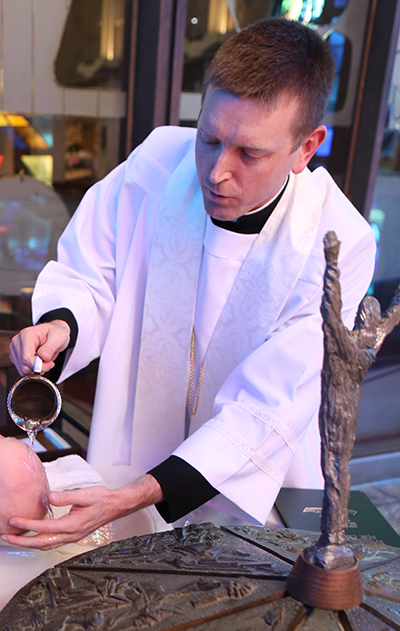
A. While the expectation in normal circumstances is that water is poured over the head, so long as water touches some part of the body, the baptism is valid. It should be noted that the (at the time) Congregation of the Doctrine of the Faith clarified that hair is a part of the body so even if water does not touch a person’s scalp, he or she is still validly baptized.
These questions were answered by Father Caleb La Rue, chancellor of the Diocese of Lincoln. Write to Ask the Register using our online form, or write to 3700 Sheridan Blvd., Suite 10, Lincoln NE 68506-6100. All questions are subject to editing. Editors decide which questions to publish. Personal questions cannot be answered. People with such questions are urged to take them to their nearest Catholic priest.
