

Thousands of young Catholics pray, march for life
By Tyler Arnold
Catholic News Agency
Cathy Blankenau Bender
Editor, Southern Nebraska Register
Thousands of young Catholics gathered at the Basilica of the National Shrine of the Immaculate Conception in Washington, D.C., Jan. 22, to worship at a vigil Mass on the eve of the March for Life.
Bishop James Conley was invited to be the main celebrant of the Mass by Bishop Daniel Thomas, chair of the U.S. Bishops’ pro-life Secretariat.
“Our goal is not only to make abortion illegal,” Bishop Conley said during the homily. “Our goal is to make abortion unthinkable.”
More than 5,000 people — many of them high school or college students — filled the upper church of the basilica to attend the Mass. After Mass, many worshippers prayed at the National Holy Hour for Life, which was held in the crypt of the basilica during adoration of the Blessed Sacrament, which included praying the luminous mysteries of the rosary.
The Jan. 22 service marked the 47th straight National Prayer Vigil for Life held at the basilica, which it began hosting in 1979 — six years after the Supreme Court decided Roe v. Wade. The Thursday night event marked the fourth post-Roe vigil.
The first reading came from Isaiah 49, in which the prophet wrote: “Before birth the Lord called me; from my mother’s womb he gave me my name.”
In his homily, Bishop Conley referred to that reading and expressed joy at the number of young people who attended the vigil with the goal to “build a culture of life and a civilization of love, where babies are protected in their mothers’ wombs and women are loved, heard, and cared for when they find themselves faced with very difficult and life-changing decisions.”
The bishop noted that there are many threats to the dignity of the human person prevalent in society, including euthanasia, gun violence, the death penalty, the suffering of the poor and of migrants, racism, and a lack of access to health care and education.
“But our brothers and sisters in the womb are the most vulnerable and the most voiceless,” he said, noting that the United States Conference of Catholic Bishops (USCCB) has labeled the issue its preeminent priority in terms of political concerns. Even after the Supreme Court overturned Roe v. Wade, Conley noted, there are still more than one million abortions annually. Yet, he expressed hope that the young people in front of him “are the pro-life generation” and will help bring an end to abortion in the United States.
“I firmly believe that 50 years from now when my generation will have gone to God, your grandchildren will ask you: ‘Is it true, that when you were my age, they put children to death in the womb?’” Conley said.
The Mass was concelebrated by Cardinal Robert McElroy of the Archdiocese of Washington; Cardinal Sean O’Malley, the archbishop emeritus of the Archdiocese of Boston; Cardinal Christophe Pierre, the apostolic nuncio to the United States; and other archbishops, bishops, and priests.
Cardinal Pierre, at the start of Mass, read aloud a note offered by Pope Leo XIV to attendees of the vigil in which the pontiff assured participants of his “spiritual closeness” as they gather “for this eloquent public witness to affirm that the protection of the right to life [is the] ... indispensable foundation of every other human right.”
According to the note, Leo told participants they are “fulfilling the Lord’s command to serve him in the least of our brothers and sisters” and bestowed an apostolic blessing on them.
Prior to the opening Mass in the basilica, Bishop Conley celebrated a Mass for pro-life leaders at the Franciscan Monastery of the Holy Land in America. He also participated in several media interviews about the Prayer Vigil for Life in Bishop Thomas’s place, and on Friday morning at the March for Life rally, he stood in place of Bishop Thomas on the podium.
Every year, the rally preceding the March for Life begins with prayer. Roman Catholic and Orthodox leaders alternate leading prayers before the March. This year, the prayer was offered by Orthodox Bishop Irinej of the Serbian Orthodox Diocese of Eastern America. Bishop Conley joined the religious leaders on the podium, wearing the bright yellow hat marchers from the Catholic Diocese of Lincoln wore.
After the rally, the March began, and Bishop Conley waited to march with a group of seminarians from the Diocese of Lincoln – those attending Mount St. Mary’s Seminary in Emmitsburg and St. Charles Borromeo near Philadelphia.
As he waited, the bishop said, he stood on a corner and watched all the marchers go by – something he has never had the opportunity to do before. While Bishop Conley has been to the March for Life many times since he was a seminarian at Mount St Mary’s more than 40 years ago, he was always in the crowd, never able to step aside and just observe the March.
“Everyone was filled with joy,” he said of the participants. “There was such enthusiasm. Some groups were singing hymns and praying the rosary out loud as they walked by. Many were dressed in their school colors from Catholic schools.”
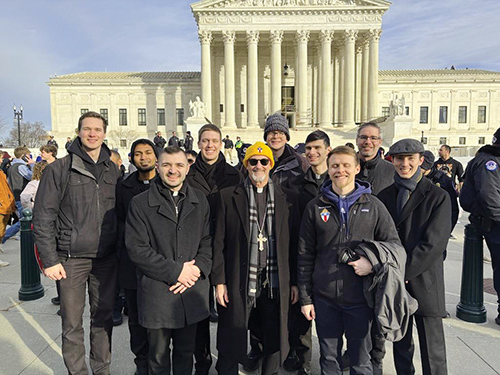 As the seminarians drew near, Bishop Conley joined them and marched to the steps of the Supreme Court. There, he said, many people congregated and he said it felt “almost like a family reunion of the pro-life community.”
After visiting with pro-life friends – and visiting over dinner with the seminarians that weekend – the bishop was soon back in the Diocese of Lincoln. On Sunday morning, Jan. 25, he celebrated Mass at the Cathedral of the Risen Christ in Lincoln, to kick off Catholic Schools Week.
The national theme for Catholic Schools Week this year, he pointed out, is “Catholic Schools: United in Faith and Community.”
He referred to the second reading for the Mass, from the beginning of Paul’s first letter to the Corinthians, in which Paul writes it has been reported that there are “rivalries” among the people.
Let there be “no divisions among you,” Paul wrote, “but that you be united in the same mind and in the same purpose.”
“We all follow Christ,” Bishop Conley said. “We’re disciples in Christ.”
Bishop Conley reflected on the unity he felt at the March for Life – and the unity he has felt many times with pro-life people of many faiths, working together for life.
However, he continued, “We live in a divided world” and he referred to the “horrible news coming out of Minnesota.”
He urged people to be united as “One Heart in Christ” – the theme of the diocesan pastoral plan announced this month. And he reiterated the message of Pope Leo XIV and the United States Bishops.
In a statement, Archbishop Paul S. Coakley, president of the U.S. Conference of Catholic Bishops, echoed the message Pope Leo delivered at his Sunday Angelus that morning: “Peace is built on respect for people.”
“Today,” Archbishop Coakley said in his statement, “Pope Leo XIV reminds us that ‘the Gospel must be proclaimed and lived in every setting, serving as a leaven of fraternity and peace among all individuals, cultures, religions and peoples.’
“It is with this in mind that I prayerfully urge calm, restraint, and respect for human life in Minneapolis, and all those places where peace is threatened. Public authorities especially have a responsibility to safeguard the well-being of people in service to the common good.
“As a nation we must come together in dialogue, turning away from dehumanizing rhetoric and acts which threaten human life. In this spirit, in unity with Pope Leo, it is important to proclaim, ‘Peace is built on respect for people!’”
Bishop Conley said: “Let us continue to pray for peace, safety, and the dignity of all human life.”
