

Q. Some of my friends are of the opinion that Lent is nothing more than a season of ritual discipline invented by the Catholic Church and imposed on her members. How might I respond?
A. I can relate to the objection; in fact, there was a time when I, too, considered Lenten practices as just another instance of religious rules and manmade traditions. After all, the word ‘lent’ never occurs in the Bible, so it must be something Catholics simply added to God’s requirements.
Among the various approaches you might take in responding to your friends—noting, for example, our Lord’s teaching on (re)ordering our lives to God through the spiritual disciplines of fasting, praying, and almsgiving (Matthew 6:1-18)—let me highlight another angle on Lent that is deeply rooted in the pages of Scripture and witnessed in the life of many a saint. This might be helpful to both Lenten objectors and devoted observers.
The concept of Lent reflects a rhythm built into the way God typically operates and one that long predates the Church’s seasonal practices. From the biblical stories of God’s ways with his people, including his very own Son, we learn that moments of God’s activity are rarely sudden. God simply is not in a hurry. His redemptive and transformative acts are never impulsive and seldom rushed. God patiently and deliberately prepares his people for what comes next, sometimes over extended periods of testing, like 40 days or 40 years, often in places removed from comforts, abundance, familiarity, noise, security, the hustle and bustle of life.
So much is this the case that a biblical motif develops around the Hebrew concept of the midbar, the wilderness or desert.
During 40 years of wandering in the wilderness, for example, God prepares the Israelites for the Promised Land both geographically (removing them from Egypt) and spiritually (eradicating “Egypt” from them). This is where they receive instruction on how to live and worship as God’s people, learn what it means to depend on the LORD alone, and form a new identity as a covenant nation—all before and in preparation for realizing their destiny in the Promised Land (“And you shall remember the whole way that the LORD your God has led you these forty years in the wilderness, that he might humble you, testing you to know what was in your heart, whether you would keep his commandments or not” [Deuteronomy 8:2]).
Again, in the wilderness region of Sinai, Moses twice spends 40 days and 40 nights, fasting from food and water, communing with the LORD, receiving the Torah, emerging with radiant face, and preparing to serve as mediator for Israel following the golden calf incident (Exodus 24; 32–34).
And then there’s the prophet Elijah. Sustained by an angel’s provision of food and water, Elijah walks 40 days and 40 nights through the wilderness before encountering the LORD in “gentle stillness” at Mount Horeb, the mountain of God, where he is quietly renewed and prepared for what lies ahead (1 Kings 19).
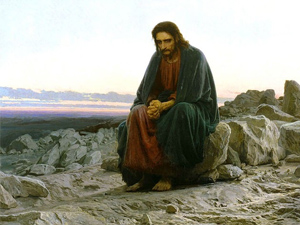
The pattern continues with Jesus. After his baptism and before embarking on his public ministry, our Lord is led by the Spirit into the wilderness, where he fasts 40 days and 40 nights in preparation for what comes next—teaching, healing, feeding, forming a community of disciples, and eventually laying down his life for the salvation of the world (Matthew 4).
Again and again, Scripture reveals a cadence in the way God operates: Preparation precedes blessing, deliverance, freedom, mission. Waiting, testing, surrender, learning dependence and obedience—these are the quiet ways in which God prepares us for something momentous, even decisive.
We might regard the season of Lent then as a wonderful grace and a moment to ponder a penetrating question: How willing are we to enter the wilderness of preparation—to slow down and to step back from normal comforts, security, plenty, the familiar, the noise, the dictates of immediacy, and to consider what blessing God might be training us to receive, that can be ours in no other way than through an extended period of testing, praying, fasting, and self-giving?
In this light, what might appear as nothing more than an ecclesiastical rule turns out to be an incredible gift of the Church, attuned to the normal rhythms of God, calling us momentarily into the desert as an occasion of hopeful anticipation, an opportunity for deeper conversion, an ordering of heart and life for something greater. What could possibly be objectionable to that?
This question was answered by Dr. Vern Steiner, president emeritus of the Emmaus Institute for Biblical Studies. For more information, visit www.emmausinstitute.net.
Write to Ask the Register using our online form, or write to 3700 Sheridan Blvd., Suite 10, Lincoln NE 68506-6100. All questions are subject to editing. Editors decide which questions to publish. Personal questions cannot be answered. People with such questions are urged to take them to their nearest Catholic priest.
