

Q. Some of my friends find it curious that “you Catholics” worship a dead Christ, still hanging on the Cross (referring to the Crucifix), and yet “you celebrate Easter for 50 days” rather than just on Easter Sunday. Isn’t that contradictory?
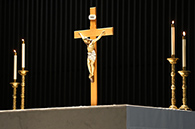
A. When a few of my friends and former students raised this concern during a dinner conversation, I assured them that the Christ we worship is no longer hanging on a Cross, but that since he once did, we live every day in light of that reality, like St. Paul who said, “But far be it from me to boast except in the cross of our Lord Jesus Christ” (Gal 6:14). And because we view his rising from the dead as once and continuing, not once and concluded, the party is just getting started on Easter Sunday!
(Parenthetically, there is a still-popular charge that Easter is rooted in the ancient rituals of the goddess Eostre, or Ishtar, a Germanic and Mesopotamian goddess of fertility, making Christians therefore guilty of celebrating a pagan holiday. For equally spurious reasons, Easter celebrations were banned among the Puritans in 17th-century colonial America, on grounds that one day should not be regarded as holier than any other, especially since the word ‘Easter’ does not occur in the Bible. These are topics for another time.)
But why does Jesus’ Resurrection matter so much to us? Why continue celebrating it through the Easter octave and all the way to Pentecost? Why does the Catechism refer to Jesus’ Resurrection as the “crowning” and “central” truth of the Christian faith (§638), and what difference should it make in our lives as Christians, not just on Easter Sunday morning and not just for seven weeks following, but every morning and every week of our lives?
The Bible answers such questions with an octave of responses––eight truths worth celebrating throughout the Easter season, and beyond.
1. Jesus’ Resurrection signals that he is Lord and that the tyrants of the world––Caesar, Satan, sin, and death––are not (Acts 2:24, 36; Phil 2:9-11). If Easter had not happened, the tyrants of the world would win.
2. Jesus’ Resurrection proves that God makes good on his promises, that his word can be trusted (John 2:19-21; 1 Cor 15:3-4). If Easter had not happened, we would have no reason to take anything God says seriously.
3. Jesus’ Resurrection guarantees that the Son’s love-offering for the sins of the world was acceptable to the Father (Rom 5:10; Heb 1:3). If Easter had not happened, Good Friday would be a tragic contradiction, and the “good news” of the gospel would be fake news.
4. Jesus’ Resurrection procures new creation––a new dimension of being for all who believe (Rom 6:1-14; 2 Cor 5:17; Col 3:1-17; cf. CCC §654). If Easter had not happened, we would be defined by the fall, forever damaged and bound by the wounds of original and personal sin.
5. Jesus’ Resurrection makes possible his Ascension to the Father’s right hand, and so his universal mission, present intercession, and gift of the Holy Spirit (John 7:38-39; 16:7; Acts 2:32-33). If Easter had not happened, the extent of Christ’s influence would be limited in space and time to whatever he accomplished while on earth and to whatever effect the movement he started might generate under its own steam.
6. Jesus’ Resurrection establishes him as the living Head of the Church (Eph 1:19-23; Col 1:18). If Easter had not happened, the Church would not exist, at least not as the incarnate presence of Christ in the world. In that case, as Bishop Robert Barron suggests, “all bishops, priests, and Christian ministers should go home and get honest jobs, and all the Christian faithful should leave their churches immediately.”
7. Jesus’ Resurrection gives meaning and a telos (end, goal) to all of life, including our suffering and trials (Rom 8:17-18; Phil 3:10-11; Col 1:18-24). If Easter had not happened, life would lack an ultimate purpose, hardships would be pointless, and nihilism (nothing-ism) would be the only reasonable conclusion to draw.
8. Jesus’ Resurrection secures the eternal hope of all who are in Christ (John 11:25-26; 1 Cor 15:1-58!). If Easter had not happened, this life would be all there is, death would be our final destiny, and we would be morons to hope for anything otherwise.
That explains why we Catholics get so carried away with Easter, extending its celebration all the way to Pentecost—and, if we think rightly, all the way to eternity. After all, “Whether Jesus merely was or… also is––this depends on the Resurrection” (Pope Benedict XVI). To quote Bishop Barron once more, “It comes down finally to this: if Jesus was not raised from death, Christianity is a fraud and a joke. But if he did rise from death, then Christianity is the fullness of God’s revelation, and Jesus must be the absolute center of our lives. There is no third option.”
And so, let the celebration continue. Christ is risen; he is truly risen! Hallelujah! Hallelujah!
This question was answered by Dr. Vern Steiner, president emeritus of the Emmaus Institute for Biblical Studies. For more information, visit www.emmausinstitute.net.
Write to Ask the Register using our online form, or write to 3700 Sheridan Blvd., Suite 10, Lincoln NE 68506-6100. All questions are subject to editing. Editors decide which questions to publish. Personal questions cannot be answered. People with such questions are urged to take them to their nearest Catholic priest.
