

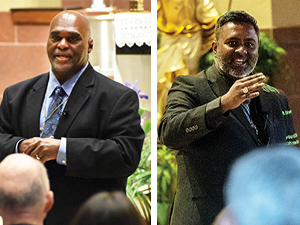
Deacon Harold Burke-Sivers and Dr. Marcus Peter are well-known Catholic radio hosts. Both host national programs that can be heard in Nebraska on Spirit Catholic Radio.
Deacon Burke-Sivers is a speaker, author and host of “Beacon of Truth,” a show addressing issues such as male spirituality, marriage and the family. He is the first baptized Catholic in his family. He left a 23-year career in law enforcement to become a full-time Catholic speaker.
Dr. Peter is a speaker and radio/television host. He was described as a “militant atheist” in 2008 before having a conversion and joining the Assemblies of God Church and espousing a very anti-Catholic view. In 2010, he found his way home to the Catholic Church. Dr. Peter hosts “Ave Maria in the Afternoon,” a radio show focusing on the Church, culture and current events. He took over for longtime Catholic radio host Al Kresta, who died in 2024.
Both men are on the “This is the Hour” speaking tour across the Midwest that included recent stops in Hastings, York, Lincoln and Grand Island. Dennis Kellogg, director of communications for the Catholic Diocese of Lincoln, interviewed them while they were in the diocese. Their conversation covered evangelization, the increase in young men seeking out the Catholic Church and the difference each wants to make in his ministry. What follows is an edited version of that interview.
Dennis Kellogg, Southern Nebraska Register, director of Communications, Catholic Diocese of Lincoln: You're both having an impact on the Catholic world through your ministries. I want to know what led you to make the choice to go into the vocation that you're in today? Deacon Harold?
Deacon Harold Burke-Sivers, speaker, author and radio host: I'm the first baptized Catholic in the history of our family. My mother was the first Catholic. She was a convert, she was Methodist, became Catholic, but then I did not have to be rebaptized, just Confirmation, first Communion. So, when I came along as the oldest child, I was the first actually baptized as a baby as Catholic. My dad was not a person of faith, but my mom really sacrificed to make sure that we had Catholic education, that we went to church every Sunday. So that was very much ingrained in me. And I remember serving Mass one day and thinking I might want to become a priest.
I ended up going to a Benedictine High School in New Jersey, and eventually joined the Benedictines. I was there for a while. Had actually enjoyed my time there, but my parents divorced. My mom got sick and almost died and so I left to take care of her and my sister, who was still in high school at the time. I went to a wedding and met my future wife. So, I got another plan. But even though I left monastic life, I still felt God was calling me to something.
And so my wife is from Oregon, so we got to Oregon, discovered the diaconate, but then I had a law enforcement career for 23 years. I was doing some speaking in the Catholic faith on the side, but never even thinking or imagining that I would leave my law enforcement career to be a full time Catholic speaker. But I had a powerful encounter with the Lord in Eucharistic Adoration in 2011 and that changed the course and direction of my life. And so a year later, in 2012 I left my career and started speaking and writing full time, and I look back now with perspective, best thing I could have ever done.
SNR: Dr. Peter, you have quite a story too, because in your biography, you're described as a “militant atheist” back in 2008 and then you have a conversion. You end up in the Assemblies of God church, where you have a very anti Catholic view, and then by 2010, you're in the Catholic Church. Those are a couple of sharp left turns. How did those happen?
Dr. Marcus Peter, speaker and radio/tv host: Primarily the grace of God more than anything. So my militant atheism happened initially in small ways, and then quite by accident, I developed a bit of a career as an atheist speaker. It all started in a philosophy class. I just stood up and I presented some philosophical arguments against the existence of God, and before I know it, I was being invited to different universities and different groups to keep doing more and more of these talks. So, I guess in that sense, I've always been a preacher, just on the wrong side of the equation.
I was tricked into going to a prayer meeting. I had an overnight conversion experience, and I gave my life to Christ, and then the Assemblies of God people took me under their wing, trained me to read scripture, and I became vehemently anti-Catholic for a lot of reasons, chief among which was I knew a lot of Catholics growing up. I knew a lot of them, and they were not only some of the angriest people I knew. The young people around my age were the ones that were drinking, they were smoking, they were swearing, and they were not living the most moral lives. And the worst part is this faith that they did was sort of nothing for them. It was like a decorative sprinkle.
And so I believed Catholicism was wrong. I believed that there's nothing Jesus about Catholicism. And so that was my mission to convert Catholics out of this pagan idolatry, I'm ashamed to say this, the whore of Babylon. One of the worst things I ever said once was to my sister, really, I told her, the Catechism is the work of the devil. That's how humanly anti-Catholic I was, and I also wanted to be a pastor, and I kept reading the scriptures. My pastors couldn't agree on things. I accidentally stumbled upon the Church fathers, and they sounded scarily Catholic.
And I had a lot of arguments against the Catholic Church, but one by one between them and Catholic apologetics and a few other resources, I wound up studying my way -- two years of barely any sleep -- I wound up becoming Catholic. I left the Assemblies of God, and I tell everyone this, my friends stopped talking to me - my friends in the Assemblies of God -- because they said Marcus went and “popped.” So that was a trajectory of my life.
SNR: You're both touring the Midwest on this speaking tour and Deacon Harold your topic is why it's important to share the love of Christ with others, and how to do that. Evangelization can be really hard for some people. What would be your advice on how to evangelize?
Deacon Harold: The name of this tour is, “This is the Hour.” So, my part of the talk following after Dr Peter, is we spend an hour at the Holy Sacrifice of the Mass. We're nurtured and fed by the Word that prepares our hearts and minds and our souls to receive Jesus again, Body, Blood, Soul, Divinity in the Eucharist. So impelled and empowered by Word and sacrament, we are then sent forth out of the church to be Eucharist to the world. By our baptism, we have an obligation, a responsibility to share and witness to the power of God's love, especially now in a culture that's confused and broken and hurting and divided and angry. They need to see the love of Christ.
So how do we effectively share and witness to the power of God's love to the world? Evangelization is not about proselytizing. It's not convincing people to become Catholic, not beating people over the head with the Bible. It's introducing people to the love of Jesus. The goal is, how do I get this person in front of me to want to listen to more of what I have to say? I think that's the key to evangelization, helping people to encounter the love of Christ. And I say this all the time, that people may meet Jesus for the very first time when they meet you. That's their first encounter with what it means to have a relationship with Jesus.
SNR: Dr. Peter, last year, you did a commentary entitled, “We have to speak about God,” so it's not an option, even though we never have the right words to say. Those words that we say aren’t meaningless.
Dr. Peter: That's really the heart of this. So, this is the hour. Those are Jesus's words. It's fortunate that this mission we're doing in this tour is coming on the heels of the Easter season, because Jesus says those words, “this is the hour.” He appeals to the hour seven times in the Gospel of John, and we hear it the most during Holy Week, and his hour really starts in the upper room, has a kind of climactic point in Calvary, but then his resurrection opens this up for all of mankind, and then he ascends into heaven.
All of this simply to say, Catechism 670 the Church tells us now that the ascension has happened, we are in the last hour. And so that puts an onus on us. The big onus is that we have to choose who Jesus Christ is to us. He's either entirely Lord or entirely nothing to us. But he cannot be in the middle. And so if he really is our Lord, God and Savior, and if we're truly in love with him. I mean, throughout this tour, Deacon and I have been talking about our brides, because we love them dearly, because when you're in love, all you want to do is share about the one you're in love with. And so giving your life to Christ means, by virtue of that, you have to speak out.
And so Evangelization is not an activity or a program that you sign up for years after becoming Catholic and getting your act together. No from day one, you embrace Jesus Christ. You start sharing what Jesus Christ has done for you, because you're in love with him, and the love of your life wants you to draw others to him.
SNR: Dr. Peter, your talk is titled "The Urgency of the Gospel." We live in a fast-paced world, 24 hours a day, nonstop. You can't turn on cable news without every other story labeled "Breaking News." It seems like we have this frantic pace. And when I think about the gospel, I think about calm, slow down. So, what's the urgency of the gospel?
Dr. Peter: The urgency of the gospel is that we've always lived in insane times. So yes, we are bombarded with media garbage today like never before. That's completely true, but the Church has never had an era where it was so peaceful, so tranquil, that the gospel could just exist. We've always faced issues. The urgency of the gospel, therefore, is not a social problem, definitely not a political problem. It's not an economic problem. It's a personal problem. When we are free to proclaim faith in Jesus Christ, what tends to happen – and I say these exact words -- is we become fat and lazy when it comes to the faith.
The urgency of the gospel message is from the mouth of Jesus Himself in Luke 14:33. The same is true for you. If you do not give me everything, you are not fit to be my disciples. And so if we call ourselves followers of Jesus Christ, that means we have an obligation to not be lukewarm. The urgency is, this is the hour. Now is the time. And so, like Deacon says, we have one hour in the Mass because the Mass becomes the culmination of the hour of the Messiah's work in our life. And that means that when I stand before Jesus in the Eucharist, and I say Amen, my body, my soul, my life, my everything, must be wrapped in that Amen. That's the urgency. Every facet of my life must either be under the Lordship of Jesus Christ, or I have to walk away. Because, if not, that's hypocrisy. That's the urgency of the gospel.
SNR: Deacon Harold you wrote the book “Behold the Man.” One of your areas of expertise is male spirituality. We're hearing many media reports right now about the young men in their 20s and 30s who are, all of a sudden, leading this surge back to the Catholic Church. The New York Times reported last week a sharp rise in men under 30 who say that religion is “very important” to them. Why do you think we're seeing more young men come to the Catholic Church?
Deacon Harold: I think it's for a number of reasons. One, the pandemic. The pandemic was a time of isolation, the pandemic was a time of not being together, of separation, but ultimately, we're an incarnational Church, right? The Word became flesh and didn't have a Zoom meeting, right? The Word became flesh and dwelt among us. He wanted to touch us with his own hands. He wanted to love us with his own heart.
And so I think young men in particular felt that isolation. So, what do we do as men? Video games, pornography. We saw sharp rises in video game playing and internet entertainment and pornography, those kinds of things. And the culture was encouraging that. And so you have the pandemic, but then you also have, as you mentioned earlier, in the culture all the news and the breaking news and all this kind of stuff. It’s again, anger, vitriol, division, and I think looking at all that, there's got to be more than this, because ultimately, there's a place in your heart that's only for God. Nothing in this world can fill that space except for God.
So, I think men are beginning to realize, wait, there's got to be something more than this. And the ship that's been steadying the course that whole time is the Catholic Church. And so now they're really like, wait a minute, this Church may have something to offer here. And then we have great groups like the Knights of Columbus. We have programs like “That Man is You.” We have my book and different things that men are discovering and saying, “Wait. There's something deeper, something more meaningful here. Something that allows me to become the man that God created me to be. That's beautiful and that's attractive.” And so men are against this whole feminization of manhood and that kind of thing. And men are pushing back against it. They're searching for truth and goodness and beauty, and that truth is found not in a philosophy, not in an ideology. It's found in the person of Jesus Christ, John 14:6, “the Way, the Truth and the Life.” That is attractive to men. I think that's what's the catalyst for helping to bring men back to Jesus.
SNR: Dr. Peter, what would you add to that?
Dr. Peter: I think Deacon is completely right that the pandemic really exposed what was in the undercurrent. The pandemic acted as a kind of catalyst and a kind of magnifying lens to the bad seeds that we had allowed to fester in the Church and in the global culture. And these seeds were planted a long time ago. We as Catholics let that happen. We sat back and let the culture rewrite the narrative of social masculinity.
And sure, as Catholics, we understand from the scriptures and teaching of the Church what manhood really means. But you expand that, even if you're not Catholic, natural law speaks about what manhood ought to be. A man, whether you like it or not, your strength is a gift. That means you are there to sacrifice and serve. Period. Every gift a man is given, in his virility, in his strength and his stamina, it's a gift for the service of others. And so inherent in boyhood is the call of a virtuous man to call out the man in this boy and to train him into a life of sacrifice.
Well, what did we do? Ever since the end of the Second World War, we've encountered this great era of peace in the west and in the world. And so we got again, fat and lazy. We got wealthier and we allowed generation after generation to not learn. We worked, we labored in work, and we forgot that fathers have to call out the men in our boys.
And so boys grew up staying boys, and they've become turned in on themselves. They become self-centered. What Deacon is talking about, this feminization, is when men don't rise up in the Church especially, men don't rise up in the culture. Catholic men have to lead the way to teach the culture how to do this. And so when we didn't do it, the culture didn't do it, the women stepped up. And so feminism has a two-pronged evil -- and I know people are going to come after us for this. I really don't care. Number one, it trains women to be more like men. Trains women to be more masculine. And then it trains men to be more feminine. And so the feminization of men and the masculinization of women have corrupted the natural order.
And so what Deacon is talking about, and what he writes about in his book, is during the pandemic, boys are growing up realizing I have no structure. These things that are natural to me, for some reason, people hate it. The Catholic Church is the only bastion that's saying your masculinity is not only good, it's virtuous and holy. Your masculinity is a gift from God. Use it wisely and well, here's how you do it. And so again, the Word became flesh and dwelt among us. Thank God he didn't have Zoom meetings. The crucifixion was not just an AI development. He actually died for us and showed us the meaning of real manhood. And that's why being in person, preaching this truth is so crucial. And so all these young men are coming back into the Church for exactly that reason. There is sinking sand everywhere else. There's one pillar that's not moved, and that's the One, Holy, Catholic and Apostolic Church.
SNR: Dr Peter, you replaced legendary Catholic radio host Al Kresta. His program was “Kresta in the Afternoon.” Now you're the host of “Ave Maria in the Afternoon.” I had the opportunity a year before his passing to sit down and have an interview like this with him, and it was fascinating. I want to know what did he teach you, and what did you learn from him that you're still using today?
Dr. Peter: Al taught me a method, and the method was, I'm a biblical preacher. I love the scriptures. My degrees are in biblical Covenant Theology, and so formally, you would call me a scripture scholar, but really, all I am is a lover of Jesus and his word.
And so in the classroom, I was teaching kids. I was teaching children at the high school level that the scriptures could be applied to every facet of their existence, and they need to learn to start viewing the world through the lens of Christ. They have to. So for young people, sexuality is a big thing, right? Rather than think in terms of the culture or even think in terms of themselves, ask themselves, what is the meaning of my personhood? Well, the scriptures have that answer. The Church has that answer. Al showed me that that could be applied to every other facet as well.
And so all these areas that I was interested in that I was holding personally, he said,” No, I want you to share this with the world.” So, in that sense, Al and I were doing very similar things. We had a lot of overlaps, but also were very different people. And so Al taught me that method, and he inducted me into the life of radio and TV because I'm a traveling preacher. I love traveling and preaching the gospel, and so what we're doing right now is joyous to me. But he also saw, as a former protestant pastor, how many traveling preachers killed their marriages and their families. And so, he brought me into the life of radio to still me and ground me so that I'd have an avenue to keep preaching but still be able to go home and work on my marriage and family. Those are some of the core important things that Al handed down. And I miss him. I thank God for his influence in my life, and I thank God for inducting me into this work because I was brought into radio, and because I have Al's hour now – Deacon’s hour is before me -- Deacon and I got to meet. And so, the weird person that I am in terms of like theology, philosophy, but economics and everything, coupled with my biblical preaching, now, with the influence of Deacon, I'm able to bring that together. So, I've been tremendously blessed in that sense.
SNR: You're both successful on the radio. Deacon Harold, I want to ask you, what do you think makes a good Catholic radio program? What does the Catholic audience want out there today?
Deacon Harold: I think they want diversification of the message of the gospel, and that's what makes Catholic radio so beautiful. You have shows that are news-based shows from a Catholic perspective, you have shows that talk about life and culture. My show “Beacon of Truth,” I didn't want to talk about any of that stuff because there's already shows talking about it. I didn't want to just regurgitate what everybody else was doing. What I wanted to do was, how do we connect people more deeply to the beauty and truth of the Catholic faith?
And we do that through, for example, music. One of the most popular things on our show is the “Beacon of Truth” playlist. We take popular songs like “Purple Rain” from Prince or “Stairway to Heaven” by Led Zeppelin, and we're not reinterpreting the song. This is what we thought the artists should have said, No. These songs that people know, how do we look at it through the lens of our faith? And that, it begins to open up something with them, like, “Whoa. I never thought about my faith in relation to this before.”
And we have a series that we do on the reflections on the rosary, reflections on the Ten Commandments. We have different topics on things about AI, the impact of AI and losing our humanity, and those are very, very popular topics. You get lots of calls and lots of engagement. How do I connect my faith more deeply, my lived experience, to these different facets of our faith? And that's we try to do well on “Beacon of Truth.”
SNR: Secular media recently has grabbed onto the disagreement between President Trump and Pope Leo. What should a Catholic think about this?
Dr. Peter: The first thing, and for every Catholic listening, I say this as a brother, from heart to heart, stop watching the secular news.
Secondly, I plead with Catholics stop listening to political commentary. I don't care, even if the person claims to be devoutly Catholic and is conservative or what have you. This is why I'll say this in all sincerity, God bless them for what they're trying to do. But even the Catholics in the political commentary sphere, they're really political commentators who happen to be Catholic.
We are called to be Catholic first. We have our vocations. In my case, it's Son of God, husband, father, and then after that, preacher, radio host, TV host, author. But then after that, I'm Catholic again. My Catholic faith book ends my entire existence, and it has to. This isn't something we can just tack on in the middle. We just don't watch TV. And so, I actually don't watch the news. I don't follow the news. I get into work the next day, and my producer, who follows the news, tells me, hey, this happened. And the first thing I do is I have one hour of prayer time with Jesus every day, and I go before him, and I put everything there before his feet, and I've begged him for the grace to not give in to outrage, because all these things are doing is stoking outrage.
I used to work in software, like I have a head for tech, and I can tell you right now the algorithms, especially on social media, they are not trying to feed engagement. They are not trying to feed interest... The thing that drives social media engagement the highest is anger and outrage. And you can look this up, there are reports out there that they just don't want to talk about, and so they keep trying to shove at you the things that will provoke your madness, because the more mad you are, the more you want to share this. How dare this person say this? Right? And so they don't care about your peace. They don't care about your life in Christ...
I tell people, listen, we the Church have encountered kings who tried to kill popes. We the Church have encountered empires that have tried to take down the Church. We the Church, have encountered priests and cardinals who have tried to take on the church from within. The Arian heresy took over so much of the bishopric in Europe, and yet the Church still stands. And so my goal every day is simply this. Your heart must be grounded in Christ… If Donald Trump says, “Let me tell you, folks, nobody, nobody does this better than I do.” Who cares? Jesus does everything much better than he does. Whoever's in the Oval Office, whoever is in the English chambers, or the British throne, Jesus Christ, is on the throne of the universe, and he is Lord of lords and King of kings. And if we can ground our hearts in that, then our political and economic engagement, our social engagement, is simply, what is Jesus Christ calling me to do in this moment? That's it. If we can ground ourselves in that, we will never lose our peace. Everywhere else is a pitfall.
SNR: I’ll end with this for both of you. What's the one difference you want to make in your ministry?
Deacon Harold: I say this all the time, we're just instruments. God is the musician. So, it's not the difference that I want to make. It's a difference that Jesus wants to make through me. What I'm trying to do by receiving the Eucharist, by going to adoration, by going to confession, by cooperating with the grace of the sacraments, baptism, confirmation, the marriage vows, and all of that, is to be a finely-tuned instrument in God's hands. So, I go to adoration instead of watching television and news, because people who imbibe that stuff are angry all the time. It's a distraction. So, don't worry about moving closer to Christ, don’t worry about my marriage, my family, my devices. Here's a distraction that you have to think about the other stuff instead. No. The more time we spend in adoration, in silence and praying the rosary and reflect on doing those basic traditional things, the more grounded we become in Christ, and I think the more effective we can be in sharing the Good News of our encounter with Jesus Christ.
Dr. Peter: I don't think I've ever thought of trying to make a difference. Initially, when I first started preaching, I think I was driven by the desire to undo the damage I did on souls. I drove so many people away from God and away from the Catholic Church. But over the years, Jesus has refined me to realize he is the one making the difference, and all I want to do is share with people what he did in my life. And if as broken a vessel as I am, he could do that in my life, think of how infinitely greater he can work in your life. The difference I hope to make is for the Lordship of Christ to take over souls so that families can be taken over by the Lordship of Christ, and that's going to transform the culture in the world. But the ultimate goal, even in cultural engagement, is the salvation of souls. If I don't wake up every day thinking of that, my life is meaningless. And by the way, that's true for all Catholics; we have to be driven for the salvation of our souls in Christ and the salvation of the souls of others. And if we can keep that at the forefront of our minds, then that's the primary difference of the gospel of Jesus Christ.
To watch the full interview including additional questions and answers with Deacon Harold Burke-Sivers and Dr. Marcus Peter, go to the Catholic Diocese of Lincoln YouTube channel.
