

By Fr. James Morin
Vice chancellor, instructor at St. Gregory the Great Seminary in Seward
And Colter Fulton
Seminarian, Mount St. Mary’s Seminary, Emmitsburg, Md.
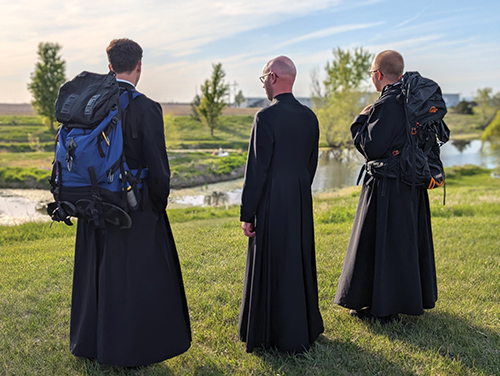
This summer several Lincoln seminarians will be making a pilgrimage across the diocese. We will begin in the east, at St. Benedict Church in Nebraska City, the oldest parish in the diocese and the oldest brick church in Nebraska. We will make our way toward Lincoln, stopping briefly for the weekend of priestly ordinations. From there we will make our way to the westernmost parish in the diocese, St. Joseph in Benkelman. We will travel 375 miles in 30 days. And yes, we are walking.
We live in an age of comfort and restlessness, of hyperconnectivity and hyper-loneliness, of virtual communities and alienation. We have lost our sense of home, our roots, our connection to a specific time or place. We long for somewhere to belong but are not equipped or willing to make the sacrifices required for such a place to exist. We know that in some way, homesickness is good: we are all strangers under the sun, pilgrims on the way toward eternity. But when homesickness becomes homelessness, when man loses any real connection to this ground, right here, under his feet, he is a nomad, not a pilgrim, a drifter, not a missionary. Exteriorly, ours is an age of travel, of amassing foreign experiences often at a frenetic pace. Interiorly, it is an age of consumption, of filling our silence with ‘content,’ with stories and news from elsewhere. Interiorly and exteriorly, we have lost a place of return, a place of silence. We are untethered, ungrounded. We are homeless at home.
Jesus of Nazareth lived differently. His three years of public ministry was restricted to an area that was geographically one-fourth of the size of the Diocese of Lincoln. Before this, he was the son of a carpenter in a tiny town of Galilee. He was from a place, known to be a Nazarene. He did not travel the world; he did not amass new experiences or constantly consume new content. He was rooted in an old tradition and for the better part of his life, he lived its liturgical rhythm with simple fidelity. Yes, perhaps some of this simplicity was imposed by his epoch, but not all: “I was sent only to the lost sheep of Israel.” God loves particularity. This love is implied by the very logic of the Incarnation. The universal aspects of Christianity always land in flesh and bone, in place and time, in a home.
A love for and connection to home is especially important for a diocesan priest. The priest does not promise to serve the Universal Church; he lays down his life for a particular church – that is, for the people of a specific place. But how can we love what we do not know? There are various ways to get to know a place, but one of the oldest and most human-sized is to walk around it. We could fly to Spain to walk the more popular, more historical Camino. But it would not be our camino or our story, it would not provide us with the important boots-on-the-ground initiation into deeper knowledge of the hills and valleys of a homeland. Such an initiation requires attention, silence, blisters, and sweat. And it requires love: enough love of a place to get its dust on our feet and in our eyes, to spend a month wandering its roads and running into the people who live there. Such love is essential to the formation of the diocesan priest.
Our pilgrimage will incorporate all four dimensions of priestly formation: human, spiritual, intellectual, and pastoral.
Human: Most basically, we will make this pilgrimage by walking. A lot. Our normal day-to-day human experience of the world has become increasingly artificial, technological, and alienating. A challenging pilgrimage is in most ways better than a conference on humanity: it provides the locus for fundamental and embodied human experiences: an encounter with the beauty and harshness of Creation, with God in silence, with hunger, thirst, and fatigue, with brother-pilgrims and strangers along the way. The pilgrimage is a way to get to know our weaknesses, our limits, and our capacity for perseverance through difficulties, helping us to grow in authentic self-knowledge, unadulterated from theories and integrated into a solid philosophical anthropology of the human person.
Spiritual: We will walk to a beat of the rhythms of liturgical and personal prayer. True Christian spirituality – and, a fortiori, priestly spirituality – is a synthesis of the liturgical and the personal. We will let the liturgy shape our walking schedule. Lauds, vespers, and compline will punctuate each day. Daily Mass in parish churches along the path will allow us to gather the prayerful miles we have trudged and offer them up in union with Christ’s sacrifice.
But our liturgical life will not be limited to what occurs indoors. Christian liturgy is cosmic in its symbolism and significance, and walking under the heavens with our feet on the wild earth will help us to recover a sense of the sacramentality of all of the world. Christ is not a Lord cooped up in the temple; He is Lord of the wilderness as well. Pilgrimages have a long tradition as “para-liturgical” acts which promote this deeper sacramental vision of the world. By our rhythm of private and communal prayer in via, we can experience Christ in all things, all places. This, in turn, will enrich our more common ecclesial existence. In the words of Martin Shaw, the pilgrimage “is a way to bring the prophetic energy of the wild back into the business of the parish. In the end we ourselves are a walking liturgy, serving the wisdoms that God’s seasons dictate.”
Intellectual: We will listen to, retell and reimagine, the story of the place where we walk. Just as philosophy prepares the way for theology, human experience enriched and directed by literature and poetry prepare the way for philosophy. Yet we live in an increasingly un-storied, illiterate, and digitalized age, one which has lost contact with local history and the poetry of place.
Again, Martin Shaw: “I think much modern Christianity has lost touch with its stories as living energies, and often seems trapped under glass…Our God speaks to us in stories, are we letting our side of that opportunity down?” Our pilgrimage will remedy this: both before and during it, we will dive into the history of Nebraska and the Diocese of Lincoln, seeking to understand – and retell – its stories and its place in universal history. We will engage with the best literature that our place has to offer, especially that of Willa Cather, making a prolonged stop in Red Cloud, her childhood home. We will work to understand and reimagine our own stories within this broader context.
Pastoral: We will encounter the people of this place along the way, both those who belong to the Body of Christ and those who do not. True pastors have their toes in people’s experience and their fingertips in the heavens. It seems to me that the greatest pastoral preparation is a profound encounter with Christ’s own dwelling with others. As Shaw points out, this is just like our Savior: “Christ is a God who doesn’t wander Olympus munching grapes; he’s down in the filth and camaraderie of it all and drinks the sorrowing of the world as a sublime demonstration of love.” Becoming pilgrims in this specific place will help us to encounter others while seeing them from Christ’s perspective and with His heart. We will seek opportunities to share meals with parishioners and priests across the diocese, share our understanding and experience of pilgrimage, all the while learning who the people are that we might one day serve as Christ’s priests.
Editor's Note: See also: Seminarians plan 'Pilgrimage across Flatwater'
