

By S.L. Hansen
for the Register
New Communion rails were recently added to North American Martyrs Church in northwest Lincoln. The polished wood rails offer an opportunity for the faithful to take more time as they receive the Blessed Sacrament, whether kneeling or standing.
Father Nathan Hall was approached by some parishioners about the idea of adding Communion rails not long after he was assigned pastor of the parish in June 2022. However, he decided to delay forming an opinion.
“I never change anything that large in a first year,” he reasoned. “That first year is to get to know the people and the community I serve.”
The following summer, North American Martyrs Parish enlisted the help of a consulting service to discern a fresh mission statement and accomplish other goals. During an open forum that was part of that process, the idea of adding Communion rails was part of the conversation.
Because it is a large parish, there were additional efforts to get feedback from members, including bulletin notices, Mass announcements and flyers. Members of various parish committees also sought input through personal conversations.
Father Hall acknowledged that some parishioners were raised believing that Communion rails were an unnecessary barrier, an idea that led to the rails being removed from many Catholic churches across the country during the late 1960s or early 1970s.
“I do not discount the experiences of people who have been taught how the Communion rail can be seen as a negative,” Father Hall said. “That is how they genuinely feel. But I also keep in mind that some people think the Communion rail is the only way to receive. We have to reach both in order to bring peace to each extreme.”
Jeff and Loretta Rademacker have been members of the parish since it was formed by Bishop Fabian W. Bruskewitz to serve the faithful in Northwest Lincoln.
The Rademackers attended the first North American Martyrs Parish Mass in 1993, which was held in an old Ramada Inn close to Interstate 80. The parish met there for a time, then moved to Freedstrom Elementary while the parish school was built. Mass was then held in the parish school gymnasium during construction of the church itself, designed by local architect Kevin Clark, a member of St. Teresa Parish in Lincoln.
Growing up in the Diocese of Des Moines, Loretta Rademacker remembered Communion rails in the churches she attended.
“When I had my first Communion, they had Communion rails,” she remembered, “and when they remodeled churches, the rails went away.”
After learning that Communion rails would be added to North American Martyrs, she said, “I don’t know why, but I was excited to have it back.”
Once the decision was made, a generous anonymous donor contacted Father Hall and volunteered to cover the entire cost of adding Communion rails.
“We did not even have a chance to ask anyone or to fundraise,” Father Hall said gratefully.
Architect Kevin Clark designed the new rails to match the sanctuary he designed around 30 years ago.
Father Hall said, “Since the pews and kneelers were wood, it seemed the natural choice to connect the new Communion rails to the pews and furniture in the sanctuary.”
Thankfully, adding the Communion rails caused very little disruption. They were installed after the 8:10 daily Mass on a late Thursday in March.
The rails stretch across the middle two sections of pews, leaving both the side sections without Communion rails for those who prefer that.
For the faithful sitting in the two middle sections, Father Hall made a short video to help them understand how to line up for receiving the Blessed Sacrament, either kneeling or standing, or using an assisted device such as a wheelchair.
While his training as an engineer allows him to appreciate the efficiency of distributing the Holy Eucharist at the rails – priests are constantly in motion down the line and back again – Father Hall’s pastoral heart is gratified that the Communion rails give each recipient more time to ponder the gift of the Lord’s true Body and Blood.
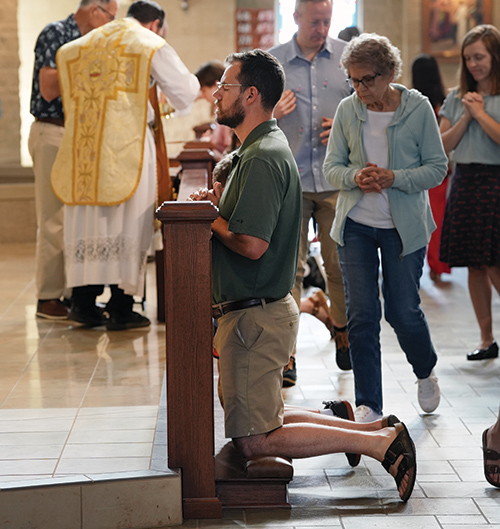
“The Communion rail is a simple way to give the individual a moment that they would otherwise not get,” he explained. “They don’t have to feel the pressure of the next person in line. People go to their spot. They have a moment of settling in, be it kneeling or standing. They receive the Host in their own discerned way. Take a beat. And then return to their pew.”
Feedback has been generally positive. Even a handful of people who were resistant to the change have been comforted that they can still receive our Eucharistic Lord the same way they did before.
Father Hall shared his pastoral teaching on the new Communion rails.
“The church building itself is trying to help us recall reality. The narthex is an entrance, a transitional area to prepare our hearts and minds to leave the world behind and get ready for a sacred space. The nave is the area of the church that represents that we’re still on earth on a journey. Our tiles even have greens and blues. The ceiling gives the impression of being on a boat traveling toward the sanctuary.”
He continued, “The sanctuary represents heaven itself. We have white tiles and elevated steps. The Communion rail is at the intersection of nave and sanctuary. This can help us see how Jesus is the Bread from heaven. He comes across the boundary of heaven and earth to enter into our lives, literally into us. He is food for the journey.”
Father Hall concluded, “The Communion rail gives us a brief extra moment to contemplate that reception and is a visual aid to help us remember where we are now and where we’re meant to be.”
