

Guest column by Amy Flamminio
Director of Liturgical Music at the Cathedral of the Risen Christ in Lincoln
Something that stayed with me from Pope Leo XIV’s first few months as pontiff are remarks he made about sacred music. That is, that sacred music shows “dynamic unity in diversity” because many different voices and parts come together to create beauty and harmony through dissonance and resolution alike.
I would say that finding “dynamic unity in diversity” describes the whole process of making music together. I have experienced this in my 10 years as choir director at the Cathedral of the Risen Christ, learning to make music alongside the talented organist David Schmidt and the many amazing volunteers who make up the choir. All our different talents and personalities come together as we journey together to glorify God with music.
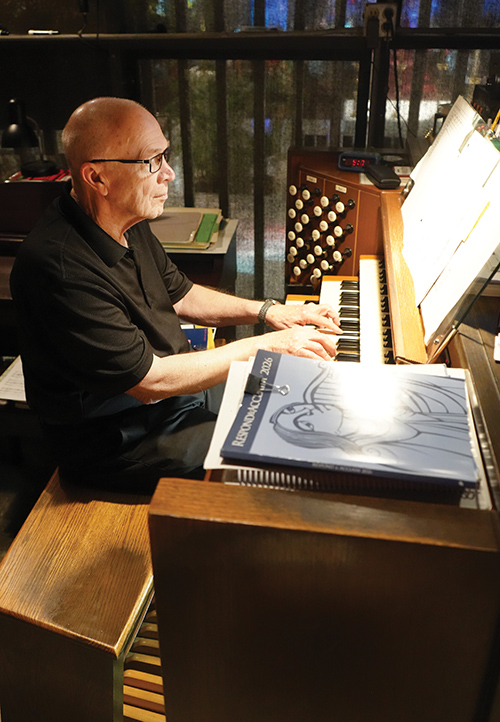
The Diocese of Lincoln marked the end of an era May 23: David Schmidt played the organ for the last time for our ordinations. For more than 40 years, Schmidt has been at the organ bench for ordinations, Chrism Masses, bishop installations, final professions, and every major celebration at the Cathedral. As he steps down from his role as principal organist at the Cathedral, it is a good time for us to consider what this role and this instrument really mean for the Church and the diocese.
The Second Vatican Council stated that the organ “adds a wonderful splendor to the Church’s ceremonies and powerfully lifts up man’s mind to God and to higher things” (Sacrosanctum Concilium, par. 120). Many of us have experienced that as we have worshipped at Cathedral. Practically speaking, pipe organs lend themselves to accompanying singing because they, like the human voice, use breath, or rather air, to create music as it flows through the pipes. An organist will accompany hymns best when he or she “breathes” – or breaks the sound – where the congregation needs to breathe between lines of the hymn.
Organs have soft flutes, triumphant trumpets, and so much more. We can all recall those softly uplifting moments with the organ playing at our own or loved one’s weddings and funerals, perhaps with the accompaniment of the “Ave Maria.” We have also heard the organ triumphantly ringing out “O God, Beyond All Praising” and other glorious hymns and music, especially at occasions like the celebration of ordinations. Perhaps you’ve felt the sound shaking you as all the stops are pulled (literally). The versatility of this instrument and the vast array of sounds make it especially suited to the many facets of the liturgy and the liturgical year, and it has been rightly referred to as “the king of instruments.”
You’ve seen pipes (although the those at Cathedral are hidden behind the screen), but just how does the pipe organ work? It starts with, of course, air. In older organs, air was manually pumped with bellows, but in modern organs it is pushed by electric blowers. The air pressure is maintained by valves inside a reservoir, and the regulated air fills the wind chests. Each pipe, like a giant whistle, waits for the stop to be opened, allowing air to flow to that rank of pipes, the key to be depressed, and the wind to enter; making that specific pitch. Pipes are made of wood, metal, or metal alloys, and some are constructed with reeds, like oboes or clarinets. The organist carefully selects what stops to pull, and thus what ranks to open, to combine different textures and sounds of the organ.
The pipes vary in height: the taller the pipe, the lower the sounding octave—at Cathedral, we have a 32-foot pipe only heard when we really want to shake the building! The smallest pipes are no wider than a pencil, and there’s every size in between. When you hear soft chords and one louder melody played in the organ, the organist is playing different manuals, the keyboards of the organ. The pipe organ at Cathedral has three manuals, so the organist can quickly switch individual hands or both hands to a different sound. The reeds, flutes, mixtures, trumpets, and all the mechanisms, all the parts of the organ, are also an example of creating “unity in diversity.”
The Cathedral pipe organ itself has been here since the church was completed, and it is a beautiful instrument, as many of us have personally experienced! Unfortunately, like anything else, time is hard on the instrument, and many parts of the organ are breaking due to age. All these parts – the metal, wood, leather, electronics and more – have to work together, and the diocese and parish will be seeking to repair this instrument before it is completely unusable.
The cost, while large, will ensure that our organ can continue to be the life breath of the music at our celebrations. It is hard to imagine worshipping at Cathedral without the beautiful voice of the organ, but it could be a very real possibility if these repairs are not undertaken soon.
It is also hard to imagine Cathedral’s organ without Schmidt at the organ bench. Working with him has taught me a great deal, and I am forever grateful for the wisdom and experience that he has shared with me. As Schmidt takes up the organ at St. Michael Parish in Lincoln to assist their growing music ministry, I am grateful to welcome our new organist to Cathedral: Justan Foster. He brings a wealth of knowledge and talent to continue the tradition of wonderful organ music that Schmidt has built here. Foster not only is a phenomenal organist, but he also has experience in overseeing the process of repairing a beautiful and beloved instrument such as our Cathedral pipe organ.
Foster echoes my own sentiments about our Cathedral organ: “The organ at the Cathedral of the Risen Christ is beautiful not only for its sound, but for the value and potential it holds in shaping the Church’s prayer. With its breadth of color and dynamic range, it is uniquely capable of leading the assembly in a purposeful, unified response of worship, supporting both the grandeur of solemn liturgy and the intimacy of quieter prayer. More than an instrument, the organ serves as a voice of the Church itself—able to sustain singing, elevate sacred texts, and invite participation. Its presence reminds us that sacred music is not performance, but prayer offered together.”
Thus, at the end of an era, a new one begins. We continue to journey together, to work together with our own unique talents and traits, and to create music that brings “unity in diversity,” that metaphor, as Pope Leo said, “for our shared journey of faith under the guidance of the Holy Spirit.”
