

Q. Why does the Church celebrate the birthday of John the Baptist?
A. There are three persons whose birth and death days we celebrate in our calendar: the first, of course, being Jesus Christ Himself (Christmas and Good Friday), the second, appropriately, being Mary (Sept. 8 as her birthday and Aug. 15, her Assumption into Heaven [whether she “died” or simply “slept” can be up for theological debate]); John the Baptist is the third (June 24 as his birthday and Aug. 29 as his martyrdom).
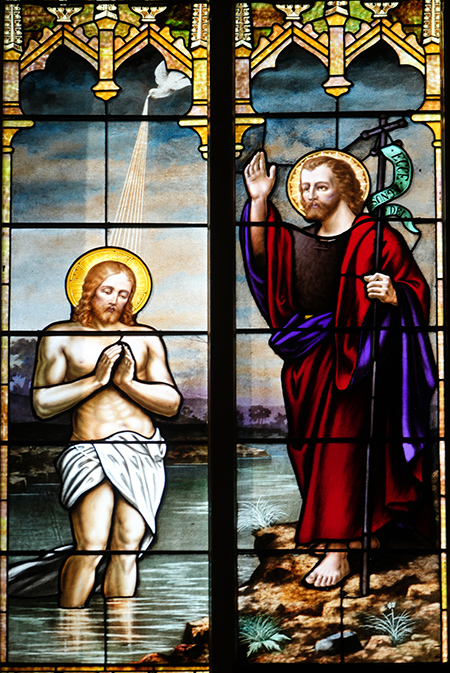
The fact that he is included in such high company should tell us of the importance of the forerunner of the Messiah. The Eastern Churches remember John with special solemnity. It would be good for us to similarly celebrate his special place in our own calendar as the one who “prepares the way of the Lord” (Mk 1:2).
John’s birthday as June 24 also bears special significance when considering the timeline of biblical events in the flurry of angelic messages brought to Mary and Zechariah in the Gospel of Luke. Zechariah, who became the father of John the Baptist, was a part of the priestly order of Abijah (Lk 1:5), which served in the Temple during the 10th priestly cycle (corresponding somewhere within May and June). It was during this cycle that the Angel Gabriel visited him to tell him he was to have a son (Lk 1:13). Once he finished his duties, he returned home to Ain Karem (a town near Jerusalem). The Gospel says, “After these days his wife Elizabeth conceived” (Lk 1:24). Who knows “after how many days” this was, but according to tradition, with John’s birthday being June 24, his conception would have occurred about three months after Zechariah’s return from the Temple (not bad work for a guy who has to convince his aging wife to try again for a child, not to mention the fact that he can’t use words since the angel Gabriel had struck him dumb!).
Six months later (cf. Lk 1:26), in March, Mary receives a vision from Gabriel and, by the power of the Holy Spirit, conceives the Christ. She immediately visits Elizabeth where she stays “for three months” (Lk 1:56) presumably until John is born (so she must have got to witness the drama of “His name is John!” in Lk 1:63). If Mary’s pregnancy began near the beginning of her three-month stay with Elizabeth, then her nine-month pregnancy would put the birth of Jesus six months after the birth of John, therefore, in late December (you know, right around Dec 25).
A beautiful pattern of cosmic significance is thus established by these birthdates. St. Augustine pointed out that St. John the Baptist’s birth occurs right around the summer solstice, when the light of day begins to grow shorter, while the birth of Christ occurs around the winter solstice, when the light of day begins to grow longer. It is as if, he noted, the entire cosmos is playing out over and over again John’s famous line, “He must increase; I must decrease” (Jn 3:30). So although St. John’s birthday is an all-too-soon reminder of the decreasing light of summer, may it be an even stronger testimony of the growing light of Christ in our world.
St. John the Baptist, pray for us!
This question was answered by Fr. Joseph Wahlmeier, pastor of St. Mary Parish in Davey and instructor at St. Gregory the Great Seminary in Seward.
Write to Ask the Register using our online form, or write to 3700 Sheridan Blvd., Suite 10, Lincoln NE 68506-6100. All questions are subject to editing. Editors decide which questions to publish. Personal questions cannot be answered. People with such questions are urged to take them to their nearest Catholic priest.
