

By Andrew Winter
1. Francis of Assisi was born in Italy in 1181 or 1182. His baptismal name was John, but he was called Francis because his father was away on a merchant trip to France when he was born.
2. Francis, a wild young man, was captured by the Perugian army after Assisi lost a battle to Perugia. He was imprisoned for a year, and after his release his slow conversion began. The final moment of his turning to Christ came when he met a leper on the road, gave him alms, and kissed him.
3. While praying in the Church of San Damiano, Christ told him, “Rebuild my church.” Francis began using his father’s own resources to repair the ruined San Damiano with his own hands. His irreligious father, in anger, imprisoned and beat him horribly, but finally Guido, the bishop of Assisi, arbitrated the dispute. When Francis’ father disinherited Francis, and Guido commanded Francis to return his father’s property, Francis took the very clothes from his back, handed them to his father, and renounced wealth forever.
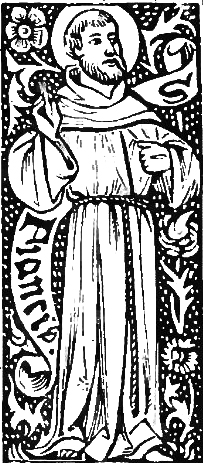
4. Francis became a sort of hermit without any property of his own. Admiring men began to follow him, and soon he had a community of brethren centered on the chapel of the Portiuncula, a gift from the Benedictines (which Francis had also rebuilt with his own hands).
5. St. Clare joined Francis in the quest for ultimate poverty, and with other holy women formed the Second Order of St. Francis, or the “Poor Clares.” Clare and Francis were lifelong friends.
6. As the order was beginning to prosper, Francis made three attempts to travel to Muslim territory and preach the Gospel. His first journey to Syria ended in shipwreck, and he had to stow away on a ship back to Italy.
His second journey ended in illness, but on the third he landed in Egypt with 12 friars. The crusaders told him he would surely be killed, but Francis, unafraid, marched straight into the Muslim camp and spoke with the sultan. Francis told Malek al-Kamil: “I am sent not by men but by the most high God, to show you and your people the way of salvation by announcing to you the truths of the gospel.” Francis did not convert the sultan, nor did he obtain the martyrdom he was seeking, but he certainly inspired Muslim and crusader alike.
7. Francis received the stigmata, or the wounds of Christ in his own body, in 1224.
8. Wracked by pain from his holy wounds and extremely ill, Francis composed the famous “Canticle of the Sun” and died in 1226.
9. Though Francis asked to be buried in a cemetery for criminals, the pope commanded that a basilica be built at the Colle dell’Inferno and Francis buried inside. Gregory IX, who had helped establish the Rule of St. Francis and had defended Francis in his poverty, canonized him in 1228, less than two years after his death.
