

By Andrew Winter
1. At a typical Mass in the Roman Catholic Church, the priest wears an amice—a rectangular white cloth covering his collar and shoulders, an alb—a white robe reaching to his ankles, a cincture, or rope belt, a stole, and a chasuble. Only the stole and the chasuble match the liturgical color of the day.
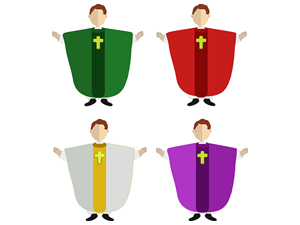
2. The main liturgical colors are: green, white, red, and violet. Green is worn for Sundays and regular weekdays of Ordinary Time; white is worn during the Easter and Christmas seasons, and on feast days; red is worn on Palm Sunday and Good Friday, when the Church remembers the Lord’s Passion, as well as on Pentecost, where it symbolizes the fire of the Holy Spirit, and on martyrs’ feast days; violet, the color of penance, is worn during Advent and Lent.
3. There are also two special liturgical colors: black and rose. Black is worn at funerals and other Masses for the dead (violet or white can also be worn). Rose is only used on “Gaudete Sunday,” the third Sunday of Advent, and “Laetare Sunday,” the fourth Sunday of Lent. Rose symbolizes the joy of the faithful at the approach of the Christ Child and the Risen Christ.
4. In very rare cases, the Catholic Church does use blue vestments. The churches of Spain are allowed to wear blue on the Feast of the Immaculate Conception (Dec. 8); some Marian shrines are also permitted blue for feast days; and the Anglican Ordinariate, a special church institution for former Anglicans who desire to become Catholic, also uses blue vestments on Marian feasts.
5. Apart from the normal vestments a priest wears at Mass, there are several other vestments used for special purposes: the cope is worn at exposition of the Eucharist, benediction, and other functions; the humeral veil is worn for benediction and Eucharistic processions; in the Traditional Latin Mass the priest wears a decorative handkerchief, or maniple, on his left arm, of the same color as the chasuble. Archbishops and the pope additionally wear a special woolen scarf adorned with six crosses, called a pallium. Although not properly a vestment, many priests and bishops also wear the fascia, or thick belt worn over the cassock to symbolize their celibacy.
6. There are several different colors of cassock worn by different ranks of the clergy. Priests wear black cassocks to represent poverty, while bishops wear magenta. Cardinals wear red cassocks to represent their willingness to shed their blood for Christ’s Church. The pope alone wears a white cassock to symbolize innocence and purity.
7. Bishops, archbishops, and the pope wear the miter, and underneath that a skullcap called the zucchetto. Bishops, archbishops, and cardinals wear scarlet zucchettos, while the pope wears his famous white one. At a regular Novus Ordo Mass the priest is bareheaded, but in the Traditional Latin Mass he wears a diamond-shaped hat with a tuft in the middle called a biretta.
8. Lay ministers often wear vestments when they assist at Mass and other liturgical functions. Altar servers usually wear the black cassock and white surplice, while acolytes wear albs. Choir members sometimes wear cassocks and surplices as well.
9. Each of the vestments a priest wears for Mass has an accompanying prayer which the priest traditionally says as he puts on the garment. The prayer for the chasuble is: “O Lord, who has said, ‘My yoke is sweet and My burden light,’ grant that I may so carry it as to merit Thy grace.”
