

By Andrew Winter
1.
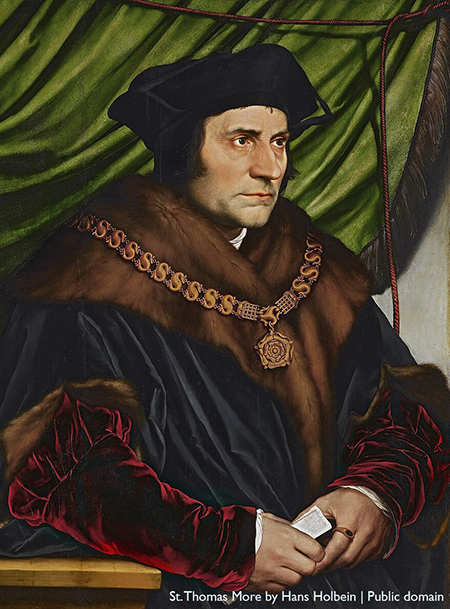
Born in 1478, Sir Thomas More led a respectable career as a statesman and judge. He served as speaker of the House of Commons as well as Lord Chancellor of England. He was also an excellent husband and father.
2.
Thomas married Jane Colt in 1505, and they had four children: Margaret, Elizabeth, Cecily and John. Shortly after Jane’s death, Thomas married the widow Alice Middleton, who never bore him any children. She outlived her martyr husband.
3.
King Henry VIII needed an heir, and so decided to divorce his wife Catherine, whose only son had died in infancy. He wanted to marry Anne Boleyn, and his lust sparked tension in the kingdom. Thomas refused to sanction this second marriage, supporting the judgment of the pope.
4.
But Thomas’ disagreement with the king did not hurt his career immediately. He was made chancellor of England in 1529 upon the death of Cardinal Wolsey, who fell out of the king’s favor when he failed to obtain a divorce from Rome.
5.
As the divorce and remarriage controversy escalated, Thomas resigned as chancellor. Finally, Henry passed the Act of Supremacy, which stated that he was Supreme Head of the Church of England, and therefore had the authority to grant himself a divorce. When Thomas refused to acknowledge the Act, he was imprisoned in the Tower of London.
6.
An eloquent man and a shrewd lawyer, Thomas stubbornly refused to share his objections to the Act. He knew that by law, if he did not openly say that he disapproved of the marriage, no court could condemn him. When the king passed another act, forcing the nobles and clergy of England to accept Anne Boleyn’s children as the heirs to the kingdom, Thomas refused to take the oath. He stood firmly on his silence.
7.
At Thomas’ trial, the court brought forward false witnesses and condemned Thomas to death for treason. He was beheaded in 1535. At the scaffold he said: “I die the King’s good servant, and God’s first.”
8.
Thomas wrote many great works of literature, including a history of Richard III, a commentary on the Lord’s Passion, a great number of poems, and of course his famous Utopia.
9.
Thomas’ training made him an extremely eloquent and witty speaker. Here are some of his best quotes:
“We may not look at our pleasure to go to heaven in featherbeds; it is not the way, for our Lord himself went thither with great pain and by many tribulations.”
Of his jail cell he said: “Is not this house as nigh heaven as my own?”
At his trial he said to the judges: “I verily trust, and shall therefore right heartily pray, that though your lordships have now here in earth been judges to my condemnation, we may yet hereafter in heaven merrily all meet together, to our everlasting salvation.”
And while mounting the stairs to his death he said to the guard: “I pray you, Master Lieutenant, see me safe up, and for my coming down, let me shift for myself.”
