

by Bishop James Conley
One of the great blessings of my priesthood was working for the Vatican Congregation for Bishops where I served from 1996-2006, before returning to my home diocese of Wichita, Kansas, where I was appointed pastor of a parish. Earlier in my priesthood I had been assigned to Rome for graduate studies in moral theology, but I never imagined that I would be back in Rome serving the Holy Father for 10 years.
The Congregation for Bishops assists the Holy Father in the naming of new bishops around the world. The officials in the Congregation were divided up by language and country. There were three of us in the English section and we followed all of the English-speaking countries in the world. I shared part of the United States, English-speaking Canada and Australia. In this capacity I was privileged to meet and interact with bishops throughout the world.
When I worked in Rome, I also served as chaplain at the University of Dallas’ Rome campus and was also an adjunct instructor of theology at Christendom College’s Rome campus. Immediately prior to working in Rome, I was chaplain of the Wichita State Newman Center, so a good part of my priesthood was spent ministering to college students. I treasure the great friendships that I made with college students during a time in their lives that is very formative. It was during my own college years that I converted to the Catholic Church and so I am always aware of the important decisions college students make and how much those decisions affect their future. It’s an exciting time of life.
After the November General Assembly of U.S. Bishops in Baltimore, I attended a reunion in Phoenix which brought together University of Dallas alumni who I had as students in Rome when they were undergrads. It was a great sign of hope in the Church to see these former students of mine living vibrant and thoroughly Catholic lives. We laughed at the fact that they are now at the same age as I was then when I served as their chaplain. Time is a mysterious thing.
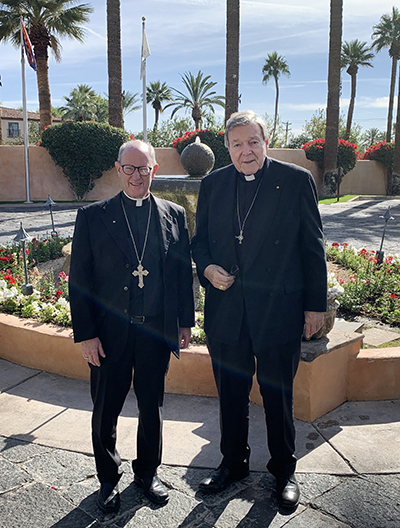 Much to my surprise, Cardinal George Pell, Archbishop Emeritus of Sydney, Australia, and Prefect Emeritus of the Vatican Secretariat for the Economy, happened to be in Phoenix visiting Bishop Thomas Olmsted at the same time. We concelebrated Mass together at a local Catholic school and then enjoyed a three-hour private lunch.
I have known Cardinal Pell for over 25 years, ever since I followed the Australian Desk at the Congregation for Bishops. He has always been like a father to me and true hero of the Catholic faith.
As many of you know, Cardinal Pell spent over a year in jail after being falsely accused of sexual abuse. Cardinal Pell was sentenced to six years in prison in March 2019. He appealed to the Victoria state Court of Appeals, and his conviction was upheld by a 2-1 vote. Cardinal Pell continued to proclaim his innocence unwaveringly, and he appealed his conviction to the High Court of Australia. The High Court’s seven judges unanimously agreed to dismiss all convictions and Cardinal Pell was released from prison.
Cardinal Pell shared with me his admiration for his fellow prisoners and the prison guards, and how kind they were to him and how open they were to the things of faith. He told me that in a very strange way, his time in prison was like an extended retreat. He was in solitary confinement 23 hours a day. He told me that the food was good, but way too starchy, and the portions were more than he could eat.
Cardinal Pell told me that it was his faith that got him through his ordeal, particularly the creed that all Catholics profess every Sunday. Every word of the creed, he said, is filled with meaning. He said his time in jail was both a gift and a grace, but he regretted that it ever happened and he would never choose to undergo such an experience. This chance meeting with my old friend, Cardinal Pell, was truly one of the highlights of my entire life. For, just a few years ago, I never thought I would see him again.
Cardinal Pell is 80 years old and he was prepared to spend six years of his life in anticipation of one day being a free man. He was longing for that day when he would once again be a free man.
Cardinal Pell didn’t waste this time that God gave him in prison. Being wrongly convicted he could have easily turned to anger toward God, self-pity, despair, and harboring grudges. What is truly heroic about Cardinal Pell is that he placed all resentment aside and put this time in prison to good use.
In an article for First Things journal, he wrote about his incarceration, “For many, time in prison is an opportunity to ponder and confront basic truths. Prison life removed any excuse that I was too busy to pray, and my regular schedule of prayer sustained me.”
Cardinal Pell went on to say, “my Catholic faith sustained me, especially the understanding that my suffering need not be pointless but could be united with Christ Our Lord’s. I never felt abandoned, knowing that the Lord was with me—even as I didn’t understand what he was doing for most of the thirteen months. For many years, I had told the suffering and disturbed that the Son of God, too, had trials on this earth, and now I, myself, was consoled by this fact. So, I prayed for friends and foes, for my supporters and my family, for the victims of sexual abuse, and for my fellow prisoners and the warders.”
The ordeal that Cardinal Pell endured serves as a reflection for all of us during this liturgical season of Advent. Advent is a season of hope. Hope is the desire for God and heaven above everything else, but it also includes letting everything go and putting our trust in God and not in ourselves as we live as his disciples.
Trust in the Lord is tested amidst trials. Maybe that is why we often grow in closeness to the Lord the most during times of trial, pain, suffering, and even in enduring injustice. Trials strengthen the muscle of our trust in God.
None of us would ever want to go through what Cardinal Pell endured in being incarcerated for a crime we did not commit. We take some solace in the fact that our longed-for redeemer, Jesus, saved us through an unjust conviction which led him to the cross. As Catholics we believe that all sufferings, including any injustices we may face, may be united to the sufferings of the wrongfully convicted savior of the world.
