

by Bishop James Conley
On Sept. 8 we celebrate the birthday of the Blessed Virgin Mary and one of the most ancient of all the feast days of Mary.
History teaches us that this feast originated in connection with the dedication of the church of St. Ann in Jerusalem in the 6th century. This ancient church, dedicated to the mother of Mary, was built over the house where Saints Joachim and Ann, the parents of Mary, lived. And this is the most likely place where Mary was born and grew up as a child.
This church is located within a two-minute walk to the site of the ancient Temple in Jerusalem. One can easily imagine Joachim and Ann taking their young daughter to the Temple for worship. The thing I remember most about visiting this stone church is the acoustics. Choirs love to sing in this church because it is so conducive to song.
We know that artists and sculptors down through the ages have been fascinated with the beauty and mystery of the Blessed Virgin Mary. The figure of the Madonna, derived from the Italian, ma donna or “my lady,” is easily the most recognizable, and the most frequently produced image in the history of art.
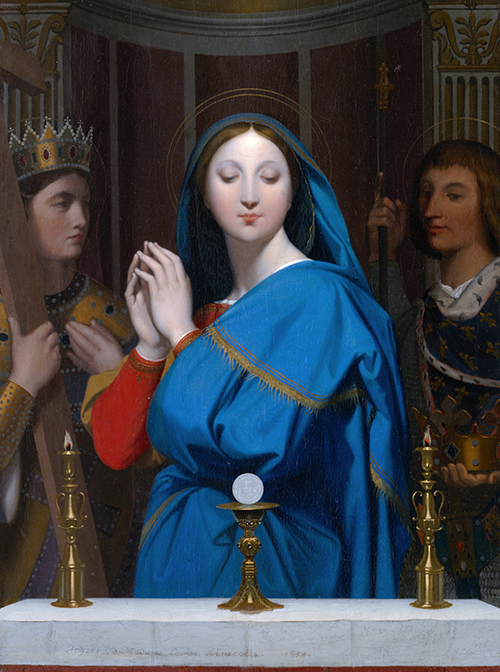 A favorite Marian image of mine is entitled, “The Virgin Adoring the Host.” The original 1852 oil-on-canvas painting by the 19th century French artist Jean Auguste Dominique Ingres can be found in the Metropolitan Museum of Art in New York City (see image).
This unusual and captivating image of Mary is particularly significant for us today because we have just entered the second year – what we are calling the “parish phase” – of a three-year National Eucharistic Revival. Ingres’ painting of Mary casts her eyes downwards, in a peaceful and devout gaze at the Sacred Host, which is suspended on a paten, covering a chalice which rests on an altar. Mary’s look draws our attention to the Holy Eucharist, the real presence of Jesus Christ, body, blood, soul and divinity, the Word made flesh in the Sacred Host. It’s as if Mary is beckoning us to adore her son, Jesus, and to gaze with her on the Sacred Host.
Gazing on the Lord in Eucharistic adoration in silence is a powerful way to revive our own love, understanding, and gratitude for the gift of Jesus, in the Holy Eucharist, engendering in us a true sacramental imagination.
I am happy to report that our diocesan Eucharistic Passport Pilgrimage initiative that was launched last month, is generating a lot of interest around the diocese. I have heard from two individuals who have already nearly completed their pilgrimage to all 17 Eucharistic sites. One of these persons told me that in addition to spending time in prayer at the various sites, they were struck by the beauty of the chapels and the vastness of the Nebraska landscape as they visited the locations, some of which they had never visited before.
Some have asked me what the difference is between Eucharistic Adoration with the Blessed Sacrament exposed in a monstrance on the altar, and making a visit to a church and spending time in prayer before Jesus in a closed tabernacle. Both, of course, are laudable and beneficial spiritual exercises. When I was teaching elementary children as a young priest, I used to explain it this way: imagine if you lived in Nazareth back in the time of Jesus and you walked by his house. You would probably think to yourself, “there is where my friend Jesus lives.”
But what if you walked by and Jesus was standing out on the front porch, wouldn’t that be different? Wouldn’t you be moved to stop, and say hello, and perhaps spend some extra time with him? I know this is probably not a very good theological argument for exposition and adoration of the Holy Eucharist, but it always resonated with the school kids.
When we adore Jesus in the Holy Eucharist, we adore God, who is love. And because we can see the Sacred Host, under the appearance of simple bread, we are looking at love made visible. We are reminded that God came down from heaven and was made flesh in the womb of the virgin. He lived, suffered, and died for us, and rose from the dead on the third day, in order to lead us to heaven.
As we grow in an ever deeper sacramental imagination, we begin to see everything through lens of the Incarnation. We even begin to see ourselves through the mirror of the Incarnation. As St. John Paul II would so often say, “Jesus Christ is the answer to the question that is every human life.” The incarnation grounds us in a true Christian anthropology and even reveals us to ourselves, in our full identity as beloved sons and daughters of the Father and true brothers and sisters of Jesus.
Gazing on Mary, who is gazing on Jesus, helps us to see Jesus as the center of everything. As we look upon the humble and demure face of Ingres’ virgin, we see the Blessed Mother caught up in the love and adoration of her son Jesus, the Eucharistic Lord, the “source and summit of our Catholic faith.”
In her gaze, she embodies truth, goodness, and beauty. Mary is also the Seat of Wisdom and the model of faith. She embodies docility to the Holy Spirit, in Trinitarian love. Let us follow her example and gaze upon Jesus so that we too can see him as the center of everything.
