

By Bishop James Conley
Still basking in the Easter joy of the Resurrection of Jesus Christ, we woke up Monday morning to the sad news of the death of our Holy Father, Pope Francis. While mindful of his advanced age and his recent six-week stay in the hospital, the news still came as a shock to me.
Particularly given the fact that the pope made a public appearance on Easter Sunday in St. Peter’s Square in the popemobile, and even met briefly with Vice President JD Vance.
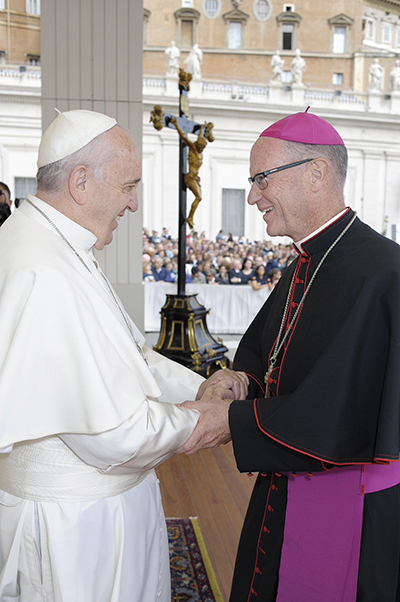
As a bishop, I am required to meet with the pope at least once every five years for what’s known as an “ad limina” visit, which means “to the threshold” of the doors of the Vatican. I have had the privilege of meeting Pope Francis personally on two other occasions, once in 2013 shortly after his election as the 265th successor of St. Peter after an ordinary Wednesday General Audience in St. Peter’s Square, and a second time during his one-and-only visit to the United States in 2015 for the World Meeting of the Family in Philadelphia. It was on these occasions that I had the opportunity to see Pope Francis’ humility, kindness, conviction and joy up close.
In these days following his passing, experts inside and outside the Catholic Church will begin to dissect his decisions, his accomplishments and his legacy. There will be those in the upcoming days who will pass judgment on his years as Supreme Pontiff. There will be plenty of time to assess and learn from Pope Francis’ papacy, but for now, I would ask you to join me in prayer, as we reflect on his efforts to bring us all closer to Christ.
His humility was apparent from the very beginning when he was announced as the next pope succeeding Pope Benedict XVI. He chose the name “Francis” after St. Francis of Assisi, signaling the simplicity and mercy that would highlight his years in the Vatican. He urged clergy to “smell like the sheep,” encouraging them to walk with the people and seek out those who society may neglect and who may need them the most.
Reaching out to those on the peripheries of life would become a hallmark of Pope Francis’ life. He encouraged the Church to fix her gaze and her efforts to address the needs of the poor, the sick, the hungry and the forgotten. He showed us how to do that by washing the feet of prison inmates, sharing the struggles of migrants, embracing the disfigured, and championing the cause of those impacted by war. He spoke hard truths at times, pushing us to look into the eyes of every single person, to see their hurt and to welcome them to the doors of our Church.
His defense of life at every stage of development extended from the unborn to the elderly and terminally ill. He pronounced his opposition to abortion, decrying the “throwaway culture” that discards those deemed inconvenient or somehow not worthy of existence. He once compared abortion to “hiring a hitman” to solve a problem, and challenged countries which try to justify the killing of the unborn. His compassion reached out to women experiencing crisis pregnancies, while always defending the rights of babies in the womb.
His views on the dignity of all human life included a strong opposition to euthanasia and assisted suicide. He was also a great proponent of traditional marriage between one man and one woman, and the importance of the family, knowing that all culture passes through the family. While urging people to have a listening heart for those who struggle with gender identity or same-sex attraction, he consistently opposed gender ideology and a distorted understanding of marriage.
Pope Francis’ first apostolic exhortation, The Joy of the Gospel, was centered on evangelization. Even during his time as the Archbishop of Buenos Aires, he had a heart for evangelization, having been one of the main architects of the famous 2007 Aparecida Document on the theme of missionary discipleship, relating the Gospel and the teachings of Christ to the economic and social problems of Latin America. Pope Francis consistently urged us to evangelize our neighbors and to become missionary disciples.
He also called us to be good stewards of our environment, to uphold economic justice and to work for a world that values peace over the tragedy of war. He worked to challenge corruption within the Church herself. His implementation of the Synod on Synodality urged us to listen to one another in a spirit of true collaboration as we search for solutions and move forward as a Church.
Pope Francis’ mission was one that should resonate with all of us: share the love and joy of Jesus Christ and our Catholic Church with the world – and that means everyone, everywhere. In the days ahead, pray for him and for his soul, and pray for our Church. Pray the Holy Spirit may guide the discernment that will take place to determine the 266th successor of St. Peter as the next disciple is chosen to lead the Catholic Church here on earth.
Perhaps the best way we can acknowledge the spiritual contributions Pope Francis has made to our Church is to live out his mission. Let us reach out to those who our society excludes. Let us defend the dignity of human life from conception to natural death. And let us bring Jesus Christ to all, starting with those closest to us.
May God welcome you into His arms and may you rest in peace, Pope Francis.
