

By Bishop James Conley
As I mentioned in my last column, due to an unexpected flight cancellation on the way back from our pilgrimage to the Holy Land, I was able to reroute my return ticket through Rome. I made it there in time to attend the last two days of the Jubilee of the World of Education and the proclamation of Saint John Henry Newman as the 38th Doctor of the Church and Co-patron of Catholic Education, along with St. Thomas Aquinas.
After celebrating Holy Mass in Jerusalem at 12:30 a.m. on Friday, Oct. 31, our pilgrim group of the Equestrian Order of the Holy Sepulchre boarded the tour bus for the Tel Aviv airport. The flight back to the states was scheduled to depart at 6:20 a.m., but because of the tight security at the Israeli airport, we had to arrive at least three hours in advance. My flight to Rome departed just 10 minutes after our pilgrim group’s departure, so I was able to say farewell to my fellow pilgrims before boarding my separate flight.
I arrived at Fiumicino airport in Rome at 8:40 a.m., after gaining an hour due to the time change. I hopped a taxi to the Casa Santa Maria, the graduate house of the North American College, where one of our diocesan priests, Father Andrew Schwenka, met me at the door. Father Schwenka is working on his doctoral dissertation in philosophy at the Pontifical University of St. Thomas (Angelicum). I quickly changed out of my clerics and into my cassock and headed down to St. Peter’s Square, arriving about 15 minutes before the popemobile made its entry into Saint Peter’s Square.
After making its rounds through the square to the cheering crowds, the popemobile drove up to the canopy and Pope Leo XIV stepped out of the vehicle. The occasion was a gathering of 15,000 Catholic school teachers and students from all over the world who were assembled in St. Peter’s Square for the Jubilee of the World of Education. Pope Leo then delivered a beautiful reflection on his own experience as a teacher at various educational institutions of the Order of St. Augustine in Rome and Peru.
Pope Leo’s reflection in Italian highlighted four key aspects of teaching, according to writings of St. Augustine: interiority, unity, love and joy. Regarding interiority, the Holy Father quoted St. Augustine who said that “the sound of our words strikes the ears, the Master is within.” Pope Leo explained that teaching is a form of friendship between teacher and student, “a profound encounter between people, without which any educational endeavor is doomed to fail.” He went on to explain that “we live in a world dominated by technological screens and filters that are often superficial, whereas students need help to get in touch with their inner selves. And not only them, but educators too, who are often tired and overburdened with bureaucratic tasks, and really run the risk of forgetting what Saint John Henry Newman summed up in the expression: cor ad cor loquitur (‘heart speaks to heart’) and what St. Augustine wrote: ‘Do not look without, return to yourself, for truth dwells within you’” (De Vera Religione, 39, 72).
Pope Leo spoke of unity, quoting his own motto: In illo uno unum (in the One we are one), explaining that “only in Christ do we truly find unity: as members united to the Head and as companions on the journey of continuous learning in life.”
Regarding love, Pope Leo said that “sharing knowledge is not enough for teaching: love is needed. Only then will knowledge be beneficial to those who receive it, in itself and above all, for the charity it conveys… Teaching should never be separated from love.”
The Holy Father’s last point spoke of the importance of joy in teaching. He said that “true teachers educate with a smile, and their goal is to awaken smiles in the depths of their students’ souls.” He went on to warn that “Artificial Intelligence, in particular, with its technical, cold and standardized knowledge, can further cut off students who are already isolated, giving them the illusion that they do not need others or, worse still, feeling that they are not worthy of them.” Pope Leo then pointed out that “the role of educators, on the other hand, is a human endeavor; and the very joy of the educational process is a fully human engagement, a ‘flame to melt our souls together, and out of many make one’” (Saint Augustine, Confessions IV, 8,13).
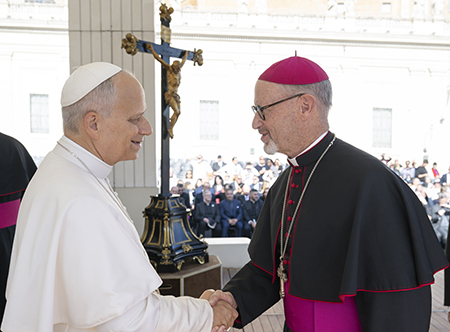
At the end of his reflection, his master of ceremonies motioned to the 30 or so bishops who were seated on the side to come forward to meet the Holy Father. While I knew that this was a possibility, I was surprised nonetheless! As I made my way up to the place where the Holy Father was standing I knew I had to keep my words brief. When it came my turn, I told Pope Leo that I was the Bishop of Lincoln, Nebraska, and I bring greetings from the faithful there. Unlike meeting previous popes, I didn’t have to tell him where Nebraska was!
Secondly, I told Pope Leo that I was a convert to the Catholic faith and that Saint John Henry Newman was a huge influence on my conversion and my vocation to the priesthood. Nodding his head as I spoke, I concluded by telling him that I even stole Cardinal Newman’s motto as my own episcopal motto! At this, he tilted his head back and let out little laugh as I shook his hand. It’s hard to explain how personally endearing it was to be able to speak to a Successor of St. Peter in our own mutual native tongue.
The next day was All Saints Day and the Mass for Saint John Henry Newman, at which I had the privilege to concelebrate. Later on that evening, I was able to take out to dinner Father Schwenka, Father Rafael Rodriquez, who is concluding a study sabbatical in Rome, Sr. Fiat Marie, CK, and Sr. Peter Marie, CK, both Lincoln School Sisters of Christ the King who are doing a study year in Rome, and a family from St. Joseph Parish in Lincoln: Luke and Shannon Hicks and their 4-year-old son Matthew.
I returned to Lincoln the next day, All Souls Day, grateful to God for his goodness and love, and for his divine providence in my life.
