by Bob Sullivan
My Sept. 8 column, “Catholic men: be honest,” created a little discussion with a few of my friends. As a result of those discussions, I thought I would continue the topic this week.
One friend (we’ll call him Frank) argued that vulnerability is a healthy and important quality for all Christians. He defined it as opening oneself up emotionally and exposing one’s feelings, fears, and weaknesses, which can imply a willingness to be open to others, to admit mistakes, and to seek help when needed. While vulnerability is not explicitly discussed in Catholic teaching, it aligns with certain values within the faith, such as humility, contrition, and the acknowledgment of one’s dependence on God. In the context of the Catholic faith, vulnerability might be seen as a form of spiritual openness and receptivity to God’s grace.
Frank distinguished honesty from vulnerability by explaining that honesty is a moral and ethical virtue which is emphasized in Catholic teaching which includes telling the truth, being sincere, and living with integrity. He further explained that honesty is explicitly linked to the Eighth Commandment, “You shall not bear false witness against your neighbor,” and is a fundamental aspect of living a virtuous life, according to Catholic moral theology.
He then discussed where the two concepts can intersect in meaningful ways. He said honesty can require vulnerability, especially when one has made mistakes or is confessing sins in the Sacrament of Reconciliation. In this context, being honest and vulnerable are intertwined, as individuals are encouraged to confess their sins honestly and with a contrite heart.
Frank concluded that, while vulnerability and honesty are not synonymous in Catholic teaching, both have their places in the faith and life of a Catholic man. Vulnerability can be a form of openness and receptivity to God’s grace, while honesty is a moral virtue central to living a virtuous life in accordance with Catholic doctrine. Both qualities can contribute to the spiritual and personal growth of Catholic men.
I agree with all of that.
However, I would still avoid using the world “vulnerable” when discussing the faith with men. In most settings, we use the word “vulnerable” when we talk about protecting vulnerable adults or the need to protect children from harm until they are no longer vulnerable due to their naivety and/or size, mental capacity, and strength. Then there is the sense that you don’t want your country to be vulnerable to attack by hostile forces. Nor do you want to leave yourself or your family vulnerable to harm from robbers, thugs, or con artists (or worse). This is all consistent with definitions of the word vulnerable found in old dictionaries I have on my bookshelf. These definitions all begin with susceptibility to being attacked and harmed. This is how many men think of vulnerability.
A different friend of mine (we’ll call him Ralph) said men need to portray a certain level of courage, even when internally, they are concerned or even fearful. It reminds me of an old quote from a motivational speaker: “Courage is being scared to death, and saddling up anyway.” Okay, so that isn’t a quote from a motivational speaker, it is a quote from John Wayne. Even if he was never actually in a cavalry, the quote serves well here.
Ralph also agrees with the concepts explained by Frank, but he firmly believes that the use of the word “vulnerable” can easily lead a man with a poorly formed conscience and/or an inadequately informed, or an immature faith, to slide into an effeminate faith.
In Ephesians 6:12, St. Paul tells us, “our struggle is not against enemies of blood and flesh, but against the rulers, against the authorities, against the cosmic powers of this present darkness, against the spiritual forces of evil in the heavenly places.”
Ralph said having a wife and children makes the idea of being “vulnerable” wholly unappealing to him. Even when speaking of our conversations with God, our spouse, our confessor and others in our lives who we trust and upon whom we depend, there are other words which are less prone to misinterpretation and negative connotations. We can even use the expanded description of “vulnerable” such as openness, and a willingness to seek help. This approach is much more likely to reach men in a way which they understand and appreciate.
This is all the more important due to a cultural slide toward an emotional approach to life. If anyone is prone to an emotional reaction to stressors and a less intellectual assessment before dealing with stressors, emphasizing the good qualities of vulnerability instead of simply throwing the word “vulnerable” out there will promote growth in faith instead of feminizing the faith for men. Also, telling someone with an already effeminate faith to be vulnerable is like telling a shy or timid person to be quiet. They are more than happy to oblige, even if remaining silent is not in their best interest.
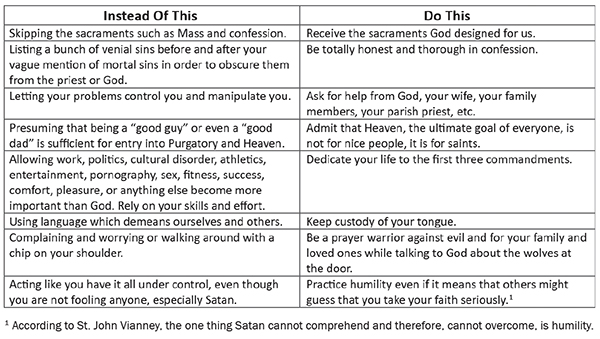
Instead of coaching men to be vulnerable, we need to focus on the things men should do and the things men should avoid. Frank and Ralph would likely both agree on the chart below.