

by Katie Patrick
Malémbe, Malémbe. Slowly, Slowly.
When I moved to the Democratic Republic of Congo in October 2010, these were the words I heard from the local Congolese most frequently. I had just finished graduate school at Seton Hall University in New Jersey where I spent a fair amount of time commuting to internships in Newark and New York City. Life was hectic, complicated, and tiresome. Even when you’re not in a rush, you’re hurrying to catch a train, a taxi or a bus.
The energy and atmosphere of the East Coast is demanding. What I remember most vividly are the times I stood at Penn Station in Manhattan staring at the TV screens waiting for the track to be announced so I could go home. On these occasions, I would find myself thinking, What on earth am I doing? Standing around with hundreds of people just staring at a TV screen. But those thoughts never lasted long because as soon as the track number for my train home to South Orange appeared on the screen, I was off just like hundreds of others racing to our trains. 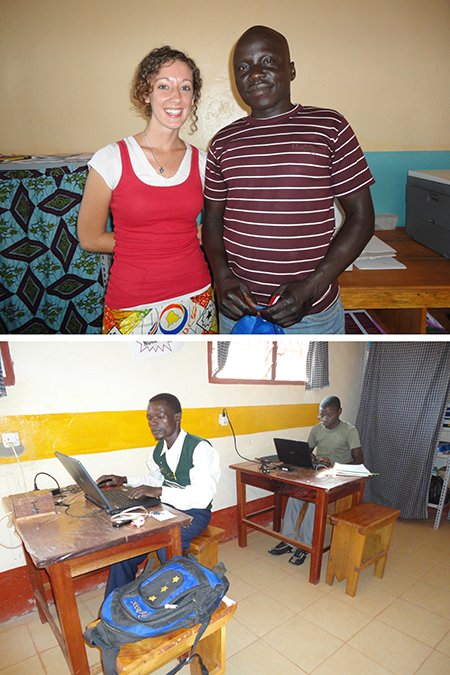
You can imagine the culture shock when I arrived in a small village in northeastern Congo. There were no trains. The only taxis were motorcycle drivers and the buses were infrequent. Occasionally, when a bus would drive down the main road they would leave a thick haze of grainy, red dust in the air. I walked everywhere. To the market. To church. And to my work at the school, bakery, and internet café. This is where I was introduced to the phrase malémbe, malémbe.
In Congo, I lived in a community with volunteers from all over the world. We served alongside the Canossian Daughters of Charity who had been living and working in the Congo since at least the 1950s. One of my responsibilities was to help Sister Alba at the internet café.
There I helped local Congolese men and women open Gmail, Yahoo, and Facebook accounts, type Word documents, and translate letters from French into English for men doing business in neighboring Uganda. I would hardly consider myself part of the “Geek Squad,” but in a place where computers and the internet were still so new, I was the best fit for the job.
But like I said, having just moved from New Jersey, the transition was rough. The East Coast was in my blood and I was impatient. I would get so frustrated when the internet dropped—and it dropped a lot—that is, if we could get a signal in the first place. I honestly don’t know if I spent more time working and assisting clients, OR watching that silly little blue circle in the center of the screen spin when the internet froze.
I can still remember those few Congolese clients who, having noticed how frustrated or impatient I was, said: Katie ça va, malémbe, malémbe. “It’s okay just, be calm.”
Eventually, I learned. Then, what I started to experience in those moments of frustration was community, connection—an encounter. I learned more about our clients and about their families, their work, and their dreams for the future. I learned about Congo and the people, their language, and their culture.
So often in life—especially at work, and even in social services when we are here to serve because we love helping people—we are too preoccupied by what needs to get done by the emails and newsletters piling up in our inbox. We are distracted from the present by thinking about the future. We don’t take time to listen to someone after we ask them a question. We all—myself included—need to be better about this. We need to be better about living in the present.
After coming out of more than a year of COVID restrictions, CSS is reopening its doors to the public. We have spent the last several months thinking about the future which is now present. We’re ready to reopen and resume our lives, not planning for it, but living it. We are inviting our clients back inside not just to collect the goods and services we provide but we are inviting them—and ourselves—to an encounter. For is it not in our brothers and sisters that we see the face of Christ? So let us all take time to be more present with one another. Who knows what we may learn or how we may grow.
Malémbe, Malémbe. May God Bless You!
