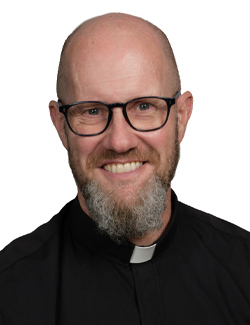
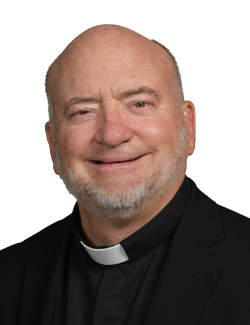
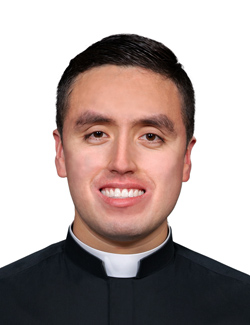
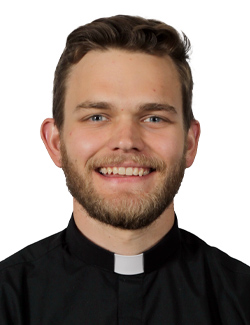
By Fr. Kenneth Hoesing Pastor of St. Joseph Parish in Harvard, Hispanic Ministry
A few weeks after I arrived at my current assignment almost two years ago, I had the opportunity to perform a baptism—a triple baptism nonetheless—for a family in my parish. This family’s roots are in Mexico. The parents were born in Mexico, but came to the United States when they were young children.
After the baptisms were done, there was a celebration at the home of the paternal grandparents of the baptized. This was a big celebration. The great-grandmother of the baptized came in from Mexico. Many generations of the family were present. Needless to say, there were a lot of people there. Tables were set up in the garage, and outside the garage to accommodate the crowd.
By Fr. Bernard Lorenz Western Diocesan Hispanic Ministry and Spiritual Advisor of the Lincoln Diocese Cursillo Movement, in residence in McCook
The horses ran
Last December, 23 cowboys and girls rode their horses into Wellfleet to celebrate the feast of the Blessed Mother Mary, Our Virgin of Guadalupe (Dec. 12). This was the third year of this beautiful tradition of joy. It incorporates the blessing of the riders’ horses into the prayer of thanksgiving to God for the gift of His mother Mary to all of us.
These men and women, almost all Mexicans, love their hard work and their horses and their Catholic faith. They love to love it all together in a sincere act of devotion. Many of the English-speaking parishioners attended with great joy. All are welcomed. After the blessings of the men and women and their horses—who ran to love Jesus in the church with His Mother Mary—all enjoyed the Holy Mass and a great potluck meal afterward.
As a priest only in his second year of priesthood, I am frequently experiencing new things, like unique situations when administering the sacraments and different pastoral encounters. But as 2025 comes to a close, I have realized that it was a distinctive liturgical year that priests ordained after 2014 have also not experienced.
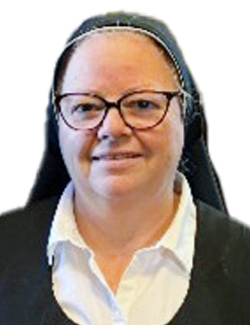
Sister Clareth, of the Passionist Sisters from Mexico, is from Costa Rica and serves the Hispanic Community at St. Cecilia Parish in Hastings, with Sister Beatriz Guzman from Mexico
At St. Cecilia Church in Hastings, during October, the month of the Rosary and of the Missions, families gather every day in different homes to pray the Rosary. Each family who hosts also invites their neighbors to their home to pray the Rosary and share a meal. Not only do the nuns participate, but there are also lay collaborators who help us in this parish mission. The month of missions culminates with a Holy Hour and a shared meal at the parish.
By Fr. Scott Nemec Assistant pastor, St. John the Apostle, Lincoln Hispanic Ministry
The home altar is set with flowers and candles, all the chairs in the house line the living room, and the kitchen is filled with the sweet aroma of Mexican food. It’s time to welcome the Blessed Virgin Mary and her pilgrims into the home!
In Hastings, each evening in the month of May, the month of the Blessed Virgin Mary, a family signed up to host the rosary and a meal at their home. The host families each night invited extended family members and friends from the Hispanic community, usually filling their homes with 10 or more guests. As everyone enters, they are welcomed with warmth and kindness: “es su casa.”
By Fr. Christopher Stoley Sacred Heart Church, Crete Hispanic Ministry
I’ve read a few different studies that have made two claims: first, that when an English speaker is learning a new language, his or her voice will get higher when speaking that language, and that a non-English speaker learning English will have the opposite effect (his voice will get lower speaking English); and second, that when one learns a new language his personality will change, based on what language one is speaking.
By Fr. Christopher Stoley Sacred Heart Church, Crete Hispanic Ministry
One of the most frustrating things I experience in Hispanic ministry is the language barrier. Even though I have more or less gained a mastery over Spanish, the barrier remains, and can impede ministry to people with real needs.
As a priest, I have felt rather useless on a number of occasions, simply because something gets lost in translation, and it can be difficult to meet the people where they are and provide assistance. My Spanish is fine, but throw in accents, stresses, and people whose main language is a Mayan or Aztec dialect, and communication can become an arduous task.
With time, however, I had to come to believe that language difficulties don’t truly matter. In the first place, most of my people are just excited that I am trying — they don’t care how good or bad the Spanish is, they care that it matters enough to me to try. But secondly, they want a pastor who will show up. I had to learn both of these lessons the hard way, especially the latter, as it often involves tragedy or crisis. Three memories come to mind that illustrate this point, which I will briefly describe.
By Deacon Santiago Izquierdo On behalf of Hispanic Ministry
“The priesthood of Christ was different from that of all pagan priests and from the Levitical priesthood of the family of Aaron. In the Old Testament and in pagan religions, the priest and the victim were distinct and separate. In Our Lord, they were united inseparably.”
With these words, Venerable Fulton Sheen opened his wonderful book, “The Priest Is Not His Own,” in which he examines the priesthood. One of his main points that has stuck with me after reading the book is the importance of the sacrificial nature of the priesthood of Jesus Christ.